1980
Issue 1 1980
Main Cover

<FONT COLOR='#ff0000'>Star Trek - The Motion Picture: Into the V'ger Maw with Douglas Trumbull</FONT>: With only nine months remaining before its world premiere, Douglas Trumbull stepped in as director of special effects for Star Trek - The Motion Picture. Five hundred effects shots later, the multimillion dollar space epic was completed - on schedule. Trumbull discusses with candor the organizational and technical shortcomings which led to the dismissal of the original effects unit, and his own subsequent efforts to salvage the beleaguered production. In addition to his personal redesign of the effects sequences, Trumbull details the extensive research and development effort, the crushing workload, and the specific techniques employed in achieving many of Star Trek's most spectacular moments. Interview by Don Shay<BR>
<FONT COLOR='#ff0000'>Alien: Creating an Alien Ambience</FONT>: As had no other film before, Alien was utterly successful in attaining a convincing depiction of alien lifeforms, artifacts and environs. Conceived first in the mind of screenwriter Dan O'Bannon, and then translated into visual terms by surrealist painter H.R. Giger, Alien was not only a consummate shocker, but also a work of great aesthetic virtuosity. Particularly demanding was the alien polymorph - from its earliest forms constructed by Roger Dicken to the full-size monstrosity sculpted by H.R.Giger and activated by Carlo Rambaldi. Equally of note were the complex otherworld sets built under the supervision of production designer Michael Seymour, and the extensive special effects engineered by Brian Johnson and Nick Allder. These and other craftsmen discuss in detail the collaborative effort behind Alien's pervasive atmosphere of eerie realism. Article by Don Shay
Issue 2 1980
Main Cover
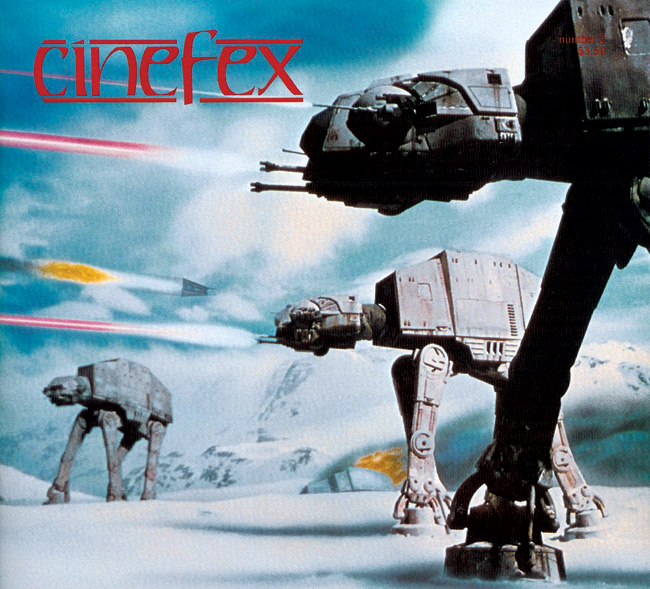
<FONT COLOR='#ff0000'>The Empire Strikes Back: Of Ice Planets, Bog Planets and Cities in the Sky</FONT>: As special effects supervisor for The Empire Strikes Back, Richard Edlund was responsible for reestablishing the Star Wars effects facility and presiding over the production of some four hundred optical effects shots. A seasoned veteran of the original Lucasfilm epic, Edlund discusses how three years of advancing technology, coupled with a top notch technical crew enabled Industrial Light & Magic to segue into an even more complex project - and with better results ... Article by Don Shay<BR>
<FONT COLOR='#ff0000'>Greg Jein - Miniature Giant</FONT>: From less than auspicious beginnings sculpting spacecraft models for porno parodies and student films, two-time Oscar nominee Greg Jein has become - in five years - one of the giants in the field of movie miniatures. In addition to detailing his early work, accounts are provided of his landscapes and mothership for Close Encounters of the Third Kind, the remarkable detailed settings of 1941, the V'ger interior and spacewalks props for Star Trek - The Motion Picture, and the add-on work for Close Encounters reissue. Article by Brad Munson <BR>
<FONT COLOR='#ff0000'>Star Trek - The Motion Picture: Star Trekking at Apogee with John Dykstra</FONT>: Approximately one third of the optical work in Star Trek - The Motion Picture was produced under the supervision of John Dykstra at his Apogee effects facility. Covering Apogee's involvement from stem to stern, Dykstra discusses in detail the Klingon and Epsilon 9 sequences and the exterior V'ger passage. He further elaborates on Apogee's approach to the digitization and energy probe effects, as well as some old standards such as the transporter beams and photon torpedos. Article by Don Shay
Issue 3 1980
Main Cover
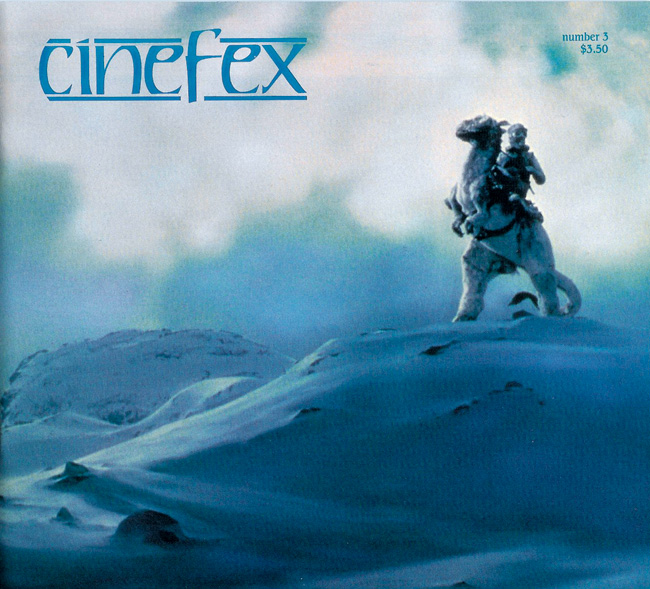
<FONT COLOR='#ff0000'>The Empire Strikes Back: Tauntauns, Walkers and Probots</FONT>: Employing a variety of techniques, ranging from vintage Willis O'brien-type steps to modern motion control technology, the special effects wizards at Industrial Light & Magic produced a dazzling array of stop motion wonders for The Empire Strikes Back. Effects director of photography Dennis Muren, stop motion animator Phil Tippett, art director Joe Johnston and other key members of the ILM effects unit discuss the complex animation sequences from start to finish. Article by Paul Mandell<BR>
<FONT COLOR='#ff0000'>Walter Murch - Making Beaches Out of Grains of Sand</FONT>: Some of the most significant recent developments in motion pictures involve not what is seen, but rather what is heard. Academy Awardwinner Walter Murch, the virtuoso whose work figures prominently in some of the pivotal films of our time, discusses the subtle, psychological, mostly invisible art of sound - from the recording of a single isolated audio track to the monumental mixing of a hundred or more at once. Article by Jordan Fox<BR>
<FONT COLOR='#ff0000'>The Microcosmic World of Ken Middleham</FONT>: Phase IV was anything but a typical science fiction film. No spaceships, no alien invaders, no unleashed technological horrors - just ants. But not ordinary ants. Ants with geometric patterns emblazoned on their foreheads; ants unafraid to engage a praying mantis in battle; ants that bestow ceremonial honors on their fallen dead; and ants that transport crystals of posionous material in a suicidal death march. Ace macro cinematographer Ken Middleham discusses the creation and photography of these uncharacteristic ant behaviors. Article by Don Shay
Issue 4 1980
Main Cover

<FONT COLOR='#ff0000'>Outland</FONT>: Outland is the first motion picture produced by the Ladd Company, whose management - formerly of 20th Century-Fox - inaugurated the current science fiction boom by giving George Lucas a chance to launch his Star Wars saga. It also marks the first major employment of Introvision - a new real-time matting system by which actors can be placed into front-projected plates. Writer-director Peter Hyams discusses his concept for the film and details some of the challenges involved in bringing the project to fruition. Providing added commentary are ditector of photography Stephen Goldblatt, special effects supervisor John Stears, modelmaker Bill Pearson, plate photographer Douglas Dawson, and Introvision team members John Eppolito, Tom Naud, William Mesa and Tim Donahue. Article by Don Shay<BR>
<FONT COLOR='#ff0000'>The Altered States of 'Altered States'</FONT>: After barely surviving the trauma of going through two major film studios, two directors, two production designers, and two special effects units - not to mention an array of ever-changing concepts and a writer who disowned the project - Altered States emerged from near-oblivion in remarkably healthy condition. Production designer Joe Alves and special effects supervisor John Dykstra discuss their involvement in the aborted Arthur Penn production. Then, visual effects coordinator Bran Ferren, director of photography Jordan Cronenweth, production designer Richard McDonald, and optical effects expert Robbie Blalack elaborate upon the regenerated Ken Russell version. Tying the narrative together is special makeup artist Dick Smith, and his assistant Carl Fullerton, who rode out the production maelstrom from beginning to end. Article by Paul Mandell
1981
Issue 5 1981
Main Cover

<FONT COLOR='#ff0000'>Ray Harryhausen - Acting Without the Lumps</FONT>: Ray Harryhausen is probably the only special effects artisan readily identified as the prime creative force behind the films with which he is associated. The enigmatic grandmaster of animation discusses with candor his formative years, his feelings about fantasy and filmmaking, and the highs and lows of a singular career which has spanned more than three decades. Article by Vic Cox<BR>
<FONT COLOR='#ff0000'>Clash of the (Foot-Tall) Titans</FONT>: For his sixteenth feature film, Ray Harryhausen has returned once again to the world of classical mythology. For the first time, however, he did so in the company of two associate animators. Jim Danforth and Steven Archer. Together, the three discuss the origins of the projects and the many months of postproduction involved in bringing Harryhausen's most ambitous film undertaking to the screen. Article by Don Shay<BR>
<FONT COLOR='#ff0000'>Roy Arbogast</FONT>: When grandiose special effects are required 'live' during main unit photography, the job is likely to fall to effects expert Roy Arbogast. Arbogast, a veteran of both Jaws films, Close Encounters of the Third Kind, Dracula and The Incredible Shrinking Woman, discusses the field of mechanical effects and his varied work in a wide range of contemporary features. Ariticle by Jordan Fox<BR>
<FONT COLOR='#ff0000'>Caveman - The Real Stars</FONT>: Writer-director Carl Gottlieb's irreverent sendup of the prehistoric melodrama provided fertile ground for some decidely unique stop-motion work. Effects supervisors Jim Danforth and Dave Allen, animators Randall William Cook and Pete Kleinow, and optical technician Spencer Gill discuss the tempestuous production. Article by Scott Vanderbilt
Issue 6 1981
Main Cover

<FONT COLOR='#ff0000'>Computer Imaging - An Apple for the Dreamsmiths</FONT>: It is unlikely that any technological breakthrough of the last decade will have as significant a long term impact on the way motion pictures look and are made than will the burgeoning field of computer generated imagery. From the earliest advances in the art and technique of computer animation to the current state of the art, a solid overview is presented on the past, present, and future of computer graphics, digital scene simulation and electronic compositing. Article by Peter Sorensen<BR>
<FONT COLOR='#ff0000'>Dragonslayer</FONT>: When Hal Barwood and Matthew Robbins set out to make a sword and sorcery fantasy, they had no idea it would spawn the most significant innovation in dimensional animation since its inception. Industrial Light & Magic dragon masters Dennis Muren, Phil Tippett and Ken Ralston discuss the development and utilization of 'go-motion' animation, aided and abetted by dragon mover engineer Stuart Ziff, optical supervisor Bruce Nicholson, armature builder Tom St. Amand, miniature set builder Dave Carson, matte painting supervisor Alan Maley, makeup artist Chris Walas, and animation supervisor Sam Comstock. Non-ILM involvement is recounted by dragon designer David Bunnett, full sized prop maker Danny Lee, and VCE animation supervisor Peter Kuran. Article by S.S. Wilson<BR>
<FONT COLOR='#ff0000'>Raiders of the Lost Ark: The Wrath of God . . . and Other Illusions</FONT>: One of the more effective recent uses of special effects to enhance rather than dominate a film was in the Lucas-Spielberg production of Raiders of the Lost Ark. Discussing the climactic holocaust sequence and other optical work in the film are Industrial Light & Magic effects supervisor Richard Edlund, effects art director Joe Johnston, animation supervisor Sam Comstock, optical supervisor Bruce Nicholson, special effects makeup artist Chris Walas, cloud manufacturer Gary Platek, matte painting supervisor Alan Maley, and matte cameraman Neil Krepela. Article by Don Shay
Issue 7 1981
Main Cover

<FONT COLOR='#ff0000'>Willis O'Brien - Creator of the Impossible</FONT>: It was mere chance that first led Willis O'Brien to consider the possibilities of producing cartoon-style animation with three-dimensional puppet figures. And while nearly seven decades have passed since his earliest attempts to imbue inanimate objects with a life of their own, the special effects form he introduced into the vocabulary of film has endured through the years relatively unscathed by the ravages of time. The Lost World, King Kong and Mighty Joe Young were all high water marks in the area of effects-oriented entertainment, and Willis O'Brien was at the heart of each. Though too many of his most ambitious projects - War Eagles, Gwangi, Valley of the Mist - were never to be realized at all, even his decidedly lesser efforts conveyed a sense of style and charm that was characteristically his own. But in counterpoint to his many triumphs, there is a darker side to the life and times of Willis O'Brien that carries with it an implied indictment of a user industry that fails to adequately recognize the strengths - and perhaps more importantly, the weaknesses - of some of its most gifted artists. On this, the eve of the twentieth anniversary of his death, Willis O'Brien's singular career is reexamined in detail, for he left behind him not only one of the great film classics of all time, but also a rich legacy of cinematic wonders and lasting inspiration. Article by Don Shay
Issue 8 1981
Main Cover

<FONT COLOR='#ff0000'>Tronic Imagery</FONT>: Tron signals the emergence of the Walt Disney organization from the black hole of formula filmmaking which has characterized the studio since the death of its founder. Combining state-of-the-art computer generated imagery with dazzling animation-enhanced live-action, the film creates an energy-charged parallel world of video games and electronic beings. Writer-director Steven Lisberger explains his concept for the film and traces the steps involved in seeing it through to fruition, while effects co-supervisors Richard Taylor and Harrison Ellenshaw reveal the technical aspects of the filic innovations employed. Providing additional details are conceptual artist Syd Mead, technical effects supervisor John Scheele, animation effects chief Lee Dyer, and nearly a dozen other technicians and artists. Article by Peter Sorensen<BR>
<FONT COLOR='#ff0000'>Silent Running</FONT>: A rare journey into the humanistic side of science fiction, Silent Running was pieced together a decade ago by Douglas Trumbull and a team of dedicated technicians and designers, many of whom have since risen to prominence in the field of special effects. Trumbull details the evolution of the project and his involvement as writer-director and effects supervisor. Effects co-supervisors John Dykstra and Richard Yuricich explain the varied techniques involved in filming the space freighter Valley Forge. In addition, the transformation of a Navy aircraft carrier into a spaceship interior, the design and construction of the unique drone robots and mini-cars, and a variety of other production details are discussed at length by art director Wayne Smith, drone coordinators James Dow and Don Trumbull, and special designers Bill Short and Richard Alexander. Article by Pamela Duncan
1982
Issue 9 1982
Main Cover

<FONT COLOR='#ff0000'>Blade Runner: 2020 Foresight</FONT>: After more than a year of intensive labor, the visual effects craftsmen at Entertainment Effects Group have produced the definitive urban future for Blade Runner - Ridley Scott's stylish homage to film noir. A polluted overpopulated megalopolis, the Blade Runner city was created largely with miniatures and matte paintings - and effectssupervisors Douglas Trumbull, Richard Yuricich and David Dryer detail the arduous process by which it was generated and captured on film. On a broader scale, director Ridley Scott and design consultant Syd Meaddiscuss the evolution of the project and the philosophy behind its distinctive ambience. Adding further dimension are director of miniature photography Dave Stewart and cameraman Don Baker, matte painters Matthew Yuricichand Rocco Gioffre, designer Tom Cranham, model shop supervisorsMark Stetson and Wayne Smith and modelmaker Bill George, animation supervisor John Wash and cameraman Glenn Campbell. Compsy tech director Richard Hollander, optical supervisor Robert Hall, matte cameraman Robert Baily, still photographer Virgil Mirano, lab liaison Jack Hinkle and effects auditor Diana Gold. Together, they present one of the most thorough accounts ever of a major special effects project - covering the design, construction and photography of the massive Tyrell pyramids, the vast Hades wasteland, the extended cityscapes and the wondrous flying vehicles. Article by Don Shay
Issue 10 1982
Main Cover

<FONT COLOR='#ff0000'>Poltergeist - Stilling the Restless Animus</FONT>: When producer Steven Spielberg decided to raise hell in suburbia, he presented the cinemagicians of Industrial Light & Magic with their most formidable assignment to date. Poltergeist visual effects supervisor Richard Edlund, along with a dozen key members of his ILM effects unit, discusses the arduous creation of ghosts and goblins, passageways into other dimensions, imploding houses and numerous other paranormal phenomena. In addition, mechanical effects supervisor Michael Wood explains the complexities involved in bringing menacing trees to life and in trying to defy gravity, while Craig Reardon discusses the film's queasy makeup effects. Article by Paul Mandell<BR>
<FONT COLOR='#ff0000'>Mach 5 Effects - The Apogee of Firefox</FONT>: Extraordinary challenges foster extraordinary ingenuity and innovation. Such was the case when superstar producer-director Clint Eastwood approached Apogee, Inc. with his Firefox project. As scripted, the film included a pivotal effects sequence featuring a fictitious pair of shiny metallic warplanes engaged in aerial combat against an optically foreboding environment of bright skies and sunlit clouds. Apogee rose to the challenge by completely rethinking the basic tenets of traditional traveling matte work and devising an altogether new process, along with a number of auxillary technologies and techniques designed to suspend audience disbelief. Effects producer John Dykstra, and seven key members of the Apogee team discuss the highs and lows of the landmark production. Article by Paul M. Sammon
Issue 11 1982
Main Cover

<FONT COLOR='#ff0000'>Turn on Your Heartlight - Inside E.T.</FONT>: With $300 million in the till at year's end, E.T. is well on its way to becoming the most popular and profitable motion picture of all time. Superstar director Steven Spielberg and production supervisor Frank Marshall provide a comprehensive overview of E.T. - both the film and the phenomenon. Construction and activation of the celebrated extraterrestrial is discussed by Carlo Rambaldi, enhanced by contributions from Mitch Suskin, Robert Short, Caprice Rothe and Craig Reardon. Then, Industrial Light & Magic effects supervisor Dennis Muren - aided by fourteen members of his crew - reveals thesecrets behind E.T.'s flying bicycles, spaceships and other magical elements. Article by Paul M. Sammon<BR>
<FONT COLOR='#ff0000'>Special Visual Effects - Robert Swarthe</FONT>: His contributions to the Close Encounters ensemble ranged from the flamboyant luminosity of the mothership underbelly to the subtle insertion of countless starlit skies. For Star Trek - The Motion Picture, he designed and supervised the vertiginous undulating wormhole interiors and the dazzling transcendence at the end. In the Close Encounters - Special Edition, he took us at last inside the awesome and wondrous alien mothership. Two-time Oscar nominee Robert Swarthe traces his way through these landmark effects productions, delves into his earlier animation work, and discusses his most recent efforts on behalf of One From the Heart and The Outsiders. Article by Don Shay
Issue 12 1982
Main Cover

<FONT COLOR='#ff0000'>Something Wicked This Way Comes - Adding the Magic</FONT>: Culminating a gestation period which spanned nearly a quarter of a century, Ray Bradbury's chilling fantasy novel, Something Wicked This Way Comes, has at last materialized on the screen under the Disney banner. Ray Bradbury and director Jack Clayton discuss the origin and evolution of the project, while effects supervisor Lee Dyer - assisted by seven key department heads - details the elaborate mechanical and optical effects, makeup, miniatures, matte paintings and computer animation that transformed the film in postproduction. Article by Brad Munson<BR>
<FONT COLOR='#ff0000'>Stop-Frame Fever, Post-Animation Blues</FONT>: After a short-lived resurgence in Clash of the Titans and Caveman, the venerable old art of stop-motion animation has slipped once again intothe role of supporting performer, struggling for a foothold among the superstar effects technologies of the day. Animators David Allen, Randall William Cook and Steven Archer discuss their respective efforts - successful and otherwise - at adding stop-motion moments to such recent and forthcoming productions as The Howling, Q, The Thing, The Hunger and Krull. Article by Paul Mandell<BR>
<FONT COLOR='#ff0000'>A Dream in the Making</FONT>: From humble beginnings in a residential garage, Dream Quest has grown - in three short years - into one of the most highly respected effects facilities in the business. A close partnership comprised of six predominantly young, but seasoned professionals, the Dream Quest principals - Scott Squires, Rocco Gioffre, Hoyt Yeatman, Robert Hollister, Tom Hollister and Frederick Iguchi - recount their evolution as a company, their ancillary work on such projects as Escape from New York, E.T. and One From the Heart, their first solo outing on Blue Thunder, and their prospects for the future. Article by Marc A. Richardson
1983
Issue 13 1983
Main Cover
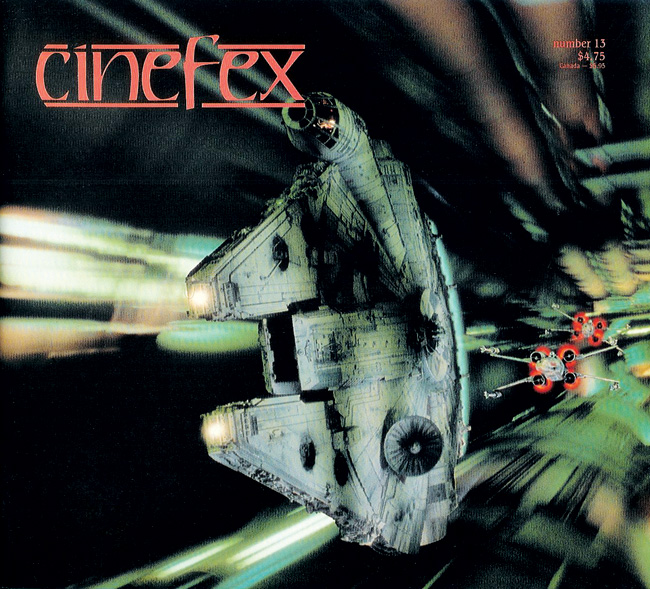
<FONT COLOR='#ff0000'>Return of the Jedi: Jedi Journal</FONT>: After dazzling audiences worldwide with the first two installments in his Star Wars saga, George Lucas set out to surpass even himself with Return of the Jedi. Doing so involved not only bringing the middle trilogy to a satisfying and dramatic conclusion, but also mustering forth the considerable capabilities of his oft-awarded effects facility - Industrial Light & Magic. Since the latest Star Wars entry involved more effects shots - and of greater complexity - than either of its two predecessors, and since the work would be compressed into a somewhat shorter time frame, it was decided to split ILM into three primary effects units. At the helm of each was a seasoned Star Wars veteran - Richard Edlund,Dennis Muren and Ken Ralston. As the postproduction effort progressed, each supervisor recorded a month-by-month account of the work as it developed and changed, producing in the process a fascinating account of how a major effects production comes together - the anticipation and planning, the crushing workload, the delights and disappointments. Edited by Don Shay
Issue 14 1983
Main Cover

<FONT COLOR='#ff0000'>Low-Tech Effects - The Right Stuff</FONT>: When Phillip Kaufman set out to film The Right Stuff, he was faced with the task of creating believable flying effects - of familiar real-world aircraft and space vessels - that could be convincingly intercut with Air Force and NASA documentary footage. To accomplish the job, he engaged experimental filmmaker Jordan Belson and USFX effects supervisor Gary Gutierrez. What followed was a two-year odyssey of discovery and growth, during which all three found that high technology did not always produce high satisfaction. Article by Adam Eisenberg<BR>
<FONT COLOR='#ff0000'>Brainstorm - Getting the Cookie at the End</FONT>: More than a decade after Silent Running, effects maestro Douglas Trumbull landed his second directing assignment on Brainstorm, only to become embroiled in a debilitating two-year struggle just to see the film completed. A key element in the postproduction effort was the creation of a point-of-view representation of the death experience - an eerie journey through a figurative heaven and hell that dominates the film's climax. Trumbull, effects supervisor Alison Yerxa and six other members of the crew, discuss the unique production. Article by Brad Munson<BR>
<FONT COLOR='#ff0000'>Twilight Zone - The Movie: Shadow and Substance</FONT>: With Twilight Zone - The Movie, four top-notch directors joined forces to extract the essence of Rod Serling's ever-popular teleseries and transform it into a theatrical experience worthy of its progenitor - an anthology of filmic fantasies, old and new, ranging from the poignant to the harrowing. Though special effects, in general, were to take a back seat, two of the film's episodes featured exuberant displays of makeup prowess and postproduction opticals - discussed in detail by the principals involved. Article by Don Shay and Paul Sammon
Issue 15 1983
Main Cover

<FONT COLOR='#ff0000'>David Dryer - Never Say Never Again</FONT>: Never Say Never Again - the maverick James Bond film starring the original 007, Sean Connery - emerged this fall as one of the series' strongest entries. To helm its postproduction opticals, producer Jack Schwartzman selected Oscar nominee David Dryer. Dryer - who utilized the high-tech facilities of Apogee - details the techniques employed to produce the pivotal cruise missle hijacking, the holographic videogame confrontation between Bond and Largo, and other less apparent illusions. Interview by Don Shay<BR>
<FONT COLOR='#ff0000'>The Day After: Waging a Four-Minute War</FONT>: In a storm of protest and praise, ABC's video presentation of The Day After descended upon the American public as a grim reminder of the potential horrors of nuclear weaponry. Recalling the highly-charged atmosphere of creative enthusiasm and emotional abhorrence, effects supervisor Robert Blalack and members of his Praxis Film Works team discuss their involvement on the film augmented by Mike Minkow of Movie Magic; and with additional recollections from director Nicholas Meyer, his predecessor Robert Butler, and production designer Peter Wooley. Article by Adam Eisenberg<BR>
<FONT COLOR='#ff0000'>Photographs and Memories - Ralph Hammeras</FONT>: In a career spanning almost half a century, effects pioneer Ralph Hammeras worked on some one thousand motion pictures - garnering, in the process, four Academy Award nominations and one Oscar. As recounted in his own words - put to paper nearly twenty years ago - Hammeras reminisces about his early days in the film business, his development of the 'glass shot' and rear process photography, and his work on such significant effects productions as The Lost World, Just Imagine and 20,000 Leagues Under the Sea. Edited by Don Shay
Issue 16 1983
Main Cover

<FONT COLOR='#ff0000'>Rick Baker - Maker of Monsters, Master of the Apes</FONT>: When ten-year-old Rick Baker first began experimenting with the most basic of makeup materials, his emerging passion for the sorts of illusions which could be wrought with these arcane substances was decidedly out of the ordinary. Motion picture makeup - the kind that transforms actors into monsters, aliens or even animals - was not at all the stellar occupation it has come to be; and at the time, there was little in the way of instructional materials an enthusiastic novice could draw upon, let alone a clearly marked path toward professional involvement. Baker's unwavering dedication, coupled with a single-minded pursuit of excellence, was to serve him well, however - vaulting him past such obstacles to a position of prominence in a burgeoning career field in which he now has few peers. From the early, low-budget efforts of Octoman and Schlock, through It's Alive and The Incredible Melting Man, and eventually on to loftier assignments in Star Wars, The Incredible Shrinking Woman and the lamentable King Kong remake, Baker honed his skills and developed his talents - ultimately reaching full maturity in response to the diverse challenges of An American Werewolf in London, Videodrome and Greystoke. From simple pie dough makeups to the most complicated of bodily transformation, Baker delves into his life and work, offering an incisive look at the artist and his art. Article by Jordan Fox
1984
Issue 17 1984
Main Cover

<FONT COLOR='#ff0000'>Ghostbusters</FONT>: After a stellar seven-year association with the Lucasfilm family, four-time Oscar-winner Richard Edlund departed Industrial Light & Magic to establish his own effects organization at Entertainment Effects Group. Ghostbusters - his first independent assignment - presented him with the challenge of producing nearly two hundred varied and complex effects shots in considerably less than a year. Before he could even begin, however, the facility - formerly operated by Douglas Trumbull and Richard Yuricich - had to be restructured, additional equipment had to be designed and built, and a top-notch crew had to be assembled from the ground up. Edlund details the problems involved and - together with key members of his production unit - discusses the magic that went into Ivan Reitman's supernatural comedy. Article by Adam Eisenberg<BR>
<FONT COLOR='#ff0000'>The Last Starfighter - Imagery Wrought in the Total Forge</FONT>: When John Whitney Jr. and Gary Demos established Digital Productions in 1981, they did so with an eye towards building a facility that would revolutionize the field of computer generated imagery and at the same time introduce to the film industry a viable alternative to optical effects and motion control photography. Armed with the Cray X-MP - the world's most powerful computer - they turned their high tech talents loose on The Last Starfighter, generating an unprecedented twenty-five minutes of digital scene simulation. Whitney and Demos discuss the unique nature and capabilities of Digital Productions, while individual members of the simulation team delve into the specifics of their premiere film - featuring, among other things, some of the most complex computer imagery every produced. Article by Peter Sorensen
Issue 18 1984
Main Cover

<FONT COLOR='#ff0000'>Indiana Jones and the Temple of Doom: Hell and High Water</FONT>: Indiana Jones and the Temple of Doom marks the second blockbuster association between executive producer George Lucas and director Steven Spielberg. Unlike Raiders of the Lost Ark, which - with the exception of its cosmic finale - relied primarily on dazzling stuntwork for its thrills and chills, many of the key sequences in the second Indiana Jones adventure were made possible only through the employment of elaborate visual effects. From miniature airplanes and mine cars to large-scale lava and water effects, the cinemagicians of Industrial Light & Magic stretched the limits of their experience and expertise to produce some 140 effects shots for the consummate cliffhanger. Three-time Oscar-winning effects supervisor Dennis Muren discusses the project in detail, aided and abetted by numerous members of his highly-specialized team. Article by Robert P. Everett<BR>
<FONT COLOR='#ff0000'>Star Trek III: The Search for Spock: The Final Voyage of the Starship 'Enterprise'</FONT>: Concurrent with their involvement in Indiana Jones, the artists and technicians of Industrial Light & Magic were also at work on a vastly different project - their second foray into Star Trek's final frontier. In Star Trek III: The Search for Spock, Oscar-winning effects supervisor Ken Ralston and his team were called upon to create alien creatures, several new spacecraft, a mammoth orbiting drydock, planetary surfaces for Genesis and Vulcan - and most memorable, the destruction of the starship Enterprise. Ralston and key members of the effects unit detail the challenges involved and the techniques employed in achieving these and other cinematic wonders. Article by Brad Munson
Issue 19 1984
Main Cover

<FONT COLOR='#ff0000'>Gremlins: Never Feed Them After Midnight</FONT>: A stylishly quirky master of the cult film, director Joe Dante took a giant step forward into mainstream filmmaking with Gremlins, a savagely witty fairy tale and resounding boxoffice success. To an extent beyond that of any recent film, Gremlins relied almost as much on its variously conceived mechanical creatures as it did on its live performers. With contributions from Joe Dante, producer Michael Finnell and others, mogwai and gremlin creator Chris Walas unveils the story behind the year's most remarkable cinematic newcomers. Article by Paul M. Sammon<BR>
<FONT COLOR='#ff0000'>Across the Eighth Dimension with Buckaroo Banzai</FONT>: Overflowing with bizarre concepts and off-the-wall humor, The Adventures of Buckaroo Banzai demanded an equally off-centered approach to its visual effects. With this in mind, effects supervisor Michael Fink was given the task of organizing and coordinating the activities of three separate facilities, all engaged in providing footage of organic spaceships and interdimensional environments. With an overview by director W.D. Richter, Fink elaborates on the project, with additional input from Hoyt Yeatman and Keith Shartle of Dream QuestImages, Peter Kuran of VCE, Inc., and John Scheele of Greenlite Effects. Article by Nora Lee<BR>
<FONT COLOR='#ff0000'>Dreamscape: What Dreams Are Made Of</FONT>: Creating a low-budget dream world was often a nightmare for the effects personnel involved in Dreamscape. Visual effects supervisor Peter Kuran details the creation of surrealistic nuclear explosions and post-holocaust environments; special makeup artist Craig Reardon outlines the construction of a full-size snakeman and various radiation-burned bomb victims; and camerman James Aupperle discusses his stop-motion animation in the film. Article by Adam Eisenberg
Issue 20 1984
Main Cover

<FONT COLOR='#ff0000'>Jupiter Revisited - The Odyssey of '2010'</FONT>: Sixteen years ago, 2001: A Space Odyssey was launched into the cinematic firmament - a glimmering enigma which, among other things, promptly established a new aesthetic, as well as a whole new set of ground rules for motion picture special effects. Nearly a decade would pass before Star Wars and Close Encounters of the Third Kind, using computerized motion control photography and advanced compositing techniques, would begin to close the technological gap established by 2001. When Arthur C. Clarke published his much anticipated sequel 2010: Odyssey Two in 1982, it was reasonable to assume that it would soon find its way onto the screen, with the full force of contemporary state-of-the-art movie magic brought to bear on its complex effects requirements. Rising to the challenge were producer-writer-director Peter Hyams, futurist designer Syd Mead and visual effects supervisor Richard Edlund. From actualizing a Russian interplanetary spaceship to devising an authentic-looking representation of Jupiter's turbulent surface, the 2010 effects unit fulfilled the demands of the production and in the process established a fresh new look in simulated space photography. Article by Don Shay
1985
Issue 21 1985
Main Cover
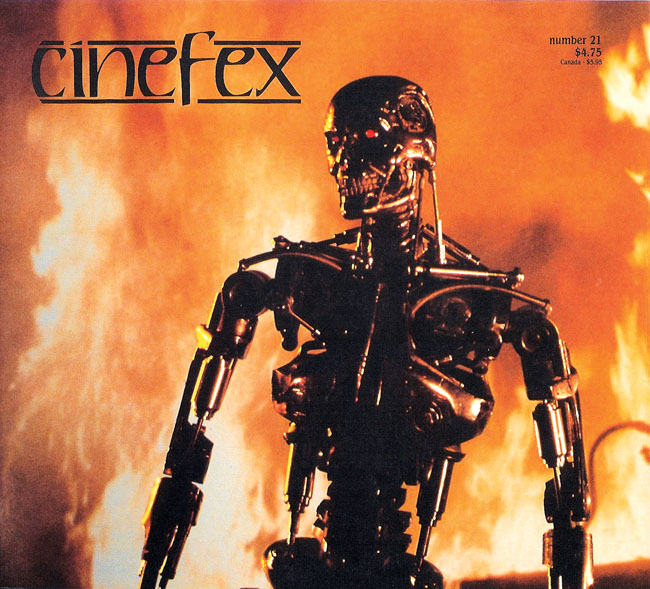
<FONT COLOR='#ff0000'>The Terminator</FONT>: When writer-director James Cameron first conceived of The Terminator, it was little more than a visceral image of a human cyborg emerging from a fire in its basic skeletal form. What it became was a modestly-budgeted blockbuster. To bring his image to life, Cameron engaged the services of Stan Winston - whose seasoned team of makeup and mechanical effects experts created the full-size robotic skeleton, as well as several lifelike representations of actor Arnold Schwarzenegger. For futuristic post-holocaust views of Los Angeles, plus contemporary pyrotechnics and stop-motion effects, the expertise and talents of Fantasy II were brought to bear. With minimal funds, but a wealth of creativity and enthusiasm, The Terminator's effects units helped transform Cameron's searing image into both a thrill-a-minute adventure and a major boxoffice event. Article by Jennifer Benidt<BR>
<FONT COLOR='#ff0000'>The Shape of 'Dune'</FONT>: Despite enormous popularity as a novel, twenty years would elapse before Frank Herbert's Dune would make the quantum leap from printed page to cinematic reality. The imposing challenge of adapting the widely-read cult classic - a saga rivaling the novel itself in epic proportion - would ultimately be met by writer-director David Lynch. In consort with cinematographer Freddie Francis, production designer Tony Masters, and a battery of high-powered effects supervisors including Carlo Rambaldi, Albert Whitlock, Barry Nolan, Kit West and Brian Smithies, Lynch would labor diligently for three-and-a-half years to bring his vision of Herbert's exotic work to life. From the worm-infested deserts of Arrakis to the murky decadence of Giedi Prime, Lynch and his production unit combineda wealth of experience with fresh innovation to weave the richly-textured tapestry of Dune. Edited by Janine Pourroy and Don Shay
Issue 22 1985
Main Cover

<FONT COLOR='#ff0000'>Return to Oz</FONT>: It all started eighty-five years ago when L. Frank Baum first captured the hearts and imaginations of children with The Wonderful Wizard of Oz. The book's literary success spawned dozens of stage and screen excursions to the Land of Oz, marked most notably by MGM's immortal classic. Repudiating the popular conception of singing and dancing munchkins and vaudevillian backdrops, Walt Disney Productions and director Walter Murch have reexplored Baum's familiar and beloved fantasy world in a dedicated new adaptation - Return to Oz. Producers Gary Kurtz and Paul Maslansky, opticals expert Zoran Perisic, creature designer Lyle Conway and Claymation innovator Will Vinton - together with other members of the Oz team - discuss in detail the special brand of wizardry involved in bringing Dorothy Gale's time-honored adventures once again to life. Article by Brad Munson<BR>
<FONT COLOR='#ff0000'>Baby: Bringing up Baby</FONT>: In the animal-adventure genre there is nothing new under the sun - or is there? For Touchstone Films, the novel twist of casting a most unusual fauna in the title role of Baby was inspiration for the telling of an old tale in a decidedly new way. The Isidoro Raponi-designed infant brontosaurus star was born cinematically in the rain forests of Africa's Ivory Coast following an arduous three-year gestation period. For director B.W.L. Norton and producer Jonathan Taplin, the trials and tribulations of bringing the $14 million production to life involved an exhausting - often harrowing - labor. And the challenge of creating high-tech special effects in a low-tech Third World country furnished all involved with more than their share of real-life thrills and chills. Article by Howard E. Green
Issue 23 1985
Main Cover

<FONT COLOR='#ff0000'>Explorers: The Stuff That Dreams Are Made Of</FONT>: Every kid has dreams of adventure by way of a backyard fort or makeshift treehouse. In Joe Dante's summertime jaunt, Explorers, the dream comes true. Only this time the journey begins when a homemade spaceship devised by three young boys really does take off for parts unknown and brings the trio face-to-face with some hilariously offbeat Rob Bottin-designed aliens. With the effects expertise of Industrial Light & Magic and the computer-generated animation of Omnibus Computer Graphics, Dante and company launched a $23 million expedition into the cinematic firmament. Article by Adam Eisenberg<BR>
<FONT COLOR='#ff0000'>Lifeforce: Baring the Soul of 'Lifeforce'</FONT>: Bizarre makeup and unusual opticals are prime elements of the modern horror or science fiction film, and director Tobe Hooper's Lifeforce - an incredible combination of the two genres - is replete with both. Keeping up with an effects-a-minute pace was no easy task for the international crew, and John Dykstra and key members of his Apogee organizaion discuss challenges faced on the visual effects front. From conventional model photography to innovative laser applications, the production team concocted an assortment of illusions to help bring Colin Wilson's tale of soul-snatching vampires to life. Article by Glenn Campbell<BR>
<FONT COLOR='#ff0000'>Shooting for an 'A' on 'My Science Project'</FONT>: Screenwriter Jonathan Betuel was certain of two things while shopping his My Science Project script around Hollywood - he wanted to direct the film, and it had to feature a terrifying tyrannosaurus rex sequence. Walt Disney Productions agreed and gave Betuel the directorial reins for his fantasy-adventure yarn about a high school science experiment gone awry. Along with effects supervisor John Scheele, dinosaur-builder Doug Beswick and other members of the effects ensemble, first-time director Betuel reflects upon the unlikely logistics of getting a prehistoric carnivore into the school gymnasium. Article by Stephen Rebello
Issue 24 1985
Main Cover

<FONT COLOR='#ff0000'>Creating the Wonder of 'Cocoon'</FONT>: Without benefit of unbridled violence, gross-out humor or food fights - apparent prerequisites for contemporary boxoffice success - Cocoon seemed a decidedly tame entry into the summer filmgoing sweepstakes. Not to mention the fact that in these times of youth-oriented fare, its principal cast consisted largely of veteran performers well into their Social Security years. But in director Ron Howards' hands, the Zanuck/Brown production - with its predominant emphasis on character and heart - finished a strong third among the season's boxoffice attractions. Helping to create the magic behind what Howard jokingly dubbed 'Close Encounters on Golden Pond' were the diversely-talented cinemagicians of Industrial Light & Magic, Cannom Creature Effects and Robert Short Productions who - separately and collectively - produced everything from lifelike mechanical dolphins to glowing extraterrestrials to flying saucers from distant worlds. Article by Jody Duncan Shay<BR>
<FONT COLOR='#ff0000'>Backyard Adventures - Spielberg Style</FONT>: When Steven Spielberg's Amblin Productions first approached Industrial Light & Magic with a request to purvey the few, minimal effects shots needed for The Goonies and Back to the Future, the proposal seemed innocent enough. The premier facility was well-accustomed to orchestrating visual effects by the hundreds for Lucasfilm's intergalactic space epics. But the fast-paced, tandem production scheduling of Amblin's earthbound adventures called for some decidedly different approaches - and compelled the already well-occupied ILM staff into a whirlwind of productivity. And although neither Goonies nor Back to the Future is considered a 'major effects film', each features several well-placed 'major effects'. Seasoned veterans of illusion Micheal McAlister, Ken Ralston and other members of Industrial Light & Magic - along with the films' special makeup experts - discuss life in the special effects fast lane and the ensuing challenges thereof. Article by Janine Pourroy
1986
Issue 25 1986
Main Cover

<FONT COLOR='#ff0000'>Behind the Lines of 'Enemy Mine'</FONT>: Although Barry Longyear's futuristic story of survival and friendship in an unwelcoming environment seemed an ideal film property, the process of bringing Enemy Mine to the screen would prove anything but ideal. The need for intricate alien makeups, bizarre scenery and dogfighting spacecraft automatically earmarked the project as an especially challenging one - rendered even more so by the replacement of the original director in mid-production. Ultimately, however, the film would come together under the direction of Wolfgang Petersen who orchestrated both the demanding live-action shoot and an international assemblage of multitalented effects people. Article by Janine Pourroy<BR>
<FONT COLOR='#ff0000'>Der Trickfilm - A Survey of German Special Effects</FONT>: During the opening years of the twentieth century, when the art of filmmaking was being developed on an international scale, the German cinema promptly established a sungular identity for itself - an identity shaped largely by the fact that its prime innovators seemed possessed by an insatiable fascination with the fantastic. Tasked with subjects ranging from epic fantasy to futuristic science fiction, German technicians were among the first to explore and exploit the magical capabilities of the motion picture camera. Article by Rolf Giesen<BR>
<FONT COLOR='#ff0000'>Fright Night</FONT>: Writer-director Tom Holland conceived of Fright Night as a contemporary tribute to the traditional vampire film, complete with all affectations of the genre. But instead of employing the simplistic techniques of yore, Holland was determined to utilize state-of-the-art special effects to their fullest. Undaunted by a relatively meager budget, Holland and Columbia Pictures turned toRichard Edlund and Boss Film Corporation with a unique challenge to produce an array of high-quality illusions - everything from flying bats to snarling man-beasts - all for an unprecedented bargain price. Article by Jennifer Benidt and Janine Pourroy
Issue 26 1986
Main Cover

<FONT COLOR='#ff0000'>Poltergeist II: To Hell and Back</FONT>: In 1982, all hell broke loose in the Freeling household. Steven Spielberg's production of Poltergeist recounted the chilling tale of a family turned upside-down by ghostly goings-on engineered and executed by Oscar-winner Richard Edlund and his visual effects team at Industrial Light & Magic. Now, four years later, Poltergeist II finds the beleaguered Freelings once again embroiled in a multidimensional melee - this time without producer Spielberg or Industrial Light & Magic, but with Edlund still at the visual effects helm. Faced with the challenge of surpassing his own previous efforts, Edlund and his Boss Film Corporation - comprised of many veterans from the earlier production - redefined the nature of supernatural filmmaking, bringing to life in the process an array of horrific new phantasms conceived by surrealist designer H.R. Giger. Article by Nora Lee and Janine Pourroy<BR>
<FONT COLOR='#ff0000'>Young Sherlock Holmes: Anything But Elementary</FONT>: Heading the ranks of cinematic supersleuths for decades has been the constant, ever-brilliant epitome of logic and clever deduction - Sherlock Holmes. As the latest entry in the Holmesian film chronicles, Young Sherlock Holmes - directed by Barry Levinson for Amblin Productions - presents a portrait of the fledgling detective as a teenager obsessed by a string of baffling murders. Veteran physical effects expert Kit West, first-time animatronics supervisor Stephen Norrington and the cinemagicians at Industrial Light & Magic were called upon to create the film's innovative special effects - ranging from flying machines and murderous hatracks to bizarre hallucinations requiring high-tech computer graphics, go-motion puppet animation and sophisticated rod puppeteering. Article by Jody Duncan Shay
Issue 27 1986
Main Cover

<FONT COLOR='#ff0000'>Aliens</FONT>: In the seven years since its release, Ridley Scott's Alien has endured as the quintessential science fiction horror film - a stylish thriller and box-office favorite that spawned a rash of forgettable clones but somehow defied legitimate efforts to generate a worthy sequel. A fresh approach was clearly in order, but that approach proved evasive until writer-director James Cameron was afforded the opportunity to develop his own scenaro - an action-packed roller coaster ride that succeeded admirably in retaining the essential elements of the original without being fettered by them. Despite a studio analyst's estimate that Cameron's Aliens script would cost $35 million, producer Gale Anne Hurd mounted the ambitious sequel in England - bringing it in for a remarkably frugal $18 million. Of crucial importance to the cost curtailment effort was the need to keep the film's extensive special effects from spiraling out of control. Striving for high-quality work with low-level technology, Cameron and Hurd assembled a team of professionals that included conceptual designers Syd Mead and Ron Cobb, production designer Peter Lamont, visual effects supervisors Robert Skotak and Dennis Skotak, postproduction supervisor Brian Johnson, alien effects creator Stan Winston and physical effects supervisor John Richardson. These and other effects artisans discuss in detail their work on the film and the time-pressured campaign to bring Aliens into being. Article by Don Shay
Issue 28 1986
Main Cover

<FONT COLOR='#ff0000'>The Fly: The Fly Papers</FONT>: For almost thirty years, The Fly has held a cherished place in the hearts and minds of genre film enthusiasts; so the decision to remake it was not surprising. Only its essential premise, however, would be retained. Under the direction of David Cronenberg, the story became one of a scientist whose genes are scrambled with those of a common housefly producing a mutant form that evolves incessantly into something neither human nor insect. Discussing the film and its manifold complexities are director David Cronenberg, special makeup creator Chris Walas, video effects supervisor Lee Wilson and others. Article by Tim Lucas <BR>
<FONT COLOR='#ff0000'>Big Trouble in Little China: Putting Big Trouble into Little China</FONT>: For Big Trouble in Little China - a sprawling fantasy-adventure set in an imaginary world under a Chinatown - director John Carpenter needed a special effects facility that could respond to the demands of a script that called for a wide range of makeup and creature effects as well as precision opticals and animation. Rising to the task was Richard Edlund and his Boss Film Corporation who collectively produced a 2000-year-old evil magician, a flying fleshball covered with eyes, several monsters and spirits of indeterminate origin, plus a vast array of lightning effects and other illusions. Article by Janine Pourroy <BR>
<FONT COLOR='#ff0000'>Short Circuit: Building the Body Electric</FONT>: The Short Circuit script had everything - adventure, humor, warmth - and John Badham knew immediately that he wanted to direct it. All it needed for success was a very special lead player - a six-foot-tall robot with an engaging personality who could drive trucks, dance disco and chase butterflies. The task of producing this singular perfomer fell to robot construction supervisor Eric Allard, futurist designer Syd Mead, puppeteer Tony Urbano and physical effects coordinator Chuck Gaspar - all of whom discuss in detail the creation of a very unique Hollywood star. Article by Jody Duncan Shay
1987
Issue 29 1987
Main Cover

<FONT COLOR='#ff0000'>Star Trek IV: The Voyage Home: Humpback to the Future</FONT>: From deep space to deep waters, Star Trek IV: The Voyage Home engages the ever-stalwart crew of the U.S.S. Enterprise in a humanistic quest that begins and ends in the twenty-third century but unfolds for the most part in modern-day San Francisco. Along with its customary quota of spaceships and transporter beams, the latest adventure called for a representation of the planet Vulcan, a unique time travel effect, major storm sequences on earth and a totally convincing simulation of two humpback whales. Article by Jody Duncan Shay<BR>
<FONT COLOR='#ff0000'>King Kong Lives: After the Fall</FONT>: Forty-three years after toppling from the Empire State Building, King Kong was called upon to take an even greater tumble from the World Trade Center. Now, another decade later, the long-suffering ape has been resurrected once more for King Kong Lives - again as an ape-suited actor augmented by full-size mechanical artifacts. Discussing their work on the film are creature creator Carlo Rambaldi, production designer Peter Murton, visual effects supervisor Barry Nolan, and model shop supervisors David Jones and Dave Kelsey. Article by Janine Pourroy<BR>
<FONT COLOR='#ff0000'>Top Gun: Sky Wars</FONT>: Even with full support from the U.S. Navy, the producers of Top Gun realized that some of the sequences planned for their film would have to rely heavily on special effects. To create crash scenes and aerial explosions that would simulate actual air-to-air photography and intercut convincingly with live-action flight footage, visual effects supervisor Gary Gutierrez and his USFX organization launched an intensive campaign employing large-scale miniatures, outdoor settings and innovative pyrotechnics. Article by Ed Martinez
Issue 30 1987
Main Cover

<FONT COLOR='#ff0000'>Little Shop of Horrors: The Care and Feeding of Audrey II</FONT>: For someone with Lyle Conway's background, Little Shop of Horrors was a dream come true - and a nightmare. Enlisted by director Frank Oz to design and create a believable plant character that could hold its own in a multimillion dollar musical comedy, Conway and a crew of forty animatronics specialists rose to the challenge by producing six fully-articulated versions of Audrey II ranging in size from four-and-a-half inches to twelve-and-a-half feet - and then taught the largest three how to speak and sing. Article by Jody Duncan<BR>
<FONT COLOR='#ff0000'>The Gate: A Question of Perspective</FONT>: Seeking major league effects on a minor league budget, producer John Kemeny and director Tibor Takacs turned to effects designer Randall William Cook for their supernatural thriller The Gate. Working with a hand-picked team of professionals, Cook orchestrated a wide range of mystifying effects - including a giant stop-motion demon and a swarm of devilish minions rendered tiny by some ingenious illusory techniques seldom employed in recent years. Article by Adam Eisenberg<BR>
<FONT COLOR='#ff0000'>The Golden Ghild: Of Daggers and Demons</FONT>: For Industrial Light & Magic, The Golden Child was business as usual - winged demons, slithering snake women, even dancing Pepsi cans. But merging these fantasy elements into a gritty urban street comedy starring Eddie Murphy was a major stylistic challenge. Rising to the occasion was a team of software engineers and puppet animators who managed to blur the line between real and unreal by employing a prototype field motion control system to convincingly incorporate stop-motion figures into hand-held action scenes. Article by Paul Mandell
Issue 31 1987
Main Cover

<FONT COLOR='#ff0000'>Spaceballs: Spaceballs - The Special Effects</FONT>: In focusing his singular sense of humor on the science fiction film genre, Mel Brooks realized the ease with which he could have milked a few extra laughs by employing deliberately poor special effects. But instead, he wanted his parody to work within the context of a high-gloss production. To this end, he enlisted visual effects supervisor Peter Donen. Working primarily with Apogee - but with outside input from Illusion Arts and Industrial Light & Magic - Donen was able to orchestrate a full and varied array of cinematic illusions. Article by Mark Elliot<BR>
<FONT COLOR='#ff0000'>The Witches of Eastwick: Witch Trials</FONT>: For director George Miller, The Witches of Eastwick was a formidable challenge - a supernatural comedy with a top-notch cast that required a deft touch to maintain its proper balance of humor and horror. Though effects would take a back seat in the production, it was necessary that they be brought to bear on such thorny problems as depicting a palatial mansion that did not exist, creating a tennis ball with a mind of its own and transforming actor Jack Nicholson into a fifty-foot demon. Engaged to accomplish these and other feats were Industrial Light & Magic and makeup effects artist Rob Bottin. Article by Adam Eisenberg<BR>
<FONT COLOR='#ff0000'>Masters of the Universe</FONT>: Though derived from a phenomenally popular toy line, Masters of the Universe would prove to be anything but fun and games for production designer William Stout, visual effects supervisor Richard Edlund and makeup artist Michael Westmore. With high expectations but minimal time and resources, the design and effects teams had to translate plastic dolls into flesh-and-blood characters, create a faraway fantasy world from scratch and implant nonstop optical trickery into a sword-and-sorcery adventure of extravagant proportions. Article by Ron Magid
Issue 32 1987
Main Cover

<FONT COLOR='#ff0000'>RoboCop: Shooting RoboCop</FONT>: Big city crime has turned Old Detroit into a combat zone. Decent citizens can no longer venture forth onto the streets, day or night, and even police officers are prime targets for murder and mayhem. Clearly something must be done. The answer as proposed in Jon Davison's production of RoboCopis a new breed of urban crime-fighter - half man, half machine, all business. Engaged to create this cyborg superhero were film director Paul Verhoeven, actor Peter Weller and makeup effects artist Rob Bottin. Also contributing to the futuristic ambience were ED 209 supervisor Peter Kuran, matte artist Rocco Gioffre and a host of others who discuss in detail their experiences on this most explosive of box office hits. Article by Paul M. Sammon<BR>
<FONT COLOR='#ff0000'>Innerspace: Inside Martin Short</FONT>: For most directors, getting inside one's characters is an intellectual exercise. But for Joe Dante, Innerspace represented a literal opportunity to explore on film the inner workings of a human being - specifically, supermarket clerk Jack Putter who, as a consequence of a miscarried microscopic submersible pod manned by test pilot Tuck Pendelton. Enlisted to design and produce the innespace footage was visual effects supervisor Dennis Muren of Industrial Light & Magic. Mixing anatomical realism with dramatic fancy, Muren and his associates produced both miniaturization effects and macroscopic excursions through the innermost recesses of actor Martin Short's eyes, ears, blood stream, stomach and lungs. Article by Janine Pourroy
1988
Issue 33 1988
Main Cover

<FONT COLOR='#ff0000'>007 X 4 - John Richardson</FONT>: In four of the last five James Bond adventures, special effects supervisor John Richardson has acted as an off-camera 'Q' to the indomitable 007 - engineering a speedboat chase over a waterfall in Moonraker; flying a minijet through an aircraft hanger in Octopussy, snaring a blimp on the Golden Gate Bridge in A View to a Kill and staging a massive ground and air battle in The Living Daylights. Eschewing opticals in favor of full-scale physical effects or cleverly integrated miniatures, Richardson has earned a reputation world-wide as an effects artisan of consummate ingenuity and skill. Article by Nora Lee<BR>
<FONT COLOR='#ff0000'>Aging Gracefully with Dick Smith</FONT>: When a film script calls for an actor to age, one name comes quickly to mind - Dick Smith. In a celebrated career that has spanned more than forty years, Smith has designed and executed aging makeups for such classic films as Little Big Man, The Godfather, The Exorcist and Amadeus. Smith discusses in detail the evolution of old age makeup and gives an anecdotal account of his experiences adding years and decades to such motion picture notables as Dustin Hoffman, Marlon Brando and Walter Matthau. Article by Jody Duncan Shannon<BR>
<FONT COLOR='#ff0000'>The Predator: Predator Revealed</FONT>: When producer Joel Silver went to R/Greenberg Associates with a script that called for an extraterrestrial being capable of rendering itself virtually invisible in the jungle, the challenge of creating such an effect - and others including it's thermographic vision - was eagerly accepted. By employing a red creature suit to generate mattes and a laborious optical technique for creating a multifaceted quasi-invisible figure, visual effects supervisor Joel Hynek and his crew were able to successfully render the alien in visual terms that were both effective and unique. Article by Paul Mandell
Issue 34 1988
Main Cover

<FONT COLOR='#ff0000'>Beetlejuice: Cheap and Cheesy and Off-the-Cuff</FONT>: To produce a wildly offbeat supernatural comedy with wall-to-wall effects and limited funding, Beetlejuice director Tim Burton turned to first-time visual effects supervisor Alan Munro who assembled a choice team of cost-conscious independents willing and able to conjure up hundreds of effects shots for a very small portion of the film's $14 million budget. In charge of creature creation and makeup illusions was principal effects contractor Robert Short; providing opticals and miniature support was Peter Kuran of Visual Concept Engineering; and tasked with enlivening three highly specialized animation sequences were Doug Beswick, Ted Rae and Tim Lawrence. Together they assembled the fanciful imagery that helped make Beetlejuice the first big hit of the summer season. Article by Jody Duncan Shannon<BR>
<FONT COLOR='#ff0000'>Batteries Not Included: Visit from a Small Planet</FONT>: When Amblin Entertainment brought Batteries Not Included to Industrial Light & Magic, visual effects supervisor Bruce Nicholson found the prospect of creating a family of pint-size anthropomorphic flying saucers both intriguing and challenging. Principal among the challenges was the need to create ships that could be photographed in real time on live-action sets and also in bluescreen environments under motion control. Most importantly, the imagery produced through employment of these two techniques had to be stylistically indistinguishable even when cut together end to end. Developed to support the effort was a sophisticated new wire rig and a winning array of flying machines brought to life via overhead wires, motion control, rod puppetry, stop-motion animation and go-motion. Article by Richard Linton
Issue 35 1988
Main Cover

<FONT COLOR='#ff0000'>Who Framed Roger Rabbit?: Romancing the Rabbit</FONT>: What if cartoon characters were real performers who lived and breathed and worked on movie soundstages like any other actor? With the considerable might of Walt Disney Studios and Amblin Entertainment behind him, director Robert Zemeckis took that offbeat notion and from it concocted Who Framed Roger Rabbit - a frenetic comedy adventure combining live-action and animation with a degree of realism never before attempted. Mechanical effects by George Gibbs and Michael Lantieri enabled actor Bob Hoskins and others to interact convincingly with characters that had no on-set presence. These characters were later provided by some three hundred artisans working under animation director Richard Williams and were then seamlessly integrated into the live-action -complete with shadows and highlights - by the optical wizards at Industrial Light & Magic. Article by Adam Eisenberg<BR>
<FONT COLOR='#ff0000'>Willow</FONT>: Filmmaking impresario George Lucas - whose flights of fancy have spawned the Star Wars trilogy and the adventures of Indiana Jones - has focused on myth and magic for his latest excursion into the world of unbridled imagination. Manufacturing an earthbound environment every bit as wondrous and complete as Tatooine or Endor, Lucas and film director Ron Howard have produced Willow - an epic sword-and-sorcery adventure complete with fairy princesses, evil queens, firebreathing dragons, pesky brownies, talking animals and a diminutive hero determined to save an infant foundling from the forces of evil. Willow represents the most complete mustering of Lucasfilm effects talent since Return of the Jedi - employing effects animation, miniaturization techniques, stop-and-gomotion, animatronics and computer generated imagery. Article by Jody Duncan Shannon
Issue 36 1988
Main Cover

<FONT COLOR='#ff0000'>Alien Nation: A Planetful of Aliens</FONT>: To fulfill a need for hundreds of extraterrestrial characters - ranging from principal players to incidental extras - the producers of Alien Nation turned to Stan Winston Studios. There - under the direction of Alec Gillis, Shane Mahan, John Rosengrant and Tom Woodruff Jr., with on-set collaboration by Zoltan Elek - was mounted the largest makeup effects show in twenty years. Article by Ron Magid<BR>
<FONT COLOR='#ff0000'>Die Hard: Exaggerated Reality</FONT>: Even with near-total access to a brand new high-rise building, the makers of Die Hard needed something more to bring their action thriller to the screen. To simulate a bomb blast in an elevator shaft and a giant rooftop explosion and helicopter crash, producer Joel Silver enlisted the services of visual effects producer Richard Edlund and his Boss Film Corporation. Article by Adam Eisenberg<BR>
Dead Ringers: Double Vision: On Dead Ringers - the latest chiller by horror impresario David Cronenberg - optical effects supervisor Lee Wilson worked with Balsmeyer and Everett and Film Effects of Toronto to create a new generation of split-screen opticals that enabled actor Jeremy Irons to play scenes with himself as twin brothers without the customary restriction of stationary splits or even locked-off cameras. Article by Don Shay<BR>
<FONT COLOR='#ff0000'>The Blob: The Right Blob for the Right Job</FONT>: For his updated remake of The Blob, director Chuck Russell engaged visual effects production supervisor Michael Fink to oversee an outpouring of cinematic illusions that included gooey creature effects by Lyle Conway and Stuart Ziff, special makeup creations by Tony Gardner and opticals and miniature photography by Hoyt Yeatman and Dream Quest Images. Article by Robert G. Pielke
1989
Issue 37 1989
Main Cover

<FONT COLOR='#ff0000'>Star Trek: The Next Generation: Special Effects - The Next Generation</FONT>: The issue of visual effects had to be addressed early in the planning stages for Star Trek - The Next Generation. With fifty or more quality effects shots needed for each weekly episode - and only a modicum of time and money to spend on them - an alternative to film opticals was considered essential. Aware of advances in video effects technology, the producers turned to two of the most progressive video postprodiction companies in the business - The Post Group and Composite Image Systems - to take them where no television series had gone before. Article by Glenn Campbell and Donna Trotter<BR>
<FONT COLOR='#ff0000'>The Fly II: On The Fly - The Making of a Sequel</FONT>: At the end of David Cronenberg's horror hit, The Fly, Veronica Quaife is left pregnant with the child of Seth Brundle, uncertain of what effect the mutant housefly genes that destroyed her lover might have on their child. First-time director Chris Walas - who as makeup effects supervisor had won an Oscar for the first film - was given an opportunity to explore the possibilities in The Fly II. Reuniting key members of his makeup and effects unit for the sequel, Walas translated onto film the physical metamorphosis of young Martin Brundle from normal human being to murderours mutant insect. Article by Robin Brunet<BR>
<FONT COLOR='#ff0000'>From Science to Showbiz</FONT>: In a serendipitous merging of skills, equipment and opportunity, Oxford Scientific Films was founded by a group of university zoologists intent upon photo-documenting the microscopic wonders of the world surrounding them. Before long, the fresh perspective they brought to motion picture problem solving led to their involvement in a variety of feature film projects. Today - expanded into a full-service facility - Oxford Scientific is a respected leader among British effects studios. Article by Pamela Duncan Looft
Issue 38 1989
Main Cover
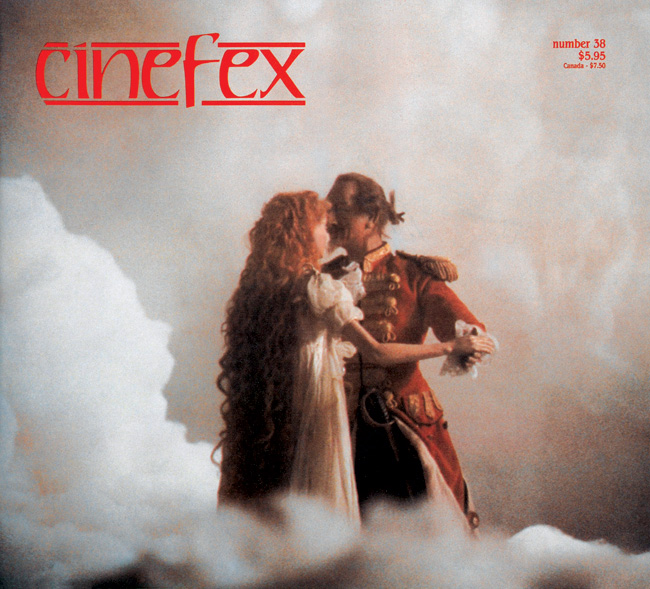
<FONT COLOR='#ff0000'>The Adventures of Terry Gilliam</FONT>: While thematic similarities resonate through the collected works of all visionary artists, even the most self-aware amongst them might be hesitant to proclaim as a trilogy three decisively unique film projects unrelated in time and place and without a single character in common. Not so Terry Gilliam. For him, Time Bandits, Brazil and The Adventures of Baron Munchausen represent a three-part celebration of the persistent dreamer seeking refuge in flights of fancy from the humdrum realities of the workaday world. With massive doses of imagination - and an irreverent sense of humor springing from his Monty Python roots - Gilliam has spent the last decade leaping through time and space and into alternate universes both wondrous and bizarre. Acutely aware that special effects are the essential elements needed to unlock his wildest imaginings, Gilliam has surrounded himself with top practitioners in the field -some spanning all three pictures - who have consistently pushed the limits of budget-conscious, low-tech film trickery to produce for him an abundance of cinematic wonders both grand and small. Article by Paul M. Sammon and Don Shay
Issue 39 1989
Main Cover
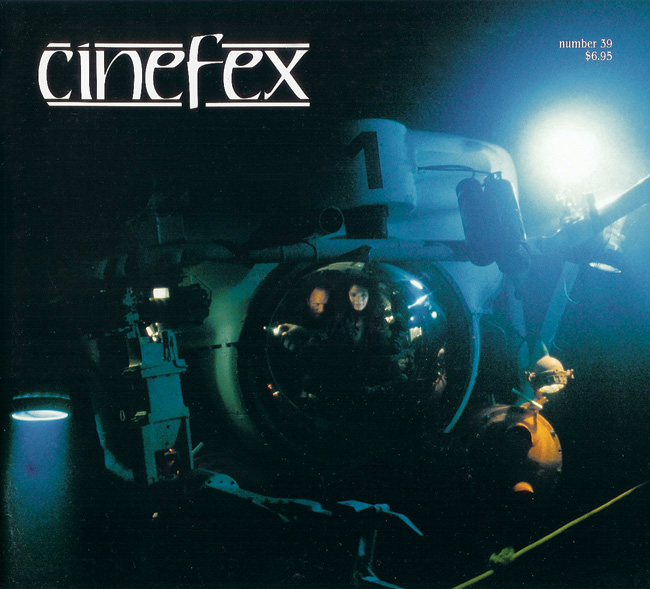
<FONT COLOR='#ff0000'>The Abyss: Dancing on the Edge of the Abyss</FONT>: Writer-director James Cameron and producer Gale Anne Hurd have carved a distinct niche for themselves in the world of high-tech science fiction filmmaking. After traveling across time in The Terminator and to the outer reaches of deep space in Aliens, they have now journeyed into the Cayman Trough - one of the deepest and most impenetrable chasms on earth - for The Abyss, Set in an underwater oil drilling habitat located seventeen hundred feet beneath the ocean surface, the film begins with the search for a downed nuclear submarine and evolves into an aquatic odyssey of cosmic consequence. Forty percent of the production was shot in the largest fresh water filming tank in the world - a specially converted reactor containment building located at an uncommissioned nuclear power plant. Nine visual effects units were engaged to produce literally hundreds of shots covering the gamut of cinematic illusions from computer generated imagery and motion control to animatronic puppets and radio control vehicles to matte paintings and underwater miniatures to rear projection and bluescreen traveling mattes. Virtually no effects technique was left untapped. A trio of distinguished effects supervisors - John Bruno and Hoyt Yeatman and Dennis Muren - oversaw the activities of in-house units and teams from Dream Quest Images and Industrial Light & Magic. Ancillary units were headed by Cameron veterans Robert and Dennis Skotak and Gene Warren of Fantasy II. Though photographed thousands of miles apart - in situations both wet and dry and by artists of diverse talents and experience - the effects blended together seamlessly with the main unit photography and with one another. The end result is an unprecedented and uncompromising accomplishment - an epic film of wonder and imagination propelled by the singular vision and relentless drive of a master filmmaker just hitting his stride. Article by Don Shay
Issue 40 1989
Main Cover

<FONT COLOR='#ff0000'>Ghostbusters II: Ghostbusters Revisited</FONT>: With Ghostbusters, producer-director Ivan Reitman and company performed a minor miracle by delivering a major effects production in less than a year - from concept to release. The result was the most successful comedy in film history. For the sequel - five years later - production and postproduction schedules were even more intense. Physical effects engineer Chuck Gaspar was on hand for his second Ghostbusters outing and Industrial Light & Magic stepped in fresh to handle the visual effects - delivering not only a full array of ghostly entities, but also a subterranean river of slime and an ambulatory Statue of Liberty. As the production continued to grow, other effects facilities - including Apogee - were brought in to absorb the over-flow. Effects team members across the spectrum - augmented by screenwriting actors Dan Aykroyd and Harold Ramis - trace the evolution and execution of the long-awaited Ghostbusters II. Article by Adam Eisenberg<BR>
<FONT COLOR='#ff0000'>Indiana Jones and the Last Crusade: Father, Son and the Holy Grail</FONT>: When director Steven Spielberg and producer George Lucas joined forces to reinvent in feature form the action-packed movie serials of the past, their stylish embellishment proved a boxoffice phenomenon - from a pair of filmmakers accustomed to making little else. Eight years and three films into the series, the saga of Indiana Jones culminates with Indiana Jones and the Last Crusade - a rousing finale in which the intrepid archaeologist's past is explored and his relationship with his father reinstated. Filmed in seven countries on three continents, the massive production relied heavily on physical and optical effects to recreate nearly every mode of transportation known to the period. Also required was the full disintegration of a major character - from flesh to dust - in one uninterrupted take. Rising to the challenge were physical effects technicians under George Gibbs and the optical illusionists at Industrial Light & Magic. Article by Adam Eisenberg
1990
Issue 41 1990
Main Cover

<FONT COLOR='#ff0000'>Batman: A Dark and Stormy Knight</FONT>: After a decade of dogged development - with countless scripts proposed and abandoned - Batman finally erupted on the screen last summer amidst a frenzy of hype and merchandising that quickly propelled it high into the ranks of all-time boxoffice champions. The man who cracked the project and finally brought it to fruition was director Tim Burton who surrounded himself with a powerhouse of moviemaking talent. Costume designer Bob Ringwood was enlisted to reconfigure Michael Keaton into the Dark Knight while makeup artist Nick Dudman was similarly engaged to transform Jack Nicholson into the Joker. At the same time, production designer Anton Furst labored to conceive and construct a brooding backlot representation of Gotham City - handsomely augmented with miniatures created by visual effects supervisor Derek Meddings and mechanical gadgetry provided by physical effects supervisor John Evans. Article by Jody Duncan Shannon<BR>
<FONT COLOR='#ff0000'>Honey, I Shrunk the Kids: Backyard Odyssey</FONT>: In the surprise megahit of the summer - Honey, I Shrunk the Kids - four children are accidentally reduced to a quarter-of-an-inch in height and deposited in a backyard jungle where grass and water drops and commonplace insects become horrendous life-threatening obstacles. Spearheaded by director Joe Johnston and executive producer Thomas G. Smith - both veterans of Industrial Light & Magic - the film featured a plethora of giant-size sets and props developed and supplied by production designer Gregg Fonseca and mechanical effects supervisor Peter Chesney. It also entailed a wide range of postproduction miniature and optical illusions accomplished on a shoe-string budget by stop-motion animators Phil Tippett and David Allen and by a diversity of small effects companies including Perpetual Motion Pictures, Visual Concept Engineering and Illusion Arts. The result was a minute comic fantasy on a grand scale. Article by Susan Dayton
Issue 42 1990
Main Cover

<FONT COLOR='#ff0000'>The Hunt for Red October: The Thrill of the Hunt</FONT>: For their thriller, The Hunt for Red October, producer Mace Neufeld and director John McTiernan had to create not only realistic interiors for state-of-the-art Soviet and American nuclear submarines, but also convincing exterior footage of these high-tech warships in simulated underwater environments. Working with large-scale models, effects team members at Industrial Light & Magic - under visual effects supervisor Scott Squires - responded to the challenge by outfitting a cavernous new stage and employing single-pass motion control to record deep-sea submarine material in dense smoke. Article by Mark Cotta Vaz<BR>
<FONT COLOR='#ff0000'>Tremors: Beneath Perfection</FONT>: In Tremors - a Ron Underwood film from a script by S.S. Wilson and Brent Maddock - four subterranean predators invade a small desert town. Hired to design and build the creatures were Tom Woodruff, Jr. and Alec Gillis of Amalgamated Dynamics. Working with physical effects supervisor Art Brewer on set, the creature crew engineered footage of fearsome monsters erupting from the ground and striking out with powerful jaws and tentacles. Later they scaled down their creations and worked closely with Robert and Dennis Skotak in the production of intercutting miniature effects. Article by Jody Duncan Shannon<BR>
<FONT COLOR='#ff0000'>Star Trek V: The Final Frontier: Sharing the Pain</FONT>: With the fifth entry in the Star Trek feature series, first-time director William Shatner set about to transport the Enterprise and her crew beyond the final frontier to a place thought to be inhabited by God. Selected as visual effects supervisor for the project was Bran Ferren whose facility - Associates and Ferren - labored to produce the effects relating to the fabled God planet and the cosmic barrier surrounding it. Serving as subcontracter for the motion control model photography was Peter Wallach Enterprises and supplying most of the composite work was The Optical House. Article by Paul Mandell
Issue 43 1990
Main Cover

<FONT COLOR='#ff0000'>Total Recall: Ego Trip</FONT>: When Total Recall went before the cameras - with director Paul Verhoeven at the helm - it was only after a maddening decade of rewrites and stalled development that would have spelled terminal doom for most film properties. But the concept of a man who learns that the body he inhabits belongs to someone else and that everything he remembers of his life is nothing more than a bogus memory implant was sufficiently intriguing to sustain it through a succession of starts and stops. A key player in the production was makeup effects designer Rob Bottin who provided the futuristic tale with a wide range of prosthetic and animatronic creations. In charge of the miniatures and opticals was effects supervisor Eric Brevig of Dream Quest Images. After nearly six months of principal photography and a year of postproduction effects work, Total Recall thundered onto the screen as a relentless thriller with a haunting psychological twist. Article by Paul Roberts<BR>
<FONT COLOR='#ff0000'>Back to Back to the Future</FONT>: In a leap of faith and enthusiasm - bolstered by Amblin Entertainment and Universal Pictures - director Robert Zemeckis undertook back-to-back sequels to his phenomenally successful Back to the Future. Reuniting most of his original cast and crew, Zemeckis continued his time travel trilogy by whisking Marty McFly and Doc Brown thirty years into the future for a mind-boggling excursion into the paradoxes of temporal displacement and then brought the series to a rousing finale by propelling them a hundred years into the past. Supplying physical effects that ranged from compact hoverboards to giant trains was mechanical effects supervisor Michael Lantieri. Providing the less tangible film magic - multiple split-screen characters, holographic sharks and flying vehicles - were visual effects supervisor Ken Ralston and the illusionists of Industrial Light & Magic. Together they enlivened a whirlwind celebration of fantasy and imagination. Article by Jody Duncan
Issue 44 1990
Main Cover

<FONT COLOR='#ff0000'>Ghost: 'Ghost' Stories</FONT>: For director Jerry Zucker, Ghost was a vast departure from the broader-than-broad comedies that had made him a bankable commodity in Hollywood. Selecting a deeply romantic supernatural thriller for his first solo outing, Zucker surrounded himself with a cadre of top-notch visual effects artisans and created a stupendous boxoffice hit. Contributing ghostly pass-throughs and otherworldly spirits - even a representation of heaven - were effects teams from Industrial Light & Magic, Available Light and Boss Film Corp. Article by Jody Duncan<BR>
<FONT COLOR='#ff0000'>Dick Tracy: Crimestoppers Textbook</FONT>: For nearly six decades, Dick Tracy has been a household name. But it was not until producer-director Warren Beatty tackled a big-budget ode to his childhood hero that the saga of Dick Tracy - complete with its bizarre villains and ultra-stylized settings - was fully realized on film. Aided by makeup artists John Caglione, Jr. and Doug Drexler and by miniatures and matte paintings from the Buena Vista Visual Effects Group, Beatty imbued his production with a comic strip look all its own. Article by Glenn Campbell<BR>
<FONT COLOR='#ff0000'>Always: Playing with Fire</FONT>: Captivated by childhood recollections of A Guy Named Joe, producer-director Steven Spielberg launched into Always - his own remake in which the characters were contemporized from World War II bomber pilots to modern-day aerial firefighters. Physical effects supervisor Mike Wood staged massive conflagrations on location and on studio soundstages, while Industrial Light & Magic used large-scale miniatures shot in-camera to produce the really expansive scenes requiring aircraft to barnstorm over blazing forest fires. Article by Kevin H. Martin
1991
Issue 45 1991
Main Cover

<FONT COLOR='#ff0000'>Flight of the Intruder: Wings of the Intruder</FONT>: The producers of Flight of the Intruder - a Vietnam war film about Navy pilots who embark on an unauthorized bombing mission over Hanoi - received plenty of support from the U.S. Navy. But for scenes too difficult or too dangerous to achieve with real aircraft, visual effects supervisor Mark Vargo was enlisted to orchestrate a vast comingling of radio control and wire-flown aircraft, expansive miniature settings, pyrotechnic explosions, motion control photography, cel animation and computer generated imagery. Nearly a dozen effects companies were employed in the effort. Article by Bill Norton<BR>
<FONT COLOR='#ff0000'>RoboCop 2: Clash of the Robotitans</FONT>: For the second chapter in his RoboCop saga, producer Jon Davison managed to assemble almost all of his orginal effects artists. Rob Bottin produced a new robosuit and an animatronic cyborg torso, Phil Tippett directed a massive stop-motion effort, Craig Davies designed and constructed a formidable mechanized monster, Peter Kuran supplied robovision effects and Rocco Gioffre provided futuristic matte paintings. Added to the effects roster for RoboCop2 was the computer graphics firm of deGraf/Wahrman and an on-set computer graphics team headed by Paul Sammon. Article by Jody Duncan<BR>
<FONT COLOR='#ff0000'>Die Hard 2: Maximum Impact</FONT>: Set within and above an international airport during a major blizzard, Die Hard 2 was a more than substantial challenge for both special effects coordinator Al Di Sarro and visual effects supervisor Micheal McAlister of Industrial Light & Magic. While Di Sarro wrestled with the problem of supplying tons of biodegradable simulated snow - the real thing was proving elusive, even in normally snowbound locations - a miniatures unit from ILM was flying and crashing gigantic airplane models in the windswept Mojave Desert. Article by Mark Cotta Vaz
Issue 46 1991
Main Cover

<FONT COLOR='#ff0000'>Rick Baker Revisited</FONT>: In the seven years since our last examination of Rick Baker and his meteoric career, the still youthful makeup artist has continued to break new ground in his chosen profession. Among the triumphs of the period was the creation of a friendly Sasquatch for Harry and the Hendersons, his transformation of Eddie Murphy into an old white man in Coming to America, the development of the ultimate gorilla suit for Gorillas in the Mist and the concoction of a new batch of mogwais and gremlins for Gremlins 2. Article by Ron Magid<BR>
<FONT COLOR='#ff0000'>Through the Proscenium Arch</FONT>: In the ever-evolving theme park business the latest attractions transport thrill-seekers into outer space, inner body and back in time without ever moving them off a fixed hydraulic platform. By marrying flight simulator technology with motion picture effects footage, ride adventures derived from genre epics such as Star Wars, Innerspace and Back to the Future employ high-tech visuals and sophisticated motion cues to create kinetic sensations of pulse-pounding impact. Article by Janine Pourroy<BR>
<FONT COLOR='#ff0000'>Death and Aging - A Corleone Chronicle</FONT>: Spanning much of the twentieth century, the Godfather trilogy called for many of its principal players to age during the course of the narrative. Hired by director Francis Ford Coppola to effect this aging convincingly was makup master Dick Smith who was involved in all three films. Realistic bloodletting was also essential. To produce the requisite mayhem, Coppola engaged two generations of physical effects men - A.D. Flowers, Sass Bedig, Joseph Lombardi, Lawrence Cavanaugh and R. Bruce Steinheimer. Article by David Morgan
Issue 47 1991
Main Cover
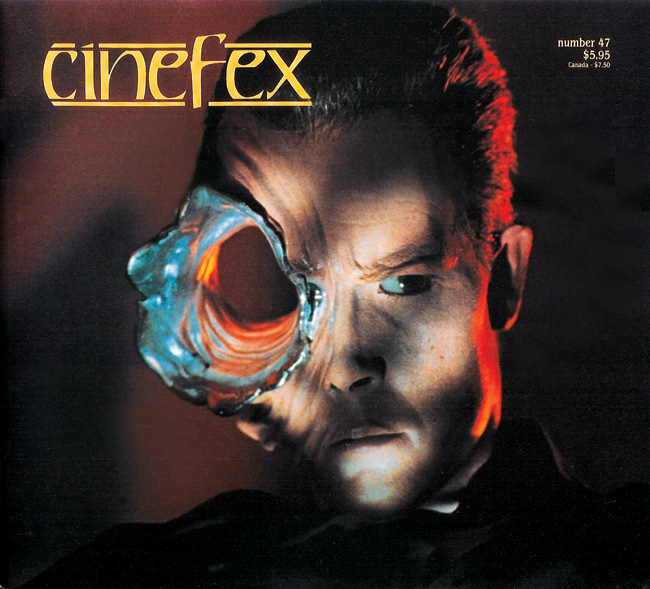
<FONT COLOR='#ff0000'>Terminator 2: Judgment Day: A Once and Future War</FONT>: Seven years ago, writer-director James Cameron was an unknown entity with only an ultra-low-budget horror picture to his credit, Arnold Schwarzenegger was a world-class bodybuilder with a few less-than-world-class movies under his belt and Linda Hamilton was a young actress with a number of nondescript teen roles on her brief resume. The Terminator changed all that. A landmark science fiction film whose nonstop techno-action was punctuated with rare humor and an affecting love story, The Terminator was the impetus for major career breaks across the board. In the next half-dozen years, Cameron would become one of the hottest directors in Hollywood, Schwarzenegger would become the world's biggest boxoffice star and Hamilton would become the celebrated beauty of a cult television series. Though a sequel seemed inevitable, prospects for launching one were snarled in a spider's web of proprietary interests and legal entanglements until early 1990 when Carolco Pictures stepped in and cleared the way. Eighteen months later, after a grueling six-month shoot and an intense postproduction schedule, one of the biggest films in history was ready for release. Bringing magic to Terminator 2: Judgment Day was an army of effects people - most of them veterans of earlier Cameron productions. Stan Winston and company were responsible for Terminator makeups and animatronic puppetry. Dennis Muren supervised the creation of an advanced shape-shifting terminator at Industrial Light & Magic. Gene Warren of Fantasy II provided a major truck crash and a future war in miniature while Robert and Dennis Skotak of 4-Ward Productions wreaked nuclear havoc on Los Angeles. Video Image supplied 'Termovision' point-of-view material and Pacific Data Images performed some digital rescue work. The result was an epic foray into science fiction filmmaking. Article by Jody Duncan
Issue 48 1991
Main Cover

<FONT COLOR='#ff0000'>Backdraft: Standing the Heat</FONT>: When director Ron Howard set out to make the ultimate firefighting picture, even he supposed that much of the fiery action in Backdraft would have to be accomplished via miniatures and process photography. Special effects supervisor Allen Hall would prove him wrong. Although a handful of visual effects shots would indeed be produced by Industrial Light & Magic, nearly all of the nonstop pyrotechnics would be accomplished live on stage sets and urban locations - with major screen actors working in close proximity to conflagrations of awesome magnitude. Article by Jody Duncan<BR>
<FONT COLOR='#ff0000'>The Rocketeer: Rocket Blast</FONT>: To capture on film the adventure and ambience of The Rocketeer - Dave Stevens' comic book evocation of Los Angeles during the golden age of aviation - director Joe Johnston assembled a team of ace collaborators including production designer Jim Bissel and special effects supervisor Jon G. Belyeu. A former visual effects art director, Johnston also returned to his alma mater - Industrial Light & Magic - for optical work and miniatures ranging from an eighteen-inch flying superhero to a thirty-four-foot zeppelin. Article by Mark Cotta Vaz.<BR>
<FONT COLOR='#ff0000'>Cast a Deadly Spell: That Old Black Magic</FONT>: Inspired by the period writings of Raymond Chandler and H.P. Lovecraft, Cast a Deadly Spell - a made-for-cable feature produced by Gale Anne Hurd for HBO Pictures - infuses the hard-boiled detective genre with unabashed elements of supernatural horror and offbeat humor. Makeup and creature effects - including a passel of gremlins, a living gargoyle and assorted demons large and small - were created by Tony Gardner and his Alterian Studios. Opticals and miniatures - primarily matte paintings and a cataclysmic finale - were provided by 4-Ward Productions. Article by Kevin H. Martin
1992
Issue 49 1992
Main Cover

<FONT COLOR='#ff0000'>Hook: Return to Neverland</FONT>: For director Steven Spielberg, Hook fulfilled a seven-year recurring dream to bring the classic story of Peter Pan to the screen for modern audiences. Accompanying the eternal boy - now a grown-up attorney who has lost touch with his youth - back to Neverland were Spielberg regulars including physical effects provider Michael Lantieri and the visual effects artists of Industrial Light & Magic. Surrounded by an army of designers and technicians, Spielberg mounted a $70 million epic destined to be remembered as the most lavish studio production in recent history. Article by Mark Cotta Vaz<BR>
<FONT COLOR='#ff0000'>Naked Lunch: Borrowed Flesh</FONT>: As a youth in his native Toronto, David Cronenberg devoured with relish the iconoclastic prose of beat generation author William S. Burroughs. Thirty years later, he was to write and direct a screen adaptation of Burroughs' most celebrated novel, Naked Lunch. Having populated his bizarre script with a variety of never-before-seen creatures - from emaciated mugwumps to talking insect-typewriters - Cronenberg engaged the effects artisans of Chris Walas Incorporated to breathe life into some of his film's most important characters. Article by Jody Duncan<BR>
<FONT COLOR='#ff0000'>Star Trek VI: The Undiscoverd Country: Letting Slip the Dogs of War</FONT>: A cataclysmic disaster prompts an unprecedented offering of peace from the Klingon empire. Thematically and time-wise, Star Trek VI: The Undiscovered Country echoed the coincident collapse of the Soviet Union and the demise of series creator Gene Roddenberry. In this atmosphere of significant finality, director Nicholas Meyer - veteran of two previous Star Trek features - marshaled the forces of Industrial Light & Magic and makeup supervisor Michael J. Mills to help realize on film the last mission of Captain James T. Kirk and the crew of the starship Enterprise. Article by Kevin H. Martin
Issue 50 1992
Main Cover

<FONT COLOR='#ff0000'>Alien 3: Zealots and Xenomorphs</FONT>: In the footsteps of Ridley Scott and James Cameron, novice director David Fincher set about to put his own personal stamp on the third installment in the Alien saga. Contributing to t he Alien 3 effects effort were creature creators Tom Woodruff, Jr. and Alec Gillis, physical effects experts George Gibbs and Al Di Sarro, and visual effects veteran Richard Edlund and his Boss Film Studios. Article by Bill Norton<BR>
<FONT COLOR='#ff0000'>The Lawnmower Man: Cyberworld</FONT>: Intent upon exploring the cinematic possibilities of 'virtual reality', director Brett Leonard and producer Gimel Everett scripted and obtained independent financing for The Lawnmower Man. To infuse their film with a big-budget computer graphics look - without the big budget - they engaged digital effects teams at Angel Studios and Xaos Incorporated to realize the virtual environments. Article by Peter Sorensen<BR>
A Message from the Publisher <BR>
<FONT COLOR='#ff0000'>Effects Scene</FONT>: 64th Academy Awards <BR>
<FONT COLOR='#ff0000'>Video Beat</FONT>: Morphing to the Music <BR>
<FONT COLOR='#ff0000'>Profile</FONT>: Joseph Viskocil <BR>
<FONT COLOR='#ff0000'>Commercial Spot</FONT>: Widebody Whales, Reflections of the Dead <BR>
<FONT COLOR='#ff0000'>Laser Revolution</FONT>: Laserdisc Manifesto <BR>
<FONT COLOR='#ff0000'>Index</FONT>: Cinefex 1-50
Issue 51 1992
Main Cover

<FONT COLOR='#ff0000'>Batman Returns: A Knight at the Zoo</FONT>: For three years after the record-breaking success of Batman, legions of batfans eagerly awaited the return of their Dark Kinght. With BatmanReturns, director Tim Burton - in his inimitably macabre style - was to once again bring the Batman legend to the screen. Like the first film,which had been a monumental production mounted in England,Batman Returns would demand the all-out efforts of a veritable army of filmmaking and effects personnel. For the sequel, the filmmakers would remain on American soil, shooting the live-action on some of the biggest soundstages in Hollywood - with no fewer than eight effects facilities joining the fray. Visual effects supervisor MichaelFink oversaw the complex effects assignment, which included everything from Gotham City miniatures to animatronic penguin puppets to computer generated bats. Key contributors to the project were to come from the celebrated ranks of Boss Film Studios, Matte World, StetsonVisual Services, The Chandler Group, Video Image Associates, StanWinston Studio, 4-Ward Productions and CG Special Effects. Article by Mark Cotta Vaz<BR>
<FONT COLOR='#ff0000'>Effects Scene</FONT>: Technology and Magic <BR>
<FONT COLOR='#ff0000'>Profile</FONT>: Katherine Kean <BR>
<FONT COLOR='#ff0000'>Quick Cuts</FONT>: Dating the Babe <BR>
<FONT COLOR='#ff0000'>Commercial Spot</FONT>: Dodge Blocks <BR>
<FONT COLOR='#ff0000'>Video Beat</FONT>: Short Intruders <BR>
<FONT COLOR='#ff0000'>Laser Revolution</FONT>: The Eighth Wonder
Issue 52 1992
Main Cover

<FONT COLOR='#ff0000'>Honey, I Shrunk the Kids: Blowing Up Baby</FONT>: When Disney was making Honey, I Shrunk the Kids, its own in-house effects facility lacked both the equipment and the personnel to take on the assignment. Three years later, Honey, I Blew Up the Kid would mark the reemergence of Buena Vista Visual Effects. Providing support were eleven other effects companies, including CIS-Hollywood and Sony High Definition in their feature film debuts. Article by Jody Duncan<BR>
<FONT COLOR='#ff0000'>Death Becomes Her: Life Neverlasting</FONT>: Among the effects challenges of Robert Zemeckis' black comedy, Death Becomes Her, were the unlikely depictions of Goldie Hawn as a two-hundred-fifty-pound blimp and Meryl Streep with a twisted-around head. The effects teams at Industrial Light & Magic and Amalgamated Dynamics Incorporated joined with makeup artists Dick Smith and Kevin Haney to realize the comically horrific tale. Article by Kevin H. Martin<BR>
<FONT COLOR='#ff0000'>Commercial Spot</FONT>: Simian Simulation, Elevator to the Stars <BR>
<FONT COLOR='#ff0000'>Quick Cuts</FONT>: Video Hell, Panic on Liberty Island <BR>
<FONT COLOR='#ff0000'>Profile</FONT>: Alan Munro <BR>
<FONT COLOR='#ff0000'>Video Beat</FONT>: Morphing to the Madness <BR>
<FONT COLOR='#ff0000'>Laser Revolution</FONT>: The Lost World Revisited <BR>
<FONT COLOR='#ff0000'>Effects Scene</FONT>: Therapy in Pen-and-Ink
1993
Issue 53 1993
Main Cover

<FONT COLOR='#ff0000'>Bram Stoker's Dracula: Heart of Darkness</FONT>: In undertaking his film adaptation of Dracula, director Francis Ford Coppola was determined to remain faithful to the original Bram Stoker novel while still leaving himself adequate freedom to examine it through his own sensibilities. Rejecting high-tech effects, he opted to employ old-time cinema illusions supervised by his son, Roman Coppola, with a host of providers includingMichael Lantieri,Cannom Creations, Matte World,4-Ward Productions, Fantasy II, Colossal Pictures, Visual Concept Engineering and Available Light. Article by Janine Pourroy<BR>
<FONT COLOR='#ff0000'>A Close Encounter with Steven Spielberg</FONT>: Once upon a time, a watershed motion picture challenged the long-entrenched Hollywood notion that unidentified flying objects and the forces behind them must be inherently evil. Choosing instead to speculate upon exraterrestrial visitation as a benign phenomenon, writer director Steven Spielberg fashioned a classic tale of everyday people swept up in extraordinary events. On the occasion of its fifteenth anniversary, Spielberg reflects upon Close Encounters of the Third Kind - its concept, its casting, its effects. Interview by Don Shay<BR>
<FONT COLOR='#ff0000'>Quick Cuts</FONT>: Muppetized Dickens <BR>
<FONT COLOR='#ff0000'>Commercial Spot</FONT>: True Colors, Sci-Fi Pest Control <BR>
<FONT COLOR='#ff0000'>Effects Scene</FONT>: Full Moon Rising <BR>
<FONT COLOR='#ff0000'>Profile</FONT>: Doug Beswick <BR>
<FONT COLOR='#ff0000'>Laser Revolution</FONT>: Harryhausen Cornucopia
Issue 54 1993
Main Cover

<FONT COLOR='#ff0000'>Cliffhanger: Effects in the Vertical Realm</FONT>: Centering on a team of expert mountain climbers and set atop the rugged peaks of the Colorado Rockies,Cliffhanger was a dizzying adventure in filmmaking for director Renny Harlinand his production crew. Key providers of the film's 'over-the-edge' illusions were special effects veteran John Richardson and visual effects supervisors Neil Krepela and John Bruno of Boss Film. Article by Debra Kaufman<BR>
<FONT COLOR='#ff0000'>Toys: Toy Wars</FONT>: Known for poignant, richly-drawn slice-of-life films such as Diner and Avalon, director Barry Levinson took a more fanciful turn with Toys, an anti-war parable starring Robin Williams. Helping Levinson to explore Toys'bizarre world were production designer Ferdinando Scarfiotti, effects coordinator Clayton Pinney and a full roster of mechanical and visual effects artisans. Article by Mark Cotta Vaz<BR>
<FONT COLOR='#ff0000'>Quick Cuts</FONT>: Unfriendly Skies <BR>
<FONT COLOR='#ff0000'>Commercial Spot</FONT>: Thoroughbred Animation, What's Up, Nike? <BR>
<FONT COLOR='#ff0000'>Video Beat</FONT>: Deep Space Miniatures, Chronicling Young Indy <BR>
<FONT COLOR='#ff0000'>Effects Scene</FONT>: The Perigee of Apogee <BR>
<FONT COLOR='#ff0000'>Profile</FONT>: Peter Kuran <BR>
<FONT COLOR='#ff0000'>Laserdisc Revolution</FONT>: Tall Tales and Epic Lore
Issue 55 1993
Main Cover

<FONT COLOR='#ff0000'>Jurassic Park: The Beauty in the Beasts</FONT>: An unusually prolonged preproduction period paid off both artistically and commercially when Steven Spielberg's much-anticipated Jurassic Park opened this summer to a dinosaur-crazed public. The creation of its amazingly lifelike dinosaurs was an odyssey into moviemaking magic led by Dennis Muren, Stan Winston, Phil Tippett and Michael Lantieri. Effects techniques as old as the movies themselves were infused with new life and direction, while newer approaches were pushed to unexpected heights. The result - a quantum leap in aggregate technologies - would establish an altogether new set of standards for a venerable old genre. Article by Jody Duncan<BR>
<FONT COLOR='#ff0000'>Video Beat</FONT>: Deep Space Wormholes <BR>
<FONT COLOR='#ff0000'>Quick Cuts</FONT>: Under Heavy Cetacean, Once More into the Abyss, Hail to the Impostor, A Crash in the Andes.<BR>
<FONT COLOR='#ff0000'>Company File</FONT>: Pixar <BR>
<FONT COLOR='#ff0000'>Portfolio</FONT>: Jurassic Park Denizens <BR>
<FONT COLOR='#ff0000'>Commercial Spot</FONT>: Evolutionary Auto <BR>
<FONT COLOR='#ff0000'>Effects Scene</FONT>: In the Digital Domain, Cinematic Archaeology <BR>
<FONT COLOR='#ff0000'>Laserdisc Revolution</FONT>: Jurassic Reality
Issue 56 1993
Main Cover

<FONT COLOR='#ff0000'>The Nightmare Before Christmas: Animation in the Third Dimension</FONT>: Ever since his days as an animator at Walt Disney Studios, Tim Burton had nurtured the idea forThe Nightmare Before Christmas, a dark and uniquely personal fairy tale that has at last come to the screen as a fully stop-motion-animated feature film. Article by Mark Cotta Vaz<BR>
<FONT COLOR='#ff0000'>Last Action Hero: Pandora's Paintbox</FONT>: Although Last Action Hero failed to live up to its pre-release hype, its massive effects workload and tight schedule did inspire some behind-the-scenes heroics by artisans at R/Greenberg Associates, Sony Pictures Imageworks and other effects companies. Article by Bill Norton<BR>
<FONT COLOR='#ff0000'>RoboCop 3: RoboCop Redux</FONT>: After two years of financial entanglement, Orion Pictures has released RoboCop 3, the latest installment in its popular franchise. Laboring to bring a more fully-evolved RoboCop to the screen was an effects team that included Rob Bottin and Phil Tippett. Article by Phil Carpenter<BR>
<FONT COLOR='#ff0000'>Quick Cuts</FONT>: Digital Soul Searching, Feline Fabrication, That Other T-rex.<BR>
<FONT COLOR='#ff0000'>Commercial Spot</FONT>: Track Sold Separately. <BR>
<FONT COLOR='#ff0000'>Profile</FONT>: Pete Romano.<BR>
<FONT COLOR='#ff0000'>Video Beat</FONT>: Making Movie Magic <BR>
<FONT COLOR='#ff0000'>Laserdisc Revolution</FONT>: From the Disney Archives
1994
Issue 57 1994
Main Cover

<FONT COLOR='#ff0000'>Attack of the 50 Foot Woman: The Making of a 50 Foot Woman</FONT>: From its humorously derivative opening logo to its campy postscript, the Home Box Office remake of Attack of the 50 Foot Woman was clearly an ode to old-style moviemaking. On a scant made-for-television budget, visual effects supervisor Gene Warren and his Fantasy II team members made mountains out of molehills with forced perspective miniatures, split-screen trickery and other vintage effects. Article by Tim Prokop<BR>
<FONT COLOR='#ff0000'>Demolition Man: Fire and Ice</FONT>: On-set effects such as large-scale pyrotechnics, frozen human replicas and robotic action props were just part of the Demolition Man story. Racing against time, with a schedule that was essentially only eight weeks long, visual effects supervisor Micheal McAlister delivered the complex cinematic illusions required for the film by tapping a wealth of talent from eight different houses. Article by Jody Duncan <BR>
<FONT COLOR='#ff0000'>Video Beat</FONT>: Toasting Babylon 5, Order Out of Xaos, McCartney Takes Wing. <BR>
<FONT COLOR='#ff0000'>Special Venues</FONT>: Deep Earth, Dark Ride <BR>
<FONT COLOR='#ff0000'>Quick Cuts</FONT>: Digital Effects <BR>
<FONT COLOR='#ff0000'>Commercial Spot</FONT>: Chevy Hulk <BR>
<FONT COLOR='#ff0000'>Laserdisc Revolution</FONT>: Coppola's Kane
Issue 58 1994
Main Cover

<FONT COLOR='#ff0000'>The Flintstones: The Making of a Rockbuster</FONT>: The Flintstones - a live-action ode to the cartoon series - was a lighthearted romp through Bedrock. Underlying its sight gags, however, was a serious filmmaking effort that required animatronic puppets from Jim Henson's Creature Shop, large-scale physical effects by Michael Lantieri, as well as computer graphics and complex image processing by Industrial Light & Magic. Article by Jody Duncan<BR>
<FONT COLOR='#ff0000'>The Hudsucker Proxy: The Rise and Fall of Norville Barnes</FONT>: Filmmakers Joel and Ethan Coen are not typically associated with visual effects extravaganzas. But with The Hudsucker Proxy, they jumped headlong into extensive miniature sets, digital composingand outrageous mechanical rigs. Joining the fray were Micheal McAlister, Stetson Visual Services, Peter Chesney, Mark Sullivan and Computer Film Company. Article by W.C. Odien <BR>
<FONT COLOR='#ff0000'>Quick Cuts</FONT>: Crime and Banishment, Visionary Visuals, Making the Crow Fly, Midair Morphing, A Lady in Disguise.<BR>
<FONT COLOR='#ff0000'>Video Beat</FONT>: Viper Sheds Its Skin<BR>
<FONT COLOR='#ff0000'>Commercial Spot</FONT>: Kong Reenergized.<BR>
<FONT COLOR='#ff0000'>Profile</FONT>: Kevin Yagher.
Issue 59 1994
Main Cover

<FONT COLOR='#ff0000'>True Lies: Mayhem Over Miami</FONT>: In his latest cinematic extravaganza,True Lies, writer-director James Cameron spiced his trademark action with comedy in depicting a few days in the harried life of Harry Tasker - a secret agent whose super-secretiveness extends even to his wife and family. Assigned to deliver the lion's share of visual effects for the film was Digital Domain - a startup company formed by Cameron and associates - which produced more than a hundred traditional and digital effects shots. Providing major and minor support were a number of other companies including Pacific Data Images and Boss Film Studios. Article by Don Shay<BR>
<FONT COLOR='#ff0000'>Special Venues</FONT>: Moon Shots<BR>
<FONT COLOR='#ff0000'>Quick Cuts</FONT>: Terminal Effects, Maximum Speed. <BR>
<FONT COLOR='#ff0000'>Video Beat</FONT>: Alien Nation Revisited <BR>
<FONT COLOR='#ff0000'>Company Files</FONT>: Animal Makers, Makeup & Effects Laboratories. <BR>
<FONT COLOR='#ff0000'>Commercial Spot</FONT>: 'They Keep Going and Going . . .' <BR>
<FONT COLOR='#ff0000'>Closeup</FONT>: Adding Teeth to Wolf <BR>
<FONT COLOR='#ff0000'>Profile</FONT>: Randal M. Dutra
Issue 60 1994
Main Cover

<FONT COLOR='#ff0000'>The Mask: From Zero To Hero</FONT>: An ancient artifact - aided by Cannom Creations makeup and effects from Industrial Light & Magic and Dream Quest Images - turned actor Jim Carrey into a manic cartoon in The Mask. Article by Jody Duncan <BR>
<FONT COLOR='#ff0000'>Mary Shelley's Frankenstein: Haunting Creation</FONT>: With creature makeups by Daniel Parker and effects by Richard Conway and Computer Film Company, director Kenneth Branagh captured the essence of Mary Shelley's Frankenstein. Article by Mark Cotta Vaz<BR>
<FONT COLOR='#ff0000'>Forrest Gump: Making Gump Happen</FONT>: To recreate some pivotal moments in recent American history, Forrest Gump director Robert Zemeckis enlisted Industrial Light & Magic to provide the subtlest of digital illusions. Article by Janine Pourroy<BR>
<FONT COLOR='#ff0000'>Video Beat</FONT>: Piloting to Earth 2, Attack of the 80-Foot Stones, Casting Another Spell.<BR>
<FONT COLOR='#ff0000'>Quick Cuts</FONT>: Time Passages, Shadow World, The Return of the Vampire<BR>
<FONT COLOR='#ff0000'>Commercial Spot</FONT>: Cola Bears, Light and Liberty, Byte-Size Cookies.
1995
Issue 61 1995
Main Cover

<FONT COLOR='#ff0000'>Interview With the Vampire: Immortal Images</FONT>: In development for nearly two decades, Interview With the Vampire at last reached the big screen under the guidance of director Neil Jordan, with makeup and animatronics by Stan Winston Studio and visual effects by Digital Domain. Article by Estelle Shay<BR>
<FONT COLOR='#ff0000'>Star Trek Generations: Kirk Out</FONT>: Star Trek Generations decisively passed command of the feature-film Enterprise from Captain James T. Kirk to Captain Jean-Luc Picard. Reprising as principal effects provider was Industrial Light & Magic, with an assist from Santa Barbara Studios. Article by Kevin H. Martin<BR>
<FONT COLOR='#ff0000'>Stargate: Through the Stargate</FONT>: For his upstart epic, Stargate, director Roland Emmerich assembled adiversely talented effects team from the ranks of Kleiser-Walczak Construction Company, Kit West Productions, Patrick Tatopoulos, Available Light and Cinema Research Corporation. Article by Mark Cotta Vaz <BR>
<FONT COLOR='#ff0000'>Quick Cuts</FONT>: A New Twist on Tornadoes, Clause and Effects, Santa's Helpers, Animal House, Wood Works <BR>
<FONT COLOR='#ff0000'>Special Venues</FONT>: Inside the Luxor Pyramid<BR>
<FONT COLOR='#ff0000'>Effects Scene</FONT>: From Tatooine to Endor
Issue 62 1995
Main Cover

<FONT COLOR='#ff0000'>Congo: Gorilla Warfare</FONT>: When Frank Marshall and Kathleen Kennedy set out to film Congo, they turned to Stan Winston Studio for one of the story's main characters, as well as its principal villains. Then, for groundbreaking earthquake and volcano effects, they enlisted Industrial Light & Magic and physical effects supervisor Michael Lantieri. Article by Jody Duncan<BR>
<FONT COLOR='#ff0000'>Judge Dredd: Dredd World</FONT>: Effects crews on both sides of the Atlantic helped to bring Judge Dredd to the screen. Working the live-action in England were physical effects supervisor Joss Williams and makeup designer Nick Dudman. And providing the miniature and digital work stateside were Mass.Illusion and Kleiser-Walczak Construction Company. Article by Mark Cotta Vaz<BR>
<FONT COLOR='#ff0000'>Dick Smith - 50 Years in Makeup</FONT>: Dick Smith won his first job in makeup during the golden age of live television. Essentially untrained, but with boundless enthusiasm and drive, he quickly mastered his craft and branched into motion pictures. In half a century of achievement, he has contributed countless technological and aesthetic advances to the field. Tribute by Don Shay<BR>
<FONT COLOR='#ff0000'>Quick Cuts</FONT>: Sub Plots, Cinematic Cyberspace, Thirty Seconds Over Zaire<BR>
<FONT COLOR='#ff0000'>Profile</FONT>: Jeff Matakovich<BR>
<FONT COLOR='#ff0000'>Video Beat</FONT>: Cannom Creations
Issue 63 1995
Main Cover

<FONT COLOR='#ff0000'>Apollo 13: Launching Apollo 13</FONT>: Total verisimilitude was the prime directive for visual effects supervisor Rob Legato and his team at Digital Domain, and for special effects coordinator Matt Sweeney, when they signed on with director Ron Howard to bring Apollo 13 to the screen. Article by Jody Duncan <BR>
<FONT COLOR='#ff0000'>Batman Forever: Forever and a Knight</FONT>: With director Joel Schumacher at the helm, big changes were in store for Gotham and its denizens in Batman Forever. Visual effects supervisor John Dykstra enlisted more than a dozen compaines to complete the gargantuan effects assignment. Article by Mark Cotta Vaz <BR>
<FONT COLOR='#ff0000'>Quick Cuts</FONT>: The Ghost and Mr. Muren, Cowboys and Indians, An Endangering Species, Capturing an Alien Species, Bonnie and Clyde.<BR>
<FONT COLOR='#ff0000'>Special Venues</FONT>: MGM's Grand EFX<BR>
<FONT COLOR='#ff0000'>Commercial Spot</FONT>: Bear Necessitites, This Frog's For You, Batteries Included<BR>
<FONT COLOR='#ff0000'>Effects Scene</FONT>: The Last Hurrah<BR>
<FONT COLOR='#ff0000'>Video Beat</FONT>: Soldiers of Fortune
Issue 64 1995
Main Cover

<FONT COLOR='#ff0000'>Jumanji: The Game Board Jungle</FONT>: For Jumanji - in which jungle animals emerge from a magical board game to wreak havoc on a small town - director Joe Johnston enlisted Industrial Light & Magic and Amalgamated Dynamics to provide computer generated and animatronic effects. Article by Janine Pourroy<BR>
<FONT COLOR='#ff0000'>Toy Story: Toys Will Be Toys</FONT>: A landmark collaboration between Walt Disney Studios and Pixar has produced Toy Story - the first fully computer animated feature-length film - a comic confluence of artistry and high technology directed by John Lasseter. Article by Rita Street<BR>
<FONT COLOR='#ff0000'>Waterworld: On the Water Front</FONT>: Production design and physical effects merged to create the vast floating sets and ships needed for Waterworld. Voluminous visual effects - overseen by Micheal J. McAlister - kept more than a dozen effects companies swimming. Article by Jeff Odien <BR>
<FONT COLOR='#ff0000'>Broken Arrow</FONT>: Stealth Effects<BR>
<FONT COLOR='#ff0000'>Gordon Smith</FONT>: Seeking Silicone Solutions<BR>
<FONT COLOR='#ff0000'>Money Train</FONT>: Training Film<BR>
<FONT COLOR='#ff0000'>Babe</FONT>: From the Mouth of Babe<BR>
<FONT COLOR='#ff0000'>Casino</FONT>: The Lights of Las Vegas<BR>
<FONT COLOR='#ff0000'>Three Wishes</FONT>: Making Wishes Come True<BR>
<FONT COLOR='#ff0000'>Cutthroat Island</FONT>: Getting Away With Murder<BR>
<FONT COLOR='#ff0000'>Operation Dumbo Drop</FONT>: Pachyderms and Parachutes
1996
Issue 65 1996
Main Cover

<FONT COLOR='#ff0000'>After the Rebellion</FONT>: Industrial Light & Magic, then and now - two decades in the evolution of a technological titan. Article by Mark Cotta Vaz .<BR>
<FONT COLOR='#ff0000'>20 Years of Industrial Light & Magic</FONT>: Established by George Lucas to insure himself first-rate effects for his own productions, Industrial Light & Magic has grown into a service organization that has supplied visual alchemy for every major studio and many of the world's top filmmakers. Survey by Jody Duncan.<BR>
<FONT COLOR='#ff0000'>30 Minutes With the Godfather of Digital Cinema</FONT> No one has done more to change the face of visual effects than George Lucas. In an exclusive interview, he discusses ILM and its contributions to the field - and drops a few hints of what to expect in the Star Wars special editions and the long-awaited prequels. Interview by Don Shay.<BR>
<FONT COLOR='#ff0000'>War Stories</FONT>: Twenty years ago, a group of young artists and technicians took over a vacant warehouse - and soon took over an industry. More than a dozen of the original Star Wars team members reminisce about making one of the most influential films of all time. Article by Kevin H. Martin.<BR>
<FONT COLOR='#ff0000'>Dennis Muren - Playing It Unsafe</FONT>: Though he now has eight Academy Awards - more than anyone else alive - Dennis Muren is down-to-earth in his insistence that the work is all that matters to him. A look back at his humble beginnings and celebrated achievements. Article by Don Shay.
Issue 66 1996
Main Cover

<FONT COLOR='#ff0000'>Dragonheart: Heart and Soul</FONT>: Producer Rafaella de Laurentiis had to wait five years for effects technology to catch up with the demands of her dream project. But with perseverance, director Rob Cohen and cutting-edge digital effects by Industrial Light & Magic, Dragonheart and its uniquely expressive talking dragon at last came wholly to life. Article by Jody Duncan.<BR>
<FONT COLOR='#ff0000'>Twister: Riders on the Storm</FONT>: Director Jan De Bont realized that a dead-on depiction of tornadoes and the destruction they wreak was essential to Twister, his suspense thriller about daredevil storm-chasers. Enlisted to produce the integrated effects were physical effects supervisor John Frazier and the digital team at Industrial Light & Magic. Article by Jonathan Luskin.<BR>
<FONT COLOR='#ff0000'>James and the Giant Peach: A Giant Peach in the Big Apple</FONT>: To bring James and the Giant Peach, the classic Roald Dahl children's story, to the the screen through the medium of puppet animation, director Henry Selick orchestrated a massive two-year stop-motion effort augmented with digital contributions by Sony Pictures Imageworks and Buena Vista Visual Effects. Article by Mark Cotta Vaz.<BR>
Aftershocks: Return of the Worms.<BR>
<FONT COLOR='#ff0000'>Flipper</FONT>: Dolphin Doubles.<BR>
<FONT COLOR='#ff0000'>Sgt. Bilko</FONT>: Techno-Tank Trickery.<BR>
<FONT COLOR='#ff0000'>White Squall</FONT>: Stormy Weather.<BR>
<FONT COLOR='#ff0000'>Gulliver's Travels</FONT>: A Brobdingnagian Endeavor.<BR>
<FONT COLOR='#ff0000'>Michael Fink</FONT>: From Fine Arts to Filmmaking.
Issue 67 1996
Main Cover

<FONT COLOR='#ff0000'>Independence Day: Fireworks</FONT>: To supply the staggering volume of effects required for Independence Day, director Roland Emmerich and producer Dean Devlin chose not to engage a major effects facility, electing instead to build an in-house miniatures and pyrotechnic unit, coupled with an independent digital effects unit, dedicated solely to the production. Article by Tim Prokop.<BR>
<FONT COLOR='#ff0000'>Mission: Impossible : Cruising the Digital Backlot</FONT> The action finale of Mission: Impossible - created by Industrial Light & Magic - entailed placing a computer generated train and helicopter into digitally altered or created backgrounds, enhanced with elaborate miniature work and pyrotechnics. Article by Mark Cotta Vaz.<BR>
<FONT COLOR='#ff0000'>Multiplicity: Split Personalities</FONT>: For Multiplicity - a comedy about a man who hopes to find time for himself by undergoing a cloning procedure - director Harold Ramis engaged Boss Film Studios to produce four distinct versions of actor Michael Keaton, all of whom had to interact verbally and physically during the course of the film. Article by Janine Pourroy.<BR>
<FONT COLOR='#ff0000'>The Nutty Professor</FONT>: Pleasingly Klump.<BR>
<FONT COLOR='#ff0000'>Escape from L.A.</FONT>: Hasta La Buena Vista.<BR>
<FONT COLOR='#ff0000'>The Arrival</FONT>: Temperatures Rising.<BR>
<FONT COLOR='#ff0000'>The Frighteners</FONT>: The Thrill of the Haunt.<BR>
<FONT COLOR='#ff0000'>Hercules</FONT>: Solving Mythical Dilemmas.<BR>
<FONT COLOR='#ff0000'>The Adventures of Pinocchio</FONT>: Puppetmasters.<BR>
<FONT COLOR='#ff0000'>Nike Commercial</FONT>: Eyes on the Ball.
Issue 68 1996
Main Cover

<FONT COLOR='#ff0000'>Mars Attacks!: Martial Art</FONT>: In Mars Attacks!, director Tim Burton's lampoon of the alien invasion genre, hordes of flying saucers and big-headed Martians wreak havoc on earth's inhabitants. Forsaking motion control spaceships and stop-motion creatures in favor of an all-digital approach, Industrial Light & Magic and the newly established Warner Digital Studio shared responsibility for the visual effects. Article by Mark Cotta Vaz.<BR>
<FONT COLOR='#ff0000'>T23D: Battle Beyond Three Dimensions</FONT>: Conceived by Landmark Entertainment as a thrill-packed continuation of the Terminator saga, Terminator 2: Battle Across Time - Universal Studio's newest theme park extravaganza - redefines 3-D and special venue entertainment. Terminator 2 director James Cameron and the film's original cast teamed with effects powerhouse Digital Domain to bring the groundbreaking project to fruition. Article by Estelle Shay.<BR>
<FONT COLOR='#ff0000'>Daylight</FONT>: Burned Out and Blown Out.<BR>
<FONT COLOR='#ff0000'>Michael Westmore</FONT>: Behind the Masks.<BR>
<FONT COLOR='#ff0000'>The Ghost and the Darkness</FONT>: Bad Cats in a Bad Place.<BR>
<FONT COLOR='#ff0000'>The City of Lost Children</FONT>: Magic With a French Touch.<BR>
<FONT COLOR='#ff0000'>The Associate</FONT>: Gender Benders.<BR>
<FONT COLOR='#ff0000'>The Island of Dr. Moreau</FONT>: Moreau's Menagerie.
1997
Issue 69 1997
Main Cover

<FONT COLOR='#ff0000'>Dante's Peak: Dante's Inferno</FONT>: For his epic disaster movie, Dante's Peak, director Roger Donaldson was determined to simulate on film a massive volcanic eruption that was both dramatic and realistic. Engaged to deliver the goods were visual effects supervisor Patrick McClung of Digital Domain and special effects supervisor Roy Arbogast. Article by Rita Street.<BR>
<FONT COLOR='#ff0000'>The Relic: The Calisto Effect</FONT>: In The Relic - directed by Peter Hyams - a genetically mutated beast prowls the dark recesses of a cavernous natural history museum looking for human prey. Charged with designing and fabricating the monster were the creature creators at Stan Winston Studio, abetted in the digital realm by effects artisans at VIFX. Article by Rita Street.<BR>
<FONT COLOR='#ff0000'>Star Trek: First Contact</FONT>: The eighth offering in an enduring franchise, Star Trek: First Contact marked the first film carried solely by The Next Generation crew, and the feature directing debut of cast member Jonathan Frakes. Supplying effects were series regulars Industrial Light & Magic and makeup creator Michael Westmore. Article by Kevin H. Martin.<BR>
<FONT COLOR='#ff0000'>Star Wars Trilogy</FONT>: Everything Old Is New Again.<BR>
<FONT COLOR='#ff0000'>Turbulence</FONT>: Terror in the Skies.<BR>
<FONT COLOR='#ff0000'>101 Dalmations</FONT>: Puppy Proliferation.<BR>
<FONT COLOR='#ff0000'>The Sixth Man</FONT>: Hoop Schemes.<BR>
<FONT COLOR='#ff0000'>Crash McCreery</FONT>: Doing Dinosaurs and Such.
Issue 70 1997
Main Cover

<FONT COLOR='#ff0000'>Men in Black: Basic Black</FONT>: For director Barry Sonnenfeld's science fiction comedy Men in Black - about shadowy government agents who oversee extraterrestrial activities on earth - makeup effects artist Rick Baker produced a variety of imaginatively conceived aliens, supplemented by computer generated creations and other effects concocted by Industrial Light & Magic. Article by Janine Pourroy.<BR>
<FONT COLOR='#ff0000'>The Lost World: On the Shoulders of Giants</FONT>: When it came time to select an effects team for The Lost World, director Steven Spielberg turned promptly to character creator Stan Winston, visual effects supervisor Dennis Muren of Industrial Light & Magic, and special effects supervisor Michael Lantieri - the trio that had written effects history on Jurassic Park - to once again push the boundaries of artistry and technology. Article by Jody Duncan.<BR>
<FONT COLOR='#ff0000'>The Fifth Element: Elemental Images</FONT>: To impart an epic quality to The Fifth Element - his whimsical science fiction adventure about a New York cab driver who is called upon to help save the universe from annihilation - director Luc Besson turned to Digital Domain and visual effects supervisor Mark Stetson to create an array of futuristic cityscapes and distant worlds through a blend of traditional and digital imagery. Article by Ted Elrick.<BR>
<FONT COLOR='#ff0000'>Con Air</FONT>: Skyjinks.<BR>
<FONT COLOR='#ff0000'>Anaconda</FONT>: Snake Charmers.<BR>
<FONT COLOR='#ff0000'>Classic Restoration</FONT>: The Lost World - Found!
Issue 71 1997
Main Cover

<FONT COLOR='#ff0000'>Batman & Robin: Freeze Frames</FONT>: For Batman & Robin - the fourth feature in the Batman Series and the second for director Joel Schumacher - visual effects supervisor John Dykstra drew upon the specialties of several effects houses to produce a series-high four hundred effects shots. Article by Mark Cotta Vaz.<BR>
<FONT COLOR='#ff0000'>Volcano: Toasting the Coast</FONT>: Tasked with unleashing the ultimate scourge on Los Angeles for the Mick Jackson film, Volcano, visual effects supervisor Mat Beck oversaw the creation of volcano and lava effects achieved via practical, miniature and digital means. Article by Rita Street .<BR>
<FONT COLOR='#ff0000'>Spawn: With a Little Help From Our Friends</FONT>: To bring the comic book sensation Spawn to the screen, a trio of young upstarts from Industrial Light & Magic donned production hats and engaged in guerrilla filmmaking in the digital realm to create a lavish effects film on a slender budget. Article by Jody Duncan.<BR>
<FONT COLOR='#ff0000'>Contact: Close Contact</FONT> With effects ranging from earthbound to cosmic, Contact marked the seventh collaboration between director Robert Zemeckis and visual effects supervisor Ken Ralston, now head of Sony Pictures Imageworks. Article by Kevin H. Martin.<BR>
<FONT COLOR='#ff0000'>Speed 2</FONT> : Crusing Speed.<BR>
<FONT COLOR='#ff0000'>John Chambers</FONT>: Maestro of Makeup.
Issue 72 1997
Main Cover

<FONT COLOR='#ff0000'>Titanic: Back to Titanic</FONT>: Titanic is an apt title for the latest film from director James Cameron, denoting not only the subject matter of the picture, but the scope of the endeavor, as well. On his odyssey to bring the story of the 1912 maritime disaster to the screen, Cameron went to the bottom of the North Atlantic to photograph the actual Titanic wreck, then reconstructed the celebrated ship, almost full-size - and sank it ! - at a studio built expressly to house the massive production. Article by Don Shay .<BR>
<FONT COLOR='#ff0000'>Titanic: Ship of Dreams</FONT>: Convinced that total verisimilitude was essential for Titanic, Cameron challenged Digital Domain and visual effects supervisor Robert Legato to blur the line between full-size photography and miniature work by constructing an enormous model of the ship, then placing it in a digital ocean environment and populating it with computer generated people to capture, in intimate detail, the expansive elegance of the liner at sea and the horror of its untimely demise. Article by Don Shay.<BR>
<FONT COLOR='#ff0000'>Titanic: Titanic Aftermath</FONT>: During principal photography and into postproduction, as the visual effects workload for Titanic increased from 150 shots to more than 500, a production-level effects department was established to assign and monitor the overflow workload, which was farmed out to seventeen separate facilities collectively contributing everything from complex compositing and miniature photography to matte paintings and computer animation. Article by Jody Duncan.
1998
Issue 73 1998
Main Cover

<FONT COLOR='#ff0000'>Starship Troopers: Bug Bytes</FONT>: To bring their ambitious adaptation of Robert A. Heinlein's classic Starship Troopers to the screen, director Paul Verhoeven and producer Jon Davison turned to animation maestro Phil Tippett for swarms of insect warriors, to Sony Pictures Imageworks for epic-scale space battles, and to special effects coordinator John Richardson for on-set pyrotechnics. Others recruited to support the war effort included Amalgamated Dynamics, Industrial Light & Magic, Boss Film Studios, Banned From the Ranch, Compound Eye, Visual Concept Engineering and Kevin Yagher Productions. Article by Paul M. Sammon.<BR>
<FONT COLOR='#ff0000'>Alien Resurrection: Cloning Aliens</FONT>: For Alien Resurrection, the latest offering in the Alien franchise, Ellen Ripley and the alien fetus within her are brought back from the dead in a film directed by Jean-Pierre Jeunet. Returning as alien purveyors were Tom Woodruff, Jr., and Alec Gillis of Amalgamated Dynamics Incorporated, whose animatronic and suit-based creatures were augmented by digital warriors created by Blue Sky Studios. Overseeing the visual effects - filmed in Los Angeles, but composited by Duboi in Paris - were effects supervisors Pitof and Erik Henry. Article by Bill Norton.<BR>
<FONT COLOR='#ff0000'>Flubber</FONT>: Playing With Flubber.<BR>
<FONT COLOR='#ff0000'>Mouse Hunt</FONT>: Of Mice and Men.<BR>
<FONT COLOR='#ff0000'>An American Werewolf in Paris</FONT>: Werewolf Wizardry.<BR>
<FONT COLOR='#ff0000'>Event Horizon</FONT>: Starship Hades Boss Film Studios: End of an Era.
Issue 74 1998
Main Cover

<FONT COLOR='#ff0000'>Godzilla: The Sound and the Fury</FONT>: As a follow-up to their Independence Day phenomenon, director Roland Emmerich and producer Dean Devlin opted to reinvent a classic Japanese film franchise with Godzilla. Under visual effects supervisor Volker Engel, the newly-formed Centropolis Effects created a twenty-story-tall digital Godzilla, supported by practical creature effects from Patrick Tatopoulos designs, plus extensive physical effects, both large and small, by Clay Pinney and Joseph Viskocil. Article by Kevin H. Martin.<BR>
<FONT COLOR='#ff0000'>The X-Files Movie: Hide It in Shadow, Hide It in Light</FONT>: After a five-season run, the television sensation The X-Files leaped to the big screen in a feature film produced by X-Files creator Chris Carter and directed by series regular Rob Bowman. In addition to makeup and creature effects by Amalgamated Dynamics Incorporated, the motion picture featured an abundance of postproduction work - supplied principally by Light Matters and Blue Sky |VIFX - overseen by visual effects supervisor Mat Beck. Article by Jody Duncan.<BR>
<FONT COLOR='#ff0000'>Deep Impact</FONT>: The Angry Rock.<BR>
<FONT COLOR='#ff0000'>Lost in Space</FONT>: Lost in London.<BR>
<FONT COLOR='#ff0000'>Deep Rising</FONT>: Horror on the High Seas.<BR>
<FONT COLOR='#ff0000'>Sphere</FONT>: Spherical Magic.<BR>
<FONT COLOR='#ff0000'>Dark City</FONT>: Masters of the Dark.
Issue 75 1998
Main Cover

<FONT COLOR='#ff0000'>Armageddon: Journey to Armageddon</FONT>: For Armageddon, about roughneck oil drillers sent on a heroic mission into space to save earth from a killer asteroid, director Michael Bay and producer Jerry Bruckheimer needed near-nonstop visual effects to support the action. To meet the demand, the production formed an in-house effects unit, Vfx, overseen by visual effects supervisor Pat McClung, and engaged Dream Quest Images, under fellow supervisor Richard Hoover. Also making sizable contributions were Blue Sky |VIFX, Digital Domain, Cinesite and Computer Film Company. Article by Mark Cotta Vaz.<BR>
<FONT COLOR='#ff0000'>Small Soldiers: A Small Soldiers Story</FONT>: For the high-concept DreamWorks project Small Soldiers, centering on toy action figures implanted with high-tech military computer chips that allow them to take on a life of their own, director Joe Dante worked closely with Stan Winston Studio, which designed the Commando Elite and Gorgonite characters and then built them in puppet form for use on set, and Industrial Light and Magic, which duplicated the combative toys in digital form and computer-animated them for scenes requiring complex action. Article by Jody Duncan.<BR>
<FONT COLOR='#ff0000'>From the Earth to the Moon</FONT>: Shooting the Moon.<BR>
<FONT COLOR='#ff0000'>Blade</FONT>: Going For the Jugular.<BR>
<FONT COLOR='#ff0000'>Dr. Dolittle</FONT>: Animals With Attitude.<BR>
<FONT COLOR='#ff0000'>The Truman Show</FONT>: The Unreal World.
1999
Issue 76
January/February/March 1999
Main Cover

<FONT COLOR='#ff0000'>Mighty Joe Young: A Gorilla Named Joe</FONT>: With Mighty Joe Young, director Ron Underwood put a modern spin on the venerable film classic about a lovable giant gorilla plucked from his idyllic home in Africa and given a dose of big-city life. While the original Joe was a triumph of stop-motion animation that astounded moviegoers of its time, the updated ape would be no less remarkable, brought into being through sophisticated animatronics and suit artistry by Rick Baker, in concert with groundbreaking visual effects spearheaded by Hoyt Yeatman of Dream Quest Images. Article by Scott Essman.<BR>
<FONT COLOR='#ff0000'>What Dreams May Come: The Sweet Hereafter</FONT>: A metaphysical speculation on the nature of the afterlife, What Dreams May Come, based on a novel by Richard Matheson, chronicles the spiritual journey through Heaven and Hell of a man determined to reunite his family and rescue his soul mate from an eternity of suffering. Guided by director Vincent Ward, whose singular vision of the hereafter infused the project, visual effects contributors Mass.Illusions, POP Film and Digital Domain offered up dazzling technical innovations in the service of an extraordinary aesthetic concept. Article by Kevin H. Martin.<BR>
<FONT COLOR='#ff0000'>Pleasantville</font>: Color My World.<BR>
<FONT COLOR='#ff0000'>Antz</FONT>: Road to Insectopia.<BR>
<FONT COLOR='#ff0000'>A Bug's Life</FONT>: An Entomological Epic.<BR>
<FONT COLOR='#ff0000'>Virus</FONT>: Building a Better Borg.
Issue 77
April/May/June 1999
Main Cover

<FONT COLOR='#ff0000'>Star Trek: Insurrection: Lost in the Briar Patch</FONT>: Star Trek: Insurrection, the ninth feature film in the venerable science fiction franchise - with veteran cast member Jonathan Frakes again at the helm - had many familiar elements, including prosthetic makeup effects by Michael Westmore, but employed new technologies and new companies in the creation of its abundant visual effects. Santa Barbara Studios crafted spaceship shots entirely in the digital realm - a first for the series - while Blue Sky |VIFX contributed a range of predominantly planet-bound illusions. Article by Kevin H. Martin.<BR>
<FONT COLOR='#ff0000'>The Mummy: Thoroughly Modern Mummy</FONT>: For his remake of the Boris Karloff horror classic, The Mummy, director Stephen Sommers was determined to present a title character far apart from the bandage-wrapped mummies that lumbered through a variety of decades-old predecessors. Engaged to design and create the mummy Imhotep as both an all-CG character and a digitally altered live actor, plus devise a host of other fabrications involving fearsome sandstorms and plagues, was visual effects supervisor John Berton and the artists at Industrial Light & Magic. Article by Estelle Shay.<BR>
<FONT COLOR='#ff0000'>My Favorite Martian</FONT>: Martian Chronicles<BR>
<FONT COLOR='#ff0000'>T-Rex - Back to the Cretaceous</FONT>: The Five-Terabyte Solution<BR>
<FONT COLOR='#ff0000'>Babe - Pig in the City</FONT>: Mean Streets<BR>
<FONT COLOR='#ff0000'>Wing Commander</FONT>: Space Ace Engagement
Issue 78
July/August/September 1999
Main Cover

<FONT COLOR='#ff0000'>Return of the Jedi</FONT>: With the patience of a Jedi master, writer-director George Lucas waited sixteen years before determining the time was right to launch his much-anticipated Star Wars prequel, The Phantom Menace. Stepping back into the limelight to personally shepherd the project through its four-year production odyssey, the visionary filmmaker shares his insights on the most ambitious effects movie ever made. Interview by Don Shay.<BR>
<FONT COLOR='#ff0000'>Phantom Visions</FONT>: An enormous conceptualization effort, headed by design director Doug Chiang, lent form and substance to Lucas' imaginings of The Phantom Menace's fantasy worlds. Initially comprised of just Chiang and another illustrator, the team eventually expanded to include seventeen artists, pumping out endless sketches, paintings, sculptures and models in the Skywalker Ranch art department. Article by Mark Cotta Vaz.<BR>
<FONT COLOR='#ff0000'>Heroe's Journey</FONT>: Fittingly, it was Industrial Light & Magic, the much-honored company established by Lucas to produce the revolutionary effects in Star Wars, that would undertake the staggering task of bringing his latest opus to fruition. For The Phantom Menace, ILM would pull out all the stops, calling upon both veterans of the earlier trilogy and a newer generation of digital devotees to advance the art of visual effects to dizzying heights. Article by Jody Duncan, Kevin H. Martin and Mark Cotta Vaz.<BR>
<FONT COLOR='#ff0000'>Populating Planets</FONT> Although computer animation would play the more prominent role in populating The Phantom Menace's alien worlds, hundreds of whimsical characters - both background and principal - were constructed for on-set use by creature creator Nick Dudman and his crew of animatronics and makeup specialists. Article by Estelle Shay.
Issue 79
October/November/December 1999
Main Cover

<FONT COLOR='#ff0000'>Wild Wild West: A Walk on the Wild Side </FONT>: With source material plumbed from the popular sixties television series, director Barry Sonnenfeld's Wild Wild West offered up a comic saga of Old West
derring-do pitted against outrageous villainy and bizarre gadgetry. Makeup effects by Rick Baker, physical gags by Michael Lantieri and digital creations by Industrial Light & Magic and Cinesite enlivened the proceedings.
Article by Kevin H. Martin.<BR>
<FONT COLOR='#ff0000'>The Haunting: The House That Roared</FONT>: In The Haunting, based on the novel by Shirley Jackson, the malevolent spirit of a killer manifests itself in a gothic mansion, turning imagined threats into
nightmarish reality for the unwitting subjects of a psychological study. Director Jan De Bont sought the talents of effects maestro Phil Tippett and production designer Eugenio Zanetti, among others, to inject new life into the eerie tale. Article by Christine Sandoval.<BR>
<FONT COLOR='#ff0000'>The Matrix: Jacking Into the Matrix</FONT>: Offering up a mix of stylish martial arts and cerebral science fiction, The Matrix -- the brainchild of writer-directors Larry and Andy Wachowski -- offered a
singular vision of a world where reality is nothing more than an elaborate computer construct. Visual effects were achieved principally by Manex Visual Effects and DFilm Services, with assists from other firms in both the United States and Australia. Article by Kevin H. Martin.<BR>
<FONT COLOR='#ff0000'>Deep Blue Sea: Devils in the Deep Blue Sea</FONT>: Mako sharks, armed with enhanced intellects and super-predatory instincts -- the result of genetic experimentation on board an aquatic research station -- turn on their captors in the Renny Harlin thriller, Deep Blue Sea. Animatronics innovator Walt Conti teamed with visualeffects supervisor Jeffrey A. Okun and a host of digital effects facilities to complete the project. Article by Estelle Shay.
2000
Issue 80
January/February/March 2000
Main Cover

<FONT COLOR='#ff0000'>A Look Back </FONT>: With this issue, Cinefex is marking its twentieth year, an occasion that has prompted us to take a wholly subjective look back -- to reflect on how Cinefex
came to be, how the effects industry has evolved since the magazine's inception,
and to recall some of the highlights of the last two decades. <BR>
<FONT COLOR='#ff0000'>20 Questions</FONT>: We asked a few of our friends in the business to help us celebrate our 20th anniversary by offering up their considered opinions as to the best effects sequences
of the past 20 years. Also, in an unprecedented display of subjectivity, Cinefex
editorial staff members picked their own personal favorites. <BR>
<FONT COLOR='#ff0000'>Stuart Little: All Things Great and Little</FONT>: Under director Rob Minkoff and senior effects supervisor John Dykstra, animators at Sony Pictures Imageworks created a photoreal, if fanciful, computer generated mouse for Stuart Little that effectively carried the movie, while artists at Rhythm & Hues
and Centropolis Effects supplied lip-sync to a supporting cast of talking cats.
article by Kevin H. Martin<BR>
<FONT COLOR='#ff0000'>Sleepy Hollow: A Region of Shadows</FONT>: For his horrific, yet stylish Sleepy Hollow, director Tim Burton created a post-colonial New York village in England and assigned effects teams at Industrial
Light & Magic, The Computer Film Company and Kevin Yagher Productions to supply
a murderous headless horseman and a gruesome array of decapitation victims.
article by Mark Cotta Vaz <BR>
<FONT COLOR='#ff0000'>Fight Club: A World of Hurt</FONT>: In Fight Club, director David Fincher concocted subtle visual effects to get inside the twisted mind of his film's narrator. With oversight from visual effects supervisor
Kevin Tod Haug, teams at Digital Domain, Pixel Liberation Front, BUF, Image Savant,
Blue Sky, Command Post/Toybox and Gray Matter contributed to the effort.
article by Kevin H. Martin <BR>
<FONT COLOR='#ff0000'>Harryhausen & Tippett: The Motion in Our Minds</FONT>: A one-on-one interview with stop-motion maestro Ray Harryhausen by Phil Tippett.
Issue 81
April/May/June 2000
Main Cover

<FONT COLOR='#ff0000'>Mission to Mars: Mission Accomplished </FONT>:
For Mission to Mars, a science fiction film from director Brian De Palma,
visual effects teams at Dream Quest Images, Industrial Light & Magic and Tippett
Studio used motion control miniatures and a wide range of digital effects to lend
dazzling verisimilitude to the cinematic depiction of NASA's first manned
mission to the red planet - and the staggering revelations that follow.
article by Kevin H. Martin<BR>
<FONT COLOR='#ff0000'>End of Days: Days of Fire and Brimstone</FONT>:
Capitalizing on Y2K doomsday predictions, End of Days dramatizes the
biblically prophesied return of Satan to earth on the eve of the millennium. Working
with director Peter Hyams, visual effects supervisor Eric Durst oversaw the efforts
of several effects companies to manifest the devil in his true form and dramatize
his epic struggle with the one man determined to thwart him.
article by Kevin H. Martin <BR>
<FONT COLOR='#ff0000'>Galaxy Quest: Trekking into the Klaatu Nebula</FONT>:
In an affectionate sendup of the Star Trek franchise and its devoted following,
Galaxy Quest tells the tale of a washed-up band of actors who give the performance
of their lives in a real-life space adventure. As lead effects house on the Dean
Parisot film, Industrial Light & Magic relied on miniature spaceships and
computer generated creatures to enliven the proceedings.
article by Jody Duncan & Estelle Shay<BR>
<FONT COLOR='#ff0000'>Bicentennial Man</FONT>: In His Own Image.<BR>
<FONT COLOR='#ff0000'>Toy Story 2</FONT>: Beyond Andy's Room.<BR>
<FONT COLOR='#ff0000'>Pitch Black</FONT>: Chimera of the Night.
Issue 82
July/August/September 2000
Main Cover

<FONT COLOR='#ff0000'>Dinosaur: Engendered Species</FONT>: The feature animation division of Walt Disney Studios created an all-new digital
facility to support its first computer generated film, Dinosaur, about an orphaned
iguanodon whose gentle ways come in conflict with his species' baser instincts.
Contributing to the movie's novel look were deftly orchestrated visual effects
that blended CG characters with digitally processed live-action backgrounds. <BR>
<FONT COLOR='#ff0000'>The Perfect Storm: Perfecting the Storm</FONT>: A real-life tragedy recounted in the book The Perfect Storm provided the basis
for director Wolfgang Petersen's movie of the same name, about a swordfishing boat
lost at sea during a storm of unprecedented ferocity. Raising the bar on CG water
effects, Industrial Light & Magic produced the digitally engineered tempest,
designed to work in concert with large-scale stage effects by John Frazier. <BR>
<FONT COLOR='#ff0000'>Chicken Run: Poultry in Motion</FONT>: Aardman Animations, of Wallace and Gromit renown, graduated to feature status
with Chicken Run, a sendup of The Great Escape, in which a farm's resident chickens
hatch a desperate plan to escape being turned into pot pies. Though the comedy
employed Aardman's signature stop-motion puppeteering, it also benefited
from a range of digital contributions by Computer Film Company.<BR>
<FONT COLOR='#ff0000'>Gladiator</FONT>: A Cut Above<BR>
<FONT COLOR='#ff0000'>U-571</FONT>: Hostile Waters<BR>
<FONT COLOR='#ff0000'>Battlefield Earth</FONT>: Battle Fatigue
Issue 83
October/November/December 2000
Main Cover

<FONT COLOR='#ff0000'>X-Men: The X-Men Cometh</FONT>: Plagued by budget and time constraints, plus a burgeoning effects slate, visual effects supervisor Michael L. Fink overcame the odds on X-Men, a fantasy
based on the enduring Marvel comic books. To handle the film's array of mutant characters -- all exhibiting singular mental or physical powers that distinguish them from ordinary humans -- Fink divided the work among some nine visual effects companies, assigning each a particular character or type of effect. Other key contributors were physical effects coordinator Colin Chilvers and makeup effects supervisor Gordon Smith. Article by Kevin H. Martin <BR>
<FONT COLOR='#ff0000'>Hollow Man: Disappearing Act</FONT> : To depict the invisible protagonist at the heart of Hollow Man, veteran director Paul Verhoeven engaged Sony Pictures Imageworks and senior visual effects
supervisor Scott Anderson to pull out all the stops, duplicating actor Kevin Bacon's physiology and live performance with a digital replica capable of revealing the character's anatomy from the inside out. Also assuming a
sizable share of the workload was Tippett Studio, under visual effects supervisor Craig Hayes. Rounding out the effort were practical effects by Stan Parks and makeup by Amalgamated Dynamics Incorporated.
Article by Estelle Shay<BR>
<FONT COLOR='#ff0000'>The Cell</FONT>: Mindscape Architects<BR>
<FONT COLOR='#ff0000'>The Patriot</FONT>: Picking His Battles<BR>
<FONT COLOR='#ff0000'>What Lies Beneath</FONT>: Hitchcock Homage
2001
Issue 84
January/February/March 2001
Main Cover

<FONT COLOR='#ff0000'>Red Planet: Red Scare</FONT>: In Red Planet, astronauts from a dying earth encounter dire obstacles as they investigate failing terraformation experiments designed to render Mars suitable for human colonization. Faced with daunting challenges of its own - including a competing project and a ballooning effects slate that threatened to top out at nearly a thousand shots -- Warner Brothers called upon visual effects supervisor Jeffrey A. Okun to oversee the massive effects effort. Also recruited were a dozen effects vendors, delivering everything from space footage and zero-gravity effects to Martian landscapes and a CG robot performance. Article by Kevin H. Martin <BR>
<FONT COLOR='#ff0000'>The Whos and Whys of How the Grinch Stole Christmas</FONT>: For his live-action version of the beloved Dr. Seuss story, How the Grinch Stole Christmas, director Ron Howard created the town of Whoville and nearby Mount Crumpit on massive soundstages at Universal, then relied upon makeup maestro Rick Baker to transform actor Jim Carrey and a huge cast of supporting actors and extras into the fictional Grinch and his Who neighbors. Adding visual dazzle to the proceedings were special effects coordinator Allen Hall, in charge of on-set gags, and Digital Domain, whose virtual set extensions and other effects lent style and verisimilitude to the fantasy world. Article by Mark Cotta Vaz <BR>
<FONT COLOR='#ff0000'>Vertical Limit</FONT>: Pushing the Limit <BR>
<FONT COLOR='#ff0000'>Bedazzled</FONT>: Devil's Work <BR>
<FONT COLOR='#ff0000'>102 Dalmatians</FONT>: Out, Out, Damned Spot
Issue 85
April/May/June 2001
Main Cover

<FONT COLOR='#ff0000'>2001: A Time Capsule</FONT>: Still a benchmark by which space films, old and new, are judged, 2001: A Space Odyssey has enthralled science fiction devotees for more than three decades with its purposefully ambiguous take on man's imagined first contact with an extraterrestrial intelligence. In this, its namesake year, Cinefex pays tribute to this seminal film with a comprehensive retrospective, culled from in-depth interviews with many of its principal technicians and craftsmen - some no longer with us - who were instrumental in bringing legendary director Stanley Kubrick's timeless, profound and startlingly realistic-looking vision of deep space exploration to the screen. From its inception as a novel and screenplay - a corroborative effort by Kubrick and science fiction maestro Arthur C. Clarke - through its painstaking, often frustrating, four-year-long odyssey, the epic undertaking continually tested the skills and resourcefulness of such innovators as special effects supervisors Douglas Trumbull and Wally Gentleman, production designer Tony Masters, cinematrographer John Alcott, makeup artist Stuart Freeborn and others whose recollections form the foundation of this account. Challenged by Kubrick, ever the perfectionist, all rose to the occasion, exploring countless concepts and approaches, and, in an era long before computers and motion control were endemic to visual effects, devising imaginative and heretofore untried techniques and equipment that would pave the way for future generations of filmmakers. Article by Don Shay and Jody Duncan <BR>
<FONT COLOR='#ff0000'>The Mummy Returns</FONT>: Warrior Kings <BR>
<FONT COLOR='#ff0000'>The 6th Day</FONT>: Copy Rights <BR>
<FONT COLOR='#ff0000'>Monkeybone</FONT>: Monkey Business
Issue 86
July/August/September 2001
Main Cover

<FONT COLOR='#ff0000'>Pearl Harbor: More War:</FONT> In Walt Disney Studios' epic Pearl Harbor, producer Jerry Bruckheimer and director Michael Bay stage a tale of love and valor against the backdrop of World War II and the infamous Japanese air attack on the U.S. Pacific Fleet that spelled the end of the country's isolationist doctrine. Depictions of the assault, along with earlier reenactments of air battles over Britain and the retaliatory Doolittle raid on Tokyo, were achieved through extensive use of digital battleships and planes -- compliments of Industrial Light & Magic -- in combination with large-scale mechanical and pyrotechnic effects by John Frazier and his crew. Stan Winston Studio contributed makeup effects.<BR>
<FONT COLOR='#ff0000'>Evolution: Accelerated Evolution</FONT>: Echoing the sensibilities of his earlier comedy hit Ghostbusters, director Ivan Reitman's newest film, Evolution, has scientists battling aliens after a meteor crashes into the Arizona desert, releasing minute extraterrestrial lifeforms that vaguely attempt to mimic earth's evolutionary cycle. Phil Tippett and his Tippett Studio artists designed and created, through digital character animation, much of the continuously metamorphosing extraterrestrial ecology, from single-cell microorganisms to complex air and land creatures. Also in the mix were digital effects by Pacific Data Images and practical creature work by KNB EFX Group and Amalgamated Dynamics.<BR>
<FONT COLOR='#ff0000'>Moulin Rouge</FONT>: Paris By Numbers<BR>
<FONT COLOR='#ff0000'>Final Fantasy</FONT>: Flesh For Fantasy<BR>
<FONT COLOR='#ff0000'>Driven</FONT>: Speed Demons
Issue 87
October/November/December 2001
Main Cover

<FONT COLOR='#ff0000'>A.I.: Mecha Odyssey</FONT>: After more than two decades of super-secret development by filmmaking legend Stanley Kubrick, A.I.: Artificial Intelligence - the story of a robot-child's quest for a means to become human - would finally see the light of day in the hands of Steven Spielberg, who crafted both the script and the film from notes and artwork left behind by Kubrick upon his death. Spielberg summoned Industrial Light & Magic visual effects supervisors Dennis Muren and Scott Farrar to convey onto film new and existing conceptual art of a future world ravaged by the effects of global warming and overpopulated by both humans and their mechanical creations. Spielberg also engaged Stan Winston Sutdio to design and build an extensive cast of robot characters. Article by Joe Fordham.<BR>
<FONT COLOR='#ff0000'>Inside the Planet of the Apes</FONT>: Visionary director Tim Burton put his own singular spin of Planet of the Apes,, a remake of the 1968 classic, depicting evolution turned on its ear in a world where humans are subjugated by a superior race of apes. The production would boast a stellar team of effects contributors. Cementing his reputation as the undisputed master of simian simulation was makeup maestro Rick Baker, whose Cinovation Studio team would create fourteen principal ape characters, all distinct and different, plus hundreds of secondary and background players. Spearheading the postproduction visual effects, a blend of models, paintings and digital work, were visual effects supervisors Bill George and George Murphy of Industrial Light & Magic. Article by Mark Cotta Vaz.<BR>
<FONT COLOR='#ff0000'>Jurassic Park III</FONT>: Bigger, Faster, Meaner.<BR>
<FONT COLOR='#ff0000'>Tomb Raider</FONT>: Illuminating Lara's World.
2002
Issue 88
January/February/March 2002
Main Cover

<FONT COLOR='#ff0000'>Harry Potter & the Sorcerer's Stone: Sleight of Hand</FONT>: Having singlehandedly captured the fancy of an entire generation of adolescent readers and ignited a pop culture phenomenon, English author J.K. Rowling's Harry Potter novels - about a novice wizard and his magical adventures at a school for the supernaturally gifted - were ripe for translation to the big screen. With Harry Potter and the Sorcerer's Stone, Warner Brothers has taken up the gauntlet, presenting the first installment in a highly anticipateed movie series based on the Rowling books. Director Chris Columbus, determined to remain faithful to the source material and its legion of fans, based the production in England and assembled an all-English cast, along with a virtual army of world-class artisans and technicians tasked with producing their own brand of alchemy in the service of the show. Joining forces with special effects supervisor John Richardson and makeup effects artist Nick Dudman as Oscar-winning visual effects supervisor Robert Legato, who orchestrated the efforts of eight visual effects facilities on both sides of the ocean, creating everything from wonderous settings to magical creatures to a thrilling aerial tournament played on broomsticks. Article by Joe Fordham <BR>
<FONT COLOR='#ff0000'>Monsters, Inc.</FONT>: Monsters in the Closet.<BR>
<FONT COLOR='#ff0000'>The Fast and the Furious</FONT>: Street Wars.<BR>
<FONT COLOR='#ff0000'>Shrek</FONT>: Jowly Green Giant.
Issue 89
April/May/June 2002
Main Cover

<FONT COLOR='#ff0000'>The Time Machine: The Shape of Things to Come</FONT>: In his remake of the classic tale, The Time Machine, director Simon Wells called upon visual effects supervisor James Price and lead effects house Digital Domain to help bridge a narrative gap that spanned some 800,000 years. While Digital Domain was responsible for many of the movie's signature time travel scenes, practical creature effects were the work of Stan Winston Studio and KNB EFX Group, and special effects supervisor Matt Sweeney oversaw creation of the fabled machine. Article by Joe Francis<BR>
<FONT COLOR='#ff0000'>Black Hawk Down: Under Fire</FONT>: Based on a nonfiction account of a 1993 military incident that ooccurred in Mogadishu, Somalia, Black Hawk Down recounts the disastrous mission and daring rescue of an elite force of U. S. Army troops, whose attempts to curb terrorist tactics by a Somali warlord were thwarted when they were ambushed by thousands of his militiamen. Ridley Scott directed the harrowing cinematic reenactment, relying heavily on in-camera effects by special effects supervisor Neil Corbould, and digital enhancements by Mill Film and Asylum Visual Effects. Article by Joe Fordham<BR>
<FONT COLOR='#ff0000'>The Lord of the Rings: The Fellowship of the Ring: Ring Masters</FONT>: In a marathon effort that has won raves from critics, recognition from peers and the admiration of legions of moviegoers, New Zealand director Peter Jackson accomplished the seemingly impossible - a faithful, live-action adaptation of J.R.R. Tolkien's The Lord of the Rings: The Fellowship of the Ring, with two more installments to follow. Working with a dedicated crew at Weta, his homegrown effects facility, Jackson relied on Kiwi ingenuity to overcome unimaginable hurdles, executing some 1500 visual effects that included the development of a breakthrough crowd simulation program with 'thinking' characters capable of autonomous behavior.
Issue 90
July/August/September 2002
Main Cover

<FONT COLOR='#ff0000'>Spider-Man: Spin City</FONT>: Following in the footsteps of countless comic book tales immortalized by Hollywood, Spider-Man distinguishes itself as one of the most memorable. Director Sam Raimi brought the popular teen crime fighter to life with help from visual effects supervisor John Dykstra and physical effects supervisor John Frazier, whose efforts enabled actor Toby Maguire to perform such superhuman feats as web-slinging and wall crawling. Though live mechanical means were used whenever possible, leaps into a more fantastic realm were accomplished by Sony Pictures Imageworks. Article by Joe Fordham<BR>
<FONT COLOR='#ff0000'>Star Wars Episode II: Attack of the Clones: Love & War</FONT>: In Attack of the Clones, the promised second prequel to the Star Wars saga, George Lucas once again called upon the artists at Industrial Light & Magic to push the technological envelope in the service of his vision. The result is a film in which nearly every frame bursts with manufactured imagery, captured entirely on high-definition digital video - a first for the motion picture industry. Among the accomplishments were an all-new CG Yoda, visually stunning miniature and digital environments, and thrilling action sequences involving armies of battle droids. Article by Jody Duncan
Issue 91
October/November/December 2002
Main Cover

<FONT COLOR='#ff0000'>Reign of Fire: Burnt Offerings</FONT>: Flame-spewing dragons awakened from centuries of sleep are imbued with a terrifying reality in Reign of Fire, directed by Rob Bowman. Pushing the envelope on character animation in its design and execution of the dragons was The Secret Lab, responsible for the film's digital and miniature work. Special effects by Dave Gauthier and additional fire effects by Reelistic FX also helped Bowman realize his vision of a charred and smoking post-apocalyptic world overrun by the beasts. Article by Bill Norton <BR>
<FONT COLOR='#ff0000'>Men In Black 2: Building a Better Pug</FONT>: Back by popular demand after a five-year hiatus, agents Kay and Jay, secret operatives in a covert alien control agency confront a host of new lifeforms in Men in Black 2. Also returning to the fold were director Barry Sonnenfeld and many of the original film's core creative team, including Industrial Light & Magic and Rick Baker's Cinovation Studio. Their contributions, along with those of Sony Pictures Imageworks and Tippett Studio, ensured that the sequel's trademark aliens would be even more outrageous than the first. Article by Brad Munson<BR>
<FONT COLOR='#ff0000'>Minority Report: Future Reality</FONT>: Director Steven Spielberg ventured into the realm of science fiction in Minority Report, a futuristic parable in which the telepathic visions of genetically engineered 'precogs' have made it possible to apprehend murderers before they commit their crimes. Visual effects by Industrial Light & Magic and a host of other vendors, and physical effects by Michael Lantieri lent authenticity to the story, meticulously conveying the technological advances of a society whose efforts to police itself have strayed into questionable moral territory. Article by Joe Fordham
2003
Issue 92
January/February/March 2003
Main Cover

<FONT COLOR='#ff0000'>The Lord of the Rings: The Two Towers</FONT>: Middle-earth Strikes Back: In The Lord of the Rings: The Two Towers, the second installment in the epic live-action film adaptation of J.R.R. Tolkien's trilogy, director Peter Jackson ramps up the action as the fellowship continues to battle the forces of darkness threatening Middle-earth. Academy Award-winning effects facilities Weta Digital and Weta Workshop again partnered with Jackson to produce some 800 visual effects shots for the film, running the gamut from elaborate creature effects and miniature work to sophisticated character animation. Lending a hand in the proceedings was Sony Pictures Imageworks. Article by Joe Fordham <BR>
<FONT COLOR='#ff0000'>Spy Kids: Working at the Speed of Thought</FONT>: With the success of Spy Kids and its equally popular sequel, Spy Kids 2, independent filmmaker Robert Rodriguez proved that high production values and a multitude of slick effects need not require a nine-digit budget. Offering up his recipe for success, Rodriguez provides an insider's view of the guerrilla-style tactics terhat he and his team of innovative effects vendors relied upon to achieve remarkable results working outside the traditional Hollywood infrastructure. Article by Jody Duncan <BR>
<FONT COLOR='#ff0000'>xXx: Shaken and Stirred</FONT>: Director Rob Cohen and action star Vin Diesel reunite for xXx, a new breed of spy film whose secret agent -- a career never-do-well recruited from the fringe culture of extreme sports - relies on death-defying feats of athleticism as his modus operandi. Special effects supervisor John Frazier staged numerous live effects on set, while Digital Domain handled the bulk of the visual effects work required to place Vin Diesel squarely in the midst of the action. Additional effects support was provided by Illusion Arts, Digiscope and Gray Matter. Article by Christian Carvajal
Issue 93
April/May/June 2003
Main Cover

<FONT COLOR='#ff0000'>Adaptation: Twin Geeks</FONT>: Witty, imaginative and highly unorthodox, Adaptation, directed by Spike Jonze, pits the film's real-life screenwriter Charlie Kaufman against his fictional twin brother, Donald - both portrayed by Nicolas Cage -- as the two go head-to-head in a comical search for artistic truth and familial redemption. Twinning and other effects were the work of visual effects supervisor Gray Marshall and his Gray Matter FX team, while makeup artists Joel Harlow and Kevin Yagher provided facial and body prosthetics. Article by Joe Fordham <BR>
<FONT COLOR='#ff0000'>Daredevil: Blind Justice</FONT>: Continuing the tradition of comic book characters making the leap from panel to screen, Daredevil follows the crimefighting adventures of vigilante lawyer Matt Murdock, whose heightened sensory powers are a by-product of a freak accident in childhood that blinded him. Director Mark Steven Johnson called upon visual effects supervisor Rich Thorne and principal vendors Rhythm & Hues, Digital Domain and Pixel Magic to render his superhero's antics, making extensive use of digital doubles in combination with practical effects and live-action stuntwork. Article by Joe Fordham <BR>
<FONT COLOR='#ff0000'>Harry Potter and the Chamber of Secrets: When Harry Met Dobby</FONT>: Harry Potter and the Chamber of Secrets, the second in a series of films based on J.K. Rowling's popular children's books, serves up more of everything - more effects, more complex action and environments, more 3D creature work. Reuniting for the sequel were director Chris Columbus and many of the first film's core effects contributors, including special effects supervisor John Richardson, creature creator Nick Dudman and London-based vendors Mill Film, The Moving Picture Company, Cinesite and Framestore CFC. Leading the visual effects effort was Jim Mitchell of Industrial Light & Magic. Article by Barbara Robertson <BR>
<FONT COLOR='#ff0000'>Star Trek Nemesis: Through a Glass Darkly</FONT>: Following a lengthy hiatus, Paramount Pictures' most enduring film franchise returns with Star Trek Nemesis, the tenth installment in the series and fourth based on the Emmy-winning Next Generation television show. First-time Trek director Stuart Baird challenged veteran production personnel such as makeup head Michael Westmore and production designer Herman Zimmerman, as well as Trek rookie Mark Forker -- who headed the visual effects team at Digital Domain -- to infuse the show with a fresh perspective. Article by Bill Norton
Issue 94
July/August/September 2003
Main Cover

<FONT COLOR='#ff0000'>The Hulk: Green Destiny</FONT>: From the pages of Marvel Comics through a popular eighties television series and several movies-of-the-week, the Hulk has endured as one of the most memorable characters of its genre. However, his big-screen debut in The Hulk, directed by Ang Lee, promises to be his most impressive, thanks to the work of award winning visual effects supervisor Dennis Muren and a team at Industrial Light & Magic, who were charged with bringing the green-skinned behemoth to life as an entirely computer generated character. Article by Joe Fordham<BR>
<FONT COLOR='#ff0000'>X-Men United: Generation X2</FONT>: The reluctant heroes and singular villains of X-Men, a film based on the popular Marvel Comics series, are back for a return engagement in the sequel, X2: X-Men United -- this time accompanied by a new generation of 'X-kids.' Also returning to the fold was visual effects supervisor Michael L. Fink and many of the original film's effects artisans, who tackled the sequel's more ambitious workload - new and improved looks for returning characters, the fleshing out of new characters and the execution of several spectacular action sequences. Article by Brad Munson<BR>
<FONT COLOR='#ff0000'>The Core: Innerspace</FONT>: A subterranean odyssey undertaken by terranauts to save the earth from destructive magnetic forces is the focus of The Core, directed by Jon Amiel. To realize the film's fantastic premise -- which included an exploration of the earth's core by the terranauts in an experimental vessel, as well as a series of spectacular natural disturbances that rock the earth's inhabitants above-ground -- visual effects supervisor Gregory McMurry relied on an international contingent of effects vendors and a panoply of effects techniques. Article by Joe Fordham
Issue 95
October/November/December 2003
Main Cover

<FONT COLOR='#ff0000'>Seabiscuit: Photo Finish</FONT>: Written and directed by Gary Ross, and adapted from the Laura Hillenbrand best-selling book, Seabiscuit recounts the legendary rise of America's favorite Depression-era racehorse. To achieve dynamic race scenes set on authentic-looking period tracks, Ross relied heavily on live-action camera work aided by Michael Lantieri's practical effects, while visual effects supervisor Richard Hoover oversaw digital effects in some 240 shots provided by Sony Pictures Imageworks, Pixel Playground, The Orphanage and New Deal Studios. Article by Jody Duncan<BR>
<FONT COLOR='#ff0000'>Spy Kids 3D: Game Over: Comin' at Ya!</FONT> Maverick filmmaker Robert Rodriguez, whose credo of low-budget filmmaking was put to the test in the immensely popular Spy Kids series, offers up a third eye-popping installment in the franchise - Spy Kids 3D: Game Over. Having shot the film in digital video and anaglyphic stereo, Rodriguez - who wore many hats including that of visual effects supervisor -- worked with an array of vendors to produce some 850 effects shots, most rendered twice for stereoscopic effect. Article by Joe Fordham<BR>
<FONT COLOR='#ff0000'>Terminator 3: Rise of the Machines: Winds of War</FONT>: In Terminator 3: Rise of the Machines, director Jonathan Mostow picks up the reins of James Cameron's futuristic tale, introduced in his breakout film The Terminator and revisited in the sequel, Terminator 2: Judgment Day. Back for a return engagement are the film's star, Arnold Schwarzenegger, as well as creature creator Stan Winston and the maestros of Industrial Light & Magic, who pushed the saga to new heights with a powerful blend of cutting-edge animatronics and digital technology used to depict the Terminator and an even deadlier threat from the future - a T-X female cyborg. Article by Barbara Robertson<BR>
<FONT COLOR='#ff0000'>The Matrix Reloaded: Neo Realism</FONT>: Delivering the first of two sequels to their 1999 hit, The Matrix, which took audiences by storm with its tale of alternate realities, the Wachowski Brothers are back with The Matrix Reloaded. This time, returning visual effects supervisor John Gaeta and an international array of visual effects vendors -- led by ESC Entertainment -- advanced synthetic imaging techniques and motion capture technology. The results are virtual-world visuals that defy description and action scenes whose complex choreography and camera work reflect a total liberation from real-world constraints. Article by Joe Fordham
2004
Issue 96
January/February/March 2004
Main Cover

<FONT COLOR='#ff0000'>The Lord of the Rings: The Return of the King: Journey's End</FONT>: In The Return of the King, the stirring finale to New Zealand filmmaker Peter Jackson's acclaimed adaptation of J. R. R. Tolkien's The Lord of the Rings, the director pulls out all the stops, bringing the epic fantasy to its long-awaited conclusion. Once again, Jackson's homegrown effects facilities, Weta Digital and Weta Workshop, faced daunting challenges in creating more creatures, more environments and even greater epic battles. Chief among the accomplishments were the depictions of Shelob, Gollum and a host of other fantasy CG characters, the super battle at Pelennor Fields, the majesty of Minas Tirith and the final assault on Mount Doom. Article by Joe Fordham<BR>
<FONT COLOR='#ff0000'>Q&A: Peter Jackson</FONT>: In an exclusive interview, Lord of the Rings director Peter Jackson reflects on the odyssey of the past eight years that has taken him from relative obscurity to world-class status. Included are insights into Jackson's philosophic and creative choices in adapting Tolkien's material, as well as his approach to the increasingly sophisticated visual effects challenges inherent in the final epic installment. Interview by Joe Fordham<BR>
<FONT COLOR='#ff0000'>Master and Commander: Victory at Sea</FONT>: A rousing tale of adventure based on the seafaring novels of Patrick O'Brian, Master and Commander: The Far Side of the World depicts life aboard an early nineteenth-century British sailing vessel navigating the dangerous seas of the Napoleonic era. Determined to capture the same degree of historically accurate detail as the novels, director Peter Weir called upon visual effects supervisors Nathan McGuinness of Asylum and Stefen Fangmeier of Industrial Light & Magic to oversee visual effects, which were used in combination with full-scale ship replicas and miniatures to recreate two major ship-to-ship battles and a raging storm at sea. Article by Jody Duncan<BR>
<FONT COLOR='#ff0000'>Peter Pan: New Toys for Lost Boys</FONT>: A perennial favorite, Peter Pan has seen many incarnations on both stage and screen during the hundred years since J. M. Barrie first penned his children's tale of perpetual youth in Never Never Land. In the latest film adaptation, director P. J. Hogan takes advantage of modern visual effects technology to bring a live-action Peter Pan to the screen, heightening the story's magical elements with the use of sophisticated flying rigs by special effects supervisor Clay Pinney and visual effects by artists at Industrial Light & Magic, Digital Domain and Sony Pictures Imageworks, who brought to bear all of their tools and talents in the service of the story's fantasy settings and characters. Article by Jody Duncan
Issue 97
April/May/June 2004
Main Cover

<FONT COLOR='#ff0000'>Q&A: Phil Tippett</FONT>: In an exclusive interview, Oscar-winning visual effects maestro Phil Tippett, founder of Tippett Studio -- one of the industry's top-rated computer animation facilities -- discusses his recent foray into film directing, with Starship Troopers 2, and the remarkable 27-year career that has carried him from stop-motion animation in Star Wars to go-motion in Dragonslayer to 3D character animation in Jurassic Park and beyond. Interview by Joe Fordham.<BR>
<FONT COLOR='#ff0000'>The Passion of the Christ: Passion Play</FONT>: Unflinching in its depiction of the crucifixion of Jesus Christ, Mel Gibson's controversial film, The Passion of the Christ, presents the horror of the event like no other. To realize his vision, Gibson chose makeup effects creator Keith Vanderlaan and his company, Captive Audience, to handle all of the film's effects work, marking the facility's debut as a full-service shop. The result was a deft blending of makeup and animatronics with sophisticated digital effects to deliver shockingly realistic images in the service of Gibson's gritty interpretation. Article by Jody Duncan.<BR>
<FONT COLOR='#ff0000'>Matte World Digital: A Company of Artists</FONT>: Having transitioned successfully from traditional matte painting to the digital backlot approach used in modern filmmaking, Matte World Digital is one of a handful of companies to survive the swift technological advances in the visual effects industry over the past decade. Co-founder Craig Barron details the company's efforts to stay at the forefront of the digital revolution and its impact on his craft, as canvasses and bushes gave way to computer workstations and sophisticated software tools. Article by Jody Duncan.<BR>
<FONT COLOR='#ff0000'>Hellboy: To Hell and Back</FONT>: Based on the graphic novels of Mike Mignola, Hellboy features the demon head of an occult crimefighting team gathered to counter the forces of evil. Charged with delivering the effects-heavy film on a modest budget, director Guillermo del Toro relied heavily on practical effects by Nick Allder and makeup and animatronics by Cinovation Studio, Spectral Motion and DDT Efectos Especiales. Complementing the practical effects were some 800 visual effects shots featuring miniatures, CG environments and character animation, with visual effects supervisor Edward Irastorza and principal vendors Tippett Studio and The Orphanage leading the effort. Article by Joe Fordham.<BR>
<FONT COLOR='#ff0000'>The Matrix Revolutions: Heavy Metal</FONT>: The Matrix Revolutions -- the final installment in the Wachowski Brothers' post-apocalyptic trilogy -- marked the close of a four-year odyssey for visual effects supervisor John Gaeta and ESC Entertainment, the company formed to lead the visual effects effort for both sequels. Working with effects vendors and physical and miniature effects teams in the U.S. and abroad, Gaeta and his collaborators devised new virtual technologies, and in Revolutions, capitalized on those advances to deliver stunning scenes of the machine world's final war against humanity. Article by Joe Fordham.
Issue 98
July/August/September 2004
Main Cover

<FONT COLOR='#ff0000'>Sky Captain and the World of Tomorrow: Brave New World</FONT>: Written and directed by first-time filmmaker Kerry Conran, Sky Captain and the World of Tomorrow is a stylized and imaginative spin on the old Republic serials, achieved via an unorthodox approach to effects filmmaking. With remarkable result, artists at World of Tomorrow, the production's own effects company established to handle the task -- and aided by more than a dozen visual effects subcontractors -- relied exclusively on bluescreened performances by the film's principal actors, composited into backgrounds constructed entirely from digital models, photographic and archival material. Article by Joe Fordham.<BR>
<FONT COLOR='#ff0000'>Troy: Bronze Age Ballistics</FONT>: In his epic film Troy, loosely adapted from Homer's The Iliad, director Wolfgang Petersen called upon effects artists across three continents to re-create the fabled city and depict its subsequent destruction. Led by visual effects supervisor Nick Davis, physical effects supervisor Joss Williams and makeup effects supervisor Daniel Parker, artists conjured expansive views of ancient cities, complex battle scenes involving thousands of warriors, and the arrival of the massive Greek armada -- a feat made possible through the clever combination of live-action and innovative digital technology. Article by Joe Fordham.<BR>
<FONT COLOR='#ff0000'>The Day After Tomorrow: Freeze Frames</FONT>: When global warming causes a sudden catastrophic climate shift, storms, floods, tornadoes and other extreme weather phenomena are unleashed upon earth's inhabitants in director Roland Emmerich's disaster film, The Day After Tomorrow. Visual effects supervisor Karen Goulekas commanded a veritable army of effects companies and artists charged with using modern digital technology to depict the calamitous conditions and wholesale destruction of cities and recognizable landmarks with frightening reality. Article by Jody Duncan.<BR>
<FONT COLOR='#ff0000'>Van Helsing: Man Made Monsters</FONT>: Serving up a smorgasbord of creatures in homage to the Universal horror films of old, Van Helsing resurrects Dracula, Frankenstein's monster and the Wolf Man, among others, to battle the venerated vampire killer of the film's title. Principal effects vendors Industrial Light & Magic and Illusion Arts - along with a dozen other companies -- provided director Stephen Sommers with creature designs and character animations, as well as digitally derived 19th-century Transylvania locales, while Captive Audience Productions tackled special makeup effects. Article by Jody Duncan.
Issue 99
October/November/December 2004
Main Cover

<FONT COLOR='#ff0000'>Alien Vs. Predator: Predator and Prey</FONT>: In an ancient pyramid beneath the Antarctic ice shelf, iconic monsters from two celebrated film franchises battle each other and a team of hapless scientists in director Paul W.S. Anderson's science fiction thriller, Alien Vs. Predator. Practical creature effects for the Prague-based production were created by Alec Gillis and Tom Woodruff Jr. of Amalgamated Dynamics Incorporated, while visual effects supervisor John Bruno directed the work of five English and Czech effects houses, which together produced nearly 500 visual effects shots in only three months. Article by Jody Duncan.<BR>
<FONT COLOR='#ff0000'>Harry Potter and the Prisoner of Azkaban: Something Wicked This Way Comes</FONT>: With a new director at the helm -- Alfonso Cuaron -- Harry Potter and the Prisoner of Azkaban rejoins the young wizard-in-training as he returns for his third year at Hogwarts amid concerns that he is being stalked by an infamous murderer who has escaped from prison. Providing massive effects support to the third film based on J.K. Rowling's bestselling novels were series regulars including special effects supervisor John Richardson, creature and makeup effects designer Nick Dudman, and eight visual effects houses under the supervision of Roger Guyett and Tim Burke. Article by Joe Fordham.<BR>
<FONT COLOR='#ff0000'>Spider-Man 2: Armed and Dangerous</FONT>: Reluctant superhero Peter Parker, yearning for a normal life, continues to pine for Mary Jane Watson while attending college and battling a new adversary in the form of Doc Ock, a fiendish genius with mechanical tentacles fused to his body. Enlisted by returning director Sam Raimi to provide digital effects for Spider-Man 2 were visual effects designer John Dykstra and the team at Sony Pictures Imageworks. Providing on-set animatronics for the production was animatronic supervisor Steve Johnson and his Edge FX company. Article by Joe Fordham.<BR>
<FONT COLOR='#ff0000'>I, Robot: Ghosts in the Machine</FONT>: As the world's most advanced domestic robot is about to undergo mass distribution, one of them is accused of murdering a human in apparent violation of the immutable Thee Laws of Robotics. Actor Will Smith plays a detective assigned to the case in director Alex Proyas' near-future film, I, Robot, based on Isaac Asimov's classic short story collection. Supplying computer generated robots and futuristic environments were visual effects crews at Digital Domain and Weta Digital. Article by Jody Duncan.
2005
Issue 100
January/February/March 2005
Main Cover

<FONT COLOR=#ff0000>State of the Art: A Cinefex 25th Anniversary Forum</FONT>: Cinefex marks the occasion of its 100th issue with a probing 'roundtable' discussion of the past, present and future of visual effects by more than 50 of the industry's leading effects practitioners. Filled with insightful observations from those who have been in the trenches, pushing effects technology to new and dazzling heights over the years, the article also offers color reproductions of every Cinefex cover to date. Edited by Jody Duncan. Interviews by Don Shay & Joe Fordham.<BR>
<FONT COLOR=#ff0000>The Polar Express: A Dream of Christmas</FONT>: For his adaption of the award-winning children's book by Chris Van Allsburg, about a young boy who embarks on a journey to the North Pole on a phantom locomotive, director Robert Zemeckis pulls out all the stops in The Polar Express. Entirely computer generated, the film relies on new and innovative techniques in performance capture and rendering to retain the charm and artistic vision of Van Allsburg's classic tale. Spearheading the effort were Oscar-winning visual effects veteran Ken Ralston and supervisor Jerome Chen, working with a team at Sony Pictures Imageworks. Article by Joe Fordham.<BR>
<FONT COLOR=#ff0000>Lemony Snicket's A Series of Unfortunate Events: A Series of Persnickety Effects</FONT>: Trouble looms around every corner for the Baudelaire orphans in Lemony Snicket's A Series of Unfortunate Events, directed by Brad Silberling and based on the first three installments in the immensely popular children's book series. Industrial Light & Magic led the visual effects effort, providing some 500 shots for the production that ranged from digital matte paintings and models of the Baudelaire mansion to a CG version of the youngest Baudelaire, baby Sunny. Makeups for Jim Carrey as the evil Count Olaf, whose schemes to claim the orphans' inheritance entail an elaborate series of disguises, were designed and implemented by Bill Corso. Article by Jody Duncan.
Issue 101
April/May/June 2005
Main Cover

<FONT COLOR=#ff0000>State of the Business: A Cinefex 25th Anniversary Forum</FONT>: Cinefex continues its visual effects forum, begun in Issue 100 as a 'roundtable discussion' on the state of the art. This time around, some 35 industry luminaries share their experiences and insights into the highly volatile nature of visual effects as a business. Their entertaining and often brutally frank assessments of the challenges they have encountered in the past and envision for the future are accompanied by cartoons from the portfolio of freelance visual effects supervisor John Van Vliet, whose witty observations on life in the visual effects trenches have earned him a devoted following. Article by Jody Duncan.<BR>
<FONT COLOR=#ff0000>The Aviator: Angels and Demons</FONT>: Exploring the untapped early years of famed aviator and industrialist Howard Hughes in The Aviator, director Martin Scorsese called upon Oscar-winning visual effects supervisor Rob Legato to oversee effects that involved the re-creation of historic aircraft and the reenactment of thrilling aerial sequences through a blending of contemporary digital technology with old-school in-camera filmmaking techniques. Heading up the digital work was Sony Pictures Imageworks and a handful of ancillary vendors, while miniatures were the purview of New Deal Studios, and full-scale effects were provided by special effects supervisor R. Bruce Steinheimer. Article by Joe Fordham.<BR>
<FONT COLOR=#ff0000>Son of the Mask: Acme Effects</FONT>: In a zany sequel to The Mask, the 1994 comedy hit that provided fertile ground for the comic contortions of actor Jim Carrey, Son of the Mask introduces an all-new plot and cast of characters, whose encounters with the transformative Mask wreak havoc on their household. Director Lawrence Guterman, in search of Chuck Jones-inspired animation and a classic cartoon aesthetic, turned to visual effects supervisor Jamie Price, and a team that included special effects supervisor Brian Cox, makeup effects and animatronics artists at Captive Audience Productions and animators at Tippett Studio, Industrial Light & Magic and nearly a dozen other digital vendors. Article by Joe Fordham.
Issue 102
July/August/September 2005
Main Cover

<FONT COLOR=#ff0000>Star Wars Episode III Revenge Of The Sith</FONT>: All the visual effects firepower of Industrial Light & Magic was applied to complete the final installment of the second Star Wars trilogy, in which writer-director George Lucas chronicles Anakin Skywalker's surrender to the dark side of the Force and the fall of the Galactic Republic.<BR>
<FONT COLOR=#ff0000>Sin City</FONT>: Maverick filmmaker Robert Rodriguez shares directing credit with Frank Miller in a cinematic adaptation of Miller's graphic novels about police officials hunting a street fighter on a rampage of violence. Makeup artists at KNB EFX and visual effects artists at Hybride and The Orphanage contributed to the film's future-noir look.<BR>
<FONT COLOR=#ff0000>The Hitchhiker's Guide To The Galaxy</FONT>: Jim Henson's Creature Shop and the visual effects team at Cinesite apply their talents to the long-awaited big-screen adaptation of Douglas Adam's comic radio show and novel about a bewildered earthling stranded after the destruction of his home planet.<BR>
<FONT COLOR=#ff0000>Constantine</FONT>: Alan Moore's graphic novel, about a world-weary investigator of supernatural mysteries prone to walking a thin line between good and evil, is brought to the screen by director Francis Lawrence. Visual effects supervisor Michael Fink oversaw an assemblage of nine effects companies to bring the effects extravaganza to fruition.
Issue 103
October/November/December 2005
Main Cover

<FONT COLOR=#ff0000>War of the Worlds</font>: Alien Apocalypse: In War of the Worlds, a gritty, contemporary retelling of the 1950s George Pal film, adapted from the novel by H.G. Wells, director Steven Spielberg reunites with longtime collaborators at Industrial Light & Magic and actor/producer Tom Cruise to put a modern spin on the classic alien invasion story, told from a more intimate point of view. Working at breakneck speed to accommodate a compressed shooting and postproduction schedule, ILM crews, under senior visual effects supervisor Dennis Muren and visual effects supervisor Pablo Helman, took advantage of upgraded digital tools and a revamped pipeline to produce the fearsome army of extraterrestrial tripod war machines intent on destroying the world. Article by Joe Fordham<br>
<FONT COLOR=#ff0000>Batman Begins</font>: Starting Over: Following an eight-year hiatus, D.C. Comics' masked crusader returns to the big screen in Batman Begins, directed by Christopher Nolan. For the newest installment, which traces the traumatic events of Wayne's childhood and his early adulthood as a means of exploring the psychological underpinnings of a superhero, Nolan rooted the film in a real-world sensibility that serves as a counterpoint to its comic book origins. Dan Glass and Janek Sirrs headed up the visual effects work, which included elaborate miniatures by Cutting Edge and Steve Begg, and digital effects by Double Negative, The Moving Picture Company and Buf Compagnie. Chris Corbould supervised the film's extensive physical effects, including a radically remodeled Batmobile. Article by Joe Fordham<br>
<FONT COLOR=#ff0000>Stealth</font>: Gamer Cool: Director Rob Cohen once again demonstrates his penchant for visceral displays of speed in Stealth, a cautionary tale of technology run amuck in a not-too-distant-future where computer-controlled drone fighter jets are used in combat. For thrilling aerial scenes involving the drone and a fleet of futuristic stealth bombers, Cohen turned to a Digital Domain crew headed by visual effects supervisor Joel Hynek, tasked with creating digital planes and environments, as well as a host of miniature effects for the film. Physical effects supervisor John Frazier led the practical work, which included construction of an elaborate hydraulic gimbal enabling Cohen to shoot his actors in dynamically moving cockpits. Article by Jody Duncan<br>
OVERVIEWS<br>
Visual effects supervisor Kurt Williams discusses makeup and visual effects employed by a dozen vendors to create the superheroes and villains for director Tim Story's film adaptation of the Marvel Comics favorite, <FONT COLOR=#ff0000>Fantastic Four</font>.<br>
Industrial Light & Magic visual effects supervisor Eric Brevig reteams with director Michael Bay to create futuristic effects for <FONT COLOR=#ff0000>The Island</font>, about two members of a clone community who discover that they have been bred and raised as involuntary organ donors.<br>
Visual effects supervisor Nick Davis delves into the creation of Oompa Loompas and a fanciful candy factory for director Tim Burton's <FONT COLOR=#ff0000>Charlie and the Chocolate Factory</font>.<br>
Visual effects supervisor John Van Vliet goes behind-the-scenes with a discussion of the physical and visual effects needed to manufacture a Volkswagen with a mind of its own in <FONT COLOR=#ff0000>Herbie: Fully Loaded</font>.
2006
Issue 104
January/February/March 2006
Main Cover

<FONT COLOR=#ff0000>King Kong</font>: One of the most beloved fantasy adventures of all time returns to the big screen in director Peter Jackson's adaptation of the 1933 film classic about a giant ape who reigns over an island of prehistoric beasts, but who falls for a winsome blonde and is transported to civilization for an epic rampage through the streets of New York. Jackson's longtime dream project, and his first film since completing The Lord of the Rings trilogy, King Kong comes alive through the efforts of Jackson's own Oscar-winning effects companies, Weta Digital and Weta Workshop in New Zealand.<br>
<FONT COLOR=#ff0000>The Chronicles of Narnia</font>: Several generations of children and adults have been captivated by C.S. Lewis' The Chronicles of Narnia, about four young children who step into an enchanted wardrobe and find themselves in the frozen land of Narnia, inhabited by witches, fauns and other magical beasts. Now, director Andrew Adamson, drawing upon the talents of three top visual effects companies (Industrial Light & Magic, Sony Pictures Imageworks and Rhythm & Hues), brings to film the first installment of the Narnia series, The Lion, the Witch and the Wardrobe.<br>
<FONT COLOR=#ff0000>The Legend of Zorro</font>: Visual effects supervisor Pete Kozachik dissects the stop-motion animation and visual effects in Tim Burton's The Corpse Bride. Visual effects supervisor Michael Shelton discusses the subtle, but creepy, digital makeup employed in The Exorcism of Emily Rose. And visual effects supervisor Kent Houston talks about exploding trains and other effects in the rollicking sequel, The Legend of Zorro.
Issue 105
April/May/June 2006
Main Cover

<FONT COLOR=#ff0000>Harry Potter and the Goblet of Fire: Dark Lord Rising</font>: For Harry Potter and the Goblet of Fire, the fourth installment in the film franchise based on J.K. Rowling's acclaimed children's book series, visual effects supervisor Jim Mitchell oversaw the creation of all-new fantasy characters and environments as a teenage Harry tests his mettle in the Triwizard Tournament. Special effects supervisor John Richardson, creature supervisor Nick Dudman, and an international team of visual effects vendors - the largest ever since the series began - joined forces to bring Rowling's increasingly mature themes to fruition. Article by Joe Fordham.<br>
<FONT COLOR=#ff0000>All Sixty: A Cinefex Forum on Effects in Television</font>: In another of its 'roundtable forums,' Cinefex explores the role of makeup and visual effects in episodic television, where the affordability and accessibility of high-end digital tools and viewers' rising expectations have resulted in greater demand for sophisticated imagery. Ten artists currently working in the medium share their insights and views on the subject, elaborating on the unique challenges of practicing their craft in an environment famous for its tight budgets and grueling schedules. Article by Jody Duncan.<br>
<FONT COLOR=#ff0000>TV x 3</font>: Cinefex goes behind the scenes of three of television's most popular effects-driven shows. In ABC TV's Lost, supervisor Kevin Blank relies on a blend of practical and visual effects to unveil the mysteries of a deserted island where survivors of a plane crash find themselves marooned; in the Sci-Fi Channel's resurrected space saga Battlestar Galactica, visual effects supervisor Gary Hutzel and Zoic Studios update the series for modern audiences, delivering all-new ships, space battles and alien planet environments; and in NBC's Surface, visual effects supervisor Mitch Suskin enlists Eden FX to create the fantasy series' strange leviathan sea creatures and an evolving baby sea monster hatchling. Article by Joe Fordham.<br>
OVERVIEWS<br>
<FONT COLOR=#ff0000>The Shaggy Dog</font>: Visual effects supervisor Stephen Rosenbaum expounds on the efforts of Tippett Studio and CIS Hollywood to sell the comic premise of a man morphing into a dog in this remake of the Disney comedy classic, The Shaggy Dog.<br>
<FONT COLOR=#ff0000>Casanova</font>: For the period film Casanova, a comic take on the life and loves of the infamous 18th-century rake, visual effects supervisors Syd Dutton and Bill Taylor of Illusion Arts discuss their methods of turning the clock back 200 years on modern-day Venice.<br>
<FONT COLOR=#ff0000>Zathura</font>: Joe Bauer, visual effects supervisor on Zathura, reveals the seamless meld of practical and digital effects used to depict the bizarre adventures of two young brothers who discover an old board game in their attic that has the power to send them spinning off into the galaxy.
Issue 106
July/August/September 2006
Main Cover

<FONT COLOR=#ff0000>X-Men: The Last Stand: Dark Phoenix Rising</font>: The X-Men and their mutant adversaries once again come to blows -- this time over thorny ethical issues -- in X-Men: The Last Stand, the third installment in the popular film franchise based on the Marvel Comics series. Faced with a breakneck schedule and a heavy slate of effects, visual effects supervisor John Bruno opted for an in-camera approach whenever possible, relying heavily on practical makeups designed and executed by Spectral Motion for lead mutants - several of them new to the story - and special effects by Mike Vezina. Innovative visual effects - some 900 of them mandated by the ambitious storyline, were distributed among ten vendors from around the globe. Article by Jody Duncan.<br>
<FONT COLOR=#ff0000>Superman Returns: A Hero's Return</font>: In Superman Returns, D.C. Comics' venerable superhero returns to the screen after an absence of nearly twenty years. Director Bryan Singer and newcomer Brandon Routh as the 'Man of Steel' breathe fresh life into the series with the help of physical effects supervisor Neil Corbould, stunt coordinator R.A. Rondell and visual effects supervisor Mark Stetson. Lead effects house Sony Pictures Imageworks and a host of other vendors spread across three continents contributed everything from digital set extensions and atmospherics to fully synthetic environments and CG stunt doubles for the film's exhilarating actions scenes. Article by Joe Fordham.<br>
<FONT COLOR=#ff0000>Poseidon: Wipeout</font>: For Poseidon, an update on the classic 1970s disaster film The Poseidon Adventure, director Wolfgang Petersen traded models and in-camera effects for sophisticated digital imagery to tell the tale of a small band of survivors who attempt a perilous climb out of a giant cruise ship overturned by a rogue wave. Visual effects supervisor Boyd Shermis challenged Industrial Light & Magic to push the boundaries of digital model complexity and fluid dynamics in the creation of an all-synthetic ship, rogue wave and ocean environments. Interior scenes of mayhem were the work of Giant Killer Robots, The Moving Picture Company, CIS Hollywood, Hydraulx, and a handful of other vendors. John Frazier handled practical effects. Article by Jody Duncan.<br>
OVERVIEWS<br>
<FONT COLOR=#ff0000>V for Vendetta</font>: Coming off the Matrix films and Batman Begins, visual effects supervisor Dan Glass discusses the challenges of working on the smaller-scale V for Vendetta, a thriller based on an Alan Moore graphic novel about a masked vigilante in a near-future society, chafing under the rigid rule of a fascist regime.<br>
<FONT COLOR=#ff0000>The Da Vinci Code</font>: For the much anticipated film version of The Da Vinci Code, Dan Brown's best-selling and controversial thriller steeped in unorthodox religious ideology, visual effects supervisor Angus Bickerton reveals the methods used to achieve a seamless blend of effects involving real-life ecclesiastical settings that were off-limits to the film crew, and a series of historical flashbacks key to the movie's complex narrative.
Issue 107
October/November/December 2006
Main Cover

<FONT COLOR=#ff0000>Pirates of the Caribbean: Dead Man's Chest: Beneath the Barnacles</font>: In Pirates of the Caribbean: Dead Man's Chest, a rousing sequel to the immensely popular original, Curse of the Black Pearl, returning director Gore Verbinski once again joins forces with Industrial Light & Magic and a host of supporting visual effects vendors to deliver all-new adventures on the high seas with Captain Jack Sparrow and his cohorts. ILM visual effects supervisor John Knoll, whose work on the original garnered an Academy Award nomination, this time pushes the boundaries of motion capture and CG animation in depicting a tentacled sea monster and legendary pirate Davy Jones and his crew, hideously mutated by an ancient mariner's curse. Other key contributors include conceptual artist Mark 'Crash' McCreery, makeup supervisor Ve Neill and physical effects supervisors Michael Lantieri and Allen Hall. Article by Joe Fordham.<br>
<FONT COLOR=#ff0000>The Fountain: Celestial Alchemy</font>: Exploring metaphysical themes of life, death and rebirth interwoven in a narrative that spans past, present and future, The Fountain follows one man's quest for the Fountain of Youth and eternal life. Writer/director Darren Aronofsky, who favored a traditional optical approach over CG, called upon visual effects designers Dan Schrecker and Jeremy Dawson to oversee the effects work, which ranged from ancient Mayan battles to a futuristic starship's exploration of uncharted space. Heading up the roster of visual effects vendors was Intelligent Creatures, a Toronto-based company assigned the majority of shots, many of them featuring spectacular cosmic vistas derived from macrophotographic imagery. Zero-gravity rigs and other practical effects were the work of Les Productions de l'Intrigue. Article by Joe Fordham.<br>
<FONT COLOR=#ff0000>Flags of our Fathers: One for All Time</font>: The iconographic photograph of six young soldiers raising the American flag during World War II's bloody battle of Iwo Jima serves as the focal point of Flags of our Fathers, director Clint Eastwood's latest film, based on the bestselling nonfiction book by James Bradley. Production visual effects supervisor Michael Owens and a team of artists at Digital Domain were challenged to re-create the famous battle and flag-raising, as well as views of 1940s-era New York and other period settings for scenes of the surviving soldiers on a cross-country tour to promote the sale of war bonds. Seeking a gritty photorealism, digital artists augmented live-action, shot mostly in Iceland, with everything from CG environments and set extensions, to virtual ships and assorted atmospheric effects. Article by Jody Duncan.<br>
OVERVIEWS<br>
<FONT COLOR=#ff0000>World Trade Center</font>: Visual effects supervisor John Scheele discusses the challenges inherent in simulating the horrific events of September 11, 2001 for Oliver Stone's World Trade Center, a recounting of the nation's worst terrorist attack as seen through the eyes of two New York Port Authority police officers, buried and later rescued from the rubble of the twin towers.<br>
<FONT COLOR=#ff0000>Lady in the Water</font>: For Lady in the Water, a scary bedtime tale adapted to the big screen by writer/director M. Night Shyamalan, creature effects supervisor Mike Elizalde of Spectral Motion and visual effects supervisor Ed Hirsh of Industrial Light & Magic share their approach to the design and creation of the story's array of mythical creatures.<br>
<FONT COLOR=#ff0000>A Scanner Darkly</font>: Lead animator Sterling Allen elaborates on the novel technique of digitally rotoscoping live-action performances to achieve the uniquely stylized, yet realistic look of Richard Linklater's all-animated film, A Scanner Darkly.
2007
Issue 108
January/February/March 2007
Main Cover

<FONT COLOR=#ff0000>Casino Royale: Back to Basics</font>: In a break from tradition, Casino Royale, the latest entry in the enduring James Bond series, directed by Martin Campbell, reverts back to the franchise's leaner beginnings, eschewing the fancy gadgetry and slick CG tricks of more recent installments in favor of practical effects, exhilarating stunt work and meatier character development. Special effects supervisor Chris Corbould and stunt coordinator Gary Powell teamed with visual effects supervisor Steven Begg and Peerless Camera Company to handle the requisite high-octane action featuring a new, more intense Bond - Daniel Craig - who, having just earned his stripes as a double-0 agent, falls in love and tangles with terrorists in a plot that spans the globe from Madagascar to Miami. Article by Joe Fordham. <br>
<FONT COLOR=#ff0000>Charlotte's Web: Arachnophilia</font>: Adapted from the children's classic about the unlikely friendship between a barnyard pig and a spider, Charlotte's Web offers up a live-action retelling of the beloved tale, directed by Gary Winick. Visual effects supervisor John Berton invited Rhythm & Hues - whose pioneering use of CG muzzle replacement in Babe made it the go-to company for talking animal effects - to craft an even more sophisticated version of that technique in the service of Wilbur, the talking pig. Tippett Studio and Rising Sun Pictures provided CG character animation for the film's other two protagonists, Charlotte and a rat named Templeton, while other contributors to the project included Digital Pictures Iloura, Fuel and Stan Winston Studio. Article by Jody Duncan.<br>
<FONT COLOR=#ff0000>Eragon: Searching for Saphira</font>: For his debut film, Eragon, based on the best-selling novel about a boy and the sapphire-colored dragon he raises from a hatchling, former visual effects supervisor-turned-director Stefen Fangmeier appealed to former colleagues at Industrial Light & Magic for help in conceiving and animating the CG fantasy creature. When the volume of shots grew in postproduction, additional CG dragon shots were assigned to Weta Digital, with visual effects supervisor Michael McAlister coordinating the work emerging from the two facilities. A variety of non-dragon effects were divvied among eight other facilities, with visual effects supervisor John Van Vliet overseeing the work. Article by Jody Duncan.<br>
OVERVIEWS<br>
<FONT COLOR=#ff0000>Q&A: Rob Legato</font>: Operating out of a home-based visual effects unit set up in his basement, Oscar-winning freelance visual effects supervisor Rob Legato discusses his decision to break away from a studio-based paradigm, as well as his most recent work with Martin Scorsese on The Departed, and Robert De Niro on The Good Shepherd.<br>
<FONT COLOR=#ff0000>Flyboys</font>: Visual effects supervisor Peter Chiang elaborates on the clever use of practical, CG and miniature effects to capture authentic aerial battles for Flyboys - a film about the daring escapades of the Lafayette Escadrille, a combat unit of youthful American pilots who battled German forces in Europe prior to the United States' entry into World War I.<br>
<FONT COLOR=#ff0000>Night at the Museum</font>: A Tyrannosaurus rex skeleton and myriad other exhibits in New York's American Museum of Natural History magically come alive in Night at the Museum. Visual effects supervisor Jim Rygiel and associate producer Ellen Somers examine the challenges of mining the film's fanciful premise for its full comic potential.
Issue 109
April/May/June 2007
Main Cover

<FONT COLOR=#ff0000>Ghost Rider: Hell on Wheels: </font>In Ghost Rider, adapted from the Marvel comic, stunt motorcyclist Johnny Blaze strikes a deal with the Devil that transforms him into a fiery skeletal avenger. For the film's array of Hellfire effects, demonic character transformations, phantom materializations and grisly confrontations, director Mark Steven Johnson called upon visual effects supervisor Kevin Mack to oversee the effort, with lead effects house Sony Pictures Imageworks assigned the majority of the Hellfire and Ghost Rider effects, while supporting vendors CafeFX, Digital Dream and Gray Matter tackled the rest. Article by Jody Duncan<br>
<FONT COLOR=#ff0000>300: A Beautiful Death</font>: The Battle of Thermopylae, in which 300 Spartans fought to the death against a massive Persian onslaught in 480 B.C., forms the basis of 300, a big-screen adaptation of the Frank Miller graphic novel loosely based on historical accounts of the incident. As with Sin City, a previous Frank Miller movie adaptation, director Zack Snyder captured Miller's impressionistic style by shooting most of the action against bluescreen and compositing it into computer generated sets and environments. Visual effects supervisor Chris Watts oversaw the digital work involving nearly a dozen vendors, led by Hybride Technologies, Animal Logic and Hydraulx. Article by Joe Fordham<br>
<FONT COLOR=#ff0000>Pan's Labyrinth: Into the Labyrinth</font>: In Pan's Labyrinth, the acclaimed film written, produced and directed by horror mogul Guillermo Del Toro, a young girl, caught up in the brutality of the Spanish Civil War, escapes her grim reality by immersing herself in a gothic fantasy world of her own creation. To realize the myriad strange creatures and magical environments of her fantasy life, Del Toro relied on long-time collaborators DDT Efectos Especiales for makeup and animatronic effects, while visual effects were provided by CafeFX. Article by Joe Fordham<br>
<FONT COLOR=#ff0000>Zodiac: The Streets of San Francisco</font>: Director David Fincher explores the serial killer theme with Zodiac, a chilling cinematic account of the real-life search to find the infamous murderer who terrorized the San Francisco Bay area in the late 1960s and '70s. Seeking historically accurate, era-appropriate environments for the period film, Fincher called upon visual effects artists at Matte World Digital and Digital Domain to provide the desired look, with effects ranging from simple split-screens to all-CG shots. Additional fix-it and cleanup work was provided by a host of independent artists and vendors. Article by Jody Duncan<br>
OVERVIEWS<br>
<FONT COLOR=#ff0000>Ted Rae on Apocalypto</font>: To realize his epic film, Apocalypto, a look into the ancient Mayan civilization, as seen through the eyes of a young hunter on the run from brutal enemies, director Mel Gibson creates an immersive experience enhanced by a full range of effects that included extensive makeup and animatronics, plus miniatures and visual effects contributed by seven vendors.<br>
<FONT COLOR=#ff0000>Rick Baker & Erik Bruhwiler on Norbit</font>: With the help of makeup veteran Rick Baker and visual effects house Digital Dimension, actor Eddie Murphy once again inhabits multiple roles in the DreamWorks comedy Norbit, playing the meek and nerdy Norbit, his 400-pound bully of wife, Rasputia, and an irascible Asian named Mr. Wong.
Issue 110
July/August/September 2007
Main Cover

<FONT COLOR=#ff0000>Spider-Man 3: The Enemy Within</font>: With Spider-Man 3, director Sam Raimi returns for the third installment in his blockbuster franchise based on Marvel Comics' famed superhero, this time delving into the darker side of Peter Parker, whose predatory nature emerges after he is exposed to a symbiotic alien virus. Visual effects supervisor Scott Stokdyk tackled the effects assignment, with Sony Pictures Imageworks handling the bulk of the work, while a dozen other vendors contributed. Chief among the challenges were high-octane action scenes featuring a new black-suited Spider-Man and a trio of villains that included Venom, Sandman and Harry Osborn in updated Goblin guise. Special effects were supervised by John Frazier. Article by Jody Duncan.<br>
<FONT COLOR=#ff0000>Pirates of the Caribbean: At World's End: Into the Maelstrom</font>: Riding the wave of pirate mania generated by their first two films based on the popular Disney theme park attraction, producer Jerry Bruckheimer and director Gore Verbinski deliver a spectacular conclusion to their swashbuckling trilogy with Pirates of the Caribbean: At World's End. Returning visual effects supervisor Charles Gibson and lead effects house Industrial Light & Magic - along with a large contingent of supporting vendors - pull out all the stops, spicing up the requisite sea lore with even more pirate ships, large-scale sea battles, ghostly effects and fantastic environments than the two previous films combined. Miniatures by Kerner Optical and special effects by John Frazier added to the thrills. Article by Joe Fordham.<br>
<FONT COLOR=#ff0000>Children of Men: The Human Project</font>: To create a dystopian near-future England for his critically acclaimed Children of Men, director Alfonso Cuar?n relied on subtle visual effects by Double Negative and Framestore CFC. Double Negative created altered environments and digital blends for a number of intricately choreographed shots running several minutes each, while Framestore CFC created a digital newborn for a pivotal childbirth scene. Physical effects by Paul Corbould and makeup effects by Nick Dudman added to the gritty realism. Article by Joe Fordham.<br>
OVERVIEWS<br>
<FONT COLOR=#ff0000>Eric Durst & Stu Maschwitz on The Last Mizmy</font>: New Line Cinema founder Robert Shaye called upon visual effects supervisor Eric Durst and a contingent of effects vendors headed by The Orphanage to design and create fanciful, yet realistic effects for The Last Mimzy, a metaphysical tale of two children who rescue mankind from a bleak fate with the help of a strange box of futuristic toys.<br>
<FONT COLOR=#ff0000>John Sullivan on Next</font>: For Next, based on a Philip K. Dick story about a man with the ability to see into his own future, visual effects supervisor John Sullivan, digital artists from seven companies, and special effects supervisor Clay Pinney joined forces to realize high-powered actions scenes and a cataclysmic finale.
Issue 111
October/November/December 2007
Main Cover

<FONT COLOR=#ff0000>Transformers: Bots & Bayhem</font>: Inspired by the immensely popular 1980s-era toy line, director Michael Bay's summer blockbuster, Transformers, re-introduced all the denizens of the much-loved Transformers mythology - including good-guy Autobots and bad-guy Decepticons, disguised as cars, jets, tanks and other machinery. Principal effects house Industrial Light & Magic rose to the challenge of creating the film's sizable contingent of CG robots, animating them to transform and battle each other over the fate of humankind. Additional visual effects support was provided by Digital Domain, with miniature effects by Kerner Optical. Article by Jody Duncan. <br>
<FONT COLOR=#ff0000>Harry Potter and the Order of the Phoenix: Army of Darkness</font>: Harry Potter and the Order of the Phoenix, the fifth installment in the blockbuster film franchise based on the bestselling books by J. K. Rowling, reunited key behind-the-scenes creatives from the previous films, including visual effects supervisor Tim Burke and makeup and creature designer Nick Dudman. Joining them, and new director David Yates, was an international team of visual effects vendors charged with creating the colorful array of magical creatures, dark villains, exotic locales and wizarding action audiences have come to expect from the series. Physical effects, including flying rigs and pyrotechnics, were the work of special effects supervisor John Richardson. Article by Joe Fordham.<br>
<FONT COLOR=#ff0000>Stardust: Starstruck</font>: For Stardust, an enchanting tale about a lovelorn hero who falls for a fallen star in the form of a beautiful young woman, director Matthew Vaughn opted for a no-frills, straightforward approach to the movie's slate of fanciful effects involving ghosts, witches and magical realms. Visual effects supervisor Peter Chiang called upon Double Negative and LipSync Post to oversee much of the work, with additional shots distributed among six supporting vendors. Makeup effects were designed by Nik Williams and created by Animated Extras. Article by Jody Duncan.<br>
OVERVIEWS <br>
<FONT COLOR=#ff0000>Tom Wood on Sunshine</font>: A dying sun threatens extinction of all life on earth, necessitating a daring rescue mission to reignite the star in Sunshine, directed by Danny Boyle, with visual effects by The Moving Picture Company.<br>
<FONT COLOR=#ff0000>Evan Jacobs & Patrick Tatopoulos on Resident Evil 3</font>: Refugee survivors of a zombie holocaust, led by a genetically altered soldier, fight back in Resident Evil: Extinction, third in a film series based on the popular shoot-'em-up videogame. Visual effects were provided by Mr. X, makeup effects by Patrick Tatopoulos Studios and miniatures by New Deal Studios.<br>
<FONT COLOR=#ff0000>Q&A: Hoyt Yeatman</font>: Veteran visual effects supervisor and Dream Quest founding partner Hoyt Yeatman expounds on the closure of his company, the vicissitudes of a rapidly-changing industry, and his recent efforts to reinvent himself as both a director and creator of content for motion pictures.
2008
Issue 112
January/February/March 2008
Main Cover

<FONT COLOR=#ff0000>The Golden Compass
New Line Cinema returns to large-scale fantasy filmmaking with The Golden Compass, written and directed by Chris Weitz and based on the first book in Philip Pullman's His Dark Materials trilogy. Visual effects supervisor Michael L. Fink orchestrated the work of nine companies in creating the film's rich array of magical characters and exotic locales, with lead vendors Rhythm & Hues and Cinesite responsible for the film's signature CG effect - shape-shifting, talking spirit animals known as 'd?mons.'
Article by Joe Fordham. <br>
<FONT COLOR=#ff0000>I Am Legend</font>:
In I Am Legend, based on a novella by Richard Matheson, a viral plague has transformed the inhabitants of Manhattan into bloodthirsty, carnivorous and preternaturally strong creatures, leaving a lone survivor to fend for himself. Visual effects supervisor Janek Sirrs engaged Sony Pictures Imageworks to handle the effects, which included digitally generating the hordes of infected creatures and creating a post-apocalyptic look for location photography shot in New York.
Article by Jody Duncan. <br>
<FONT COLOR=#ff0000>Beowulf</font>:
Director Robert Zemeckis re-teams with visual effects supervisor Jerome Chen and Sony Pictures Imageworks to bring the ancient epic tale, Beowulf, to the big screen as an all-CG feature. Expanding on and further refining the groundbreaking performance capture developed for The Polar Express, Chen and his team reached new heights of realism in the creation of the film's synthetic humans, while breathing new life into its fabled beasts, exotic environments and dynamic battle action.
Article by Jody Duncan. <br>
OVERVIEWS <br>
<FONT COLOR=#ff0000>Enchanted</font>:
2D characters from an animated fairytale are magically transported to the real world of modern-day New York in the Walt Disney fantasy Enchanted, directed by Kevin Lima, with visual effects by Tippett Studio. <br>
<FONT COLOR=#ff0000>The Mist</font>:
For The Mist, adapted from a Stephen King novella, director Frank Darabont and visual effects supervisor Everett Burrell combined full-scale animatronic puppets, maquettes and makeup effects provided by KNB EFX with CG creatures created by CafeFX. <br>
<FONT COLOR=#ff0000>Q&A: Dennis Berardi</font>:
Visual effects supervisor Dennis Berardi discusses the work of Toronto-based effects company Mr. X, and the state of the burgeoning visual effects industry in Canada.
Issue 113
April/May/June 2008
Main Cover

<FONT COLOR=#ff0000>10,000 B.C.:
The First Hero</font>:
Director Roland Emmerich resurrects the prehistoric world -- populated with mammoths, saber-tooth tigers and giant terror birds -- in 10,000 B.C. Visual effects supervisor Karen Goulekas engaged Tatopoulos Studios to supply early creature designs, which were later refined and translated into photoreal CG beasts by The Moving Picture Company and Double Negative. Additional contributors included The Senate, Machine FX and a production-side visual effects team. An expansive miniature environment for the film's climax was provided by Magicon.
Article by Jody Duncan. <br>
<FONT COLOR=#ff0000>The Spiderwick Chronicles:
Fierce Creatures</font>:
A young girl and her twin brothers tangle with magical fairy folk who invade their rural New England home in The Spiderwick Chronicles, adapted from the popular childrens' fantasy books by Tony DiTerlizzi and Holly Black. Director Mark Waters called upon Tippett Studio to develop creature concepts, ranging from goblins, trolls and ogres to a tiny brownie guardian of the Spiderwick Estate. The extensive creature animation assignment was shared by Tippett and Industrial Light & Magic.
Article by Joe Fordham. <br>
<FONT COLOR=#ff0000>Cloverfield:
Ground Zero</font>:
In Cloverfield, New Yorkers flee for their lives as a colossal beast of unknown origin destroys the city. Conceived by J.J. Abrams and directed by Matt Reeves, the film put a new spin on the rampaging-monster genre by having all of the action filtered through the shaky lens of a bystander's handheld camcorder. Visual effects supervisors Kevin Blank, Eric Leven and Michael Ellis teamed with special effects coordinator David Waine to oversee the guerrilla-style shoot, while Tippett Studio and Double Negative handled environmental and creature effects.
Article by Joe Fordham. <br>
<FONT COLOR=#ff0000>Charlie Wilson's War:
Mike Nichols' War</font>:
Based on a true story, Charlie Wilson's War recounts the remarkable tale of how a playboy congressman, aided by a wealthy socialite and a renegade CIA agent, waged a secret war against the Soviet Union, leading to its defeat in Afghanistan, and ultimately to its collapse. Working under director Mike Nichols, veteran visual effects supervisor Richard Edlund and a team at Whodoo EFX contributed shots designed to establish the time period, extend location settings and simulate combat action.
Article by Jody Duncan. <br>
OVERVIEWS
<FONT COLOR=#ff0000>Chas Jarrett on Sweeney Todd</font>:
Tim Burton adapts the popular Steven Sondheim stage musical to the big screen in a moodier and more intimate retelling of the macabre tale, enlisting the aid of visual effects supervisor Chas Jarrett and a team at The Moving Picture Company to re-create a squalid Victorian England. <br>
<FONT COLOR=#ff0000>Joel Hynek and Keven Elam on Jumper</font>:
In the science fiction adventure Jumper, a teenager discovers the ability to teleport himself instantly to any locale. Jump effects and action sequences spanning the globe necessitated a major visual effects effort involving more than a dozen vendors led by visual effects supervisors Joel Hynek and Kevin Elam. <br>
<FONT COLOR=#ff0000>Greg and Colin Strause on Alien Vs. Predator: Requiem</font>:
Brothers Colin and Greg Strause, founders of the visual effects company Hydraulx, discuss the highlights of their career in visual effects, culminating in their recent gig as directors of their first full-length feature film, Alien Vs. Predator: Requiem.
Issue 114
July/August/September 2008
Main Cover

<FONT COLOR=#ff0000>Iron Man: The Man in the Iron Mask</font>: <br>
Article by Jody Duncan<br>
In Iron Man, Robert Downey Jr. stars as weapons mogul Tony Stark, whose flying suit of armor serves as a life-support system after a near-fatal run-in with terrorists in Afghanistan. For its debut film, based on the iconic comic book character, Marvel Studios enlisted director Jon Favreau to bring an air of fun and originality to the proceedings, aided by Stan Winston Studio's elaborate practical suits, and eye-popping visuals by Industrial Light & Magic, The Orphanage and a host of other vendors working under the guidance of visual effects supervisor John Nelson.<br>
<FONT COLOR=#ff0000>The Chronicles of Narnia: Prince Caspian: Lost World</font>: <br>
Article by Joe Fordham<br>
In The Chronicles of Narnia: Prince Caspian, the second in C. S. Lewis' classic novel series to receive a big-screen adaptation, returning director Andrew Adamson offers up a darker tale in which the Pevensie children join forces with an exiled prince in his bid to rescue Narnia from a power-hungry usurper. Orchestrated by Dean Wright and Wendy Rogers, visual effects created at The Moving Picture Company, Framestore and Weta Digital invested the Narnian universe with all-new fantasy characters and environments, while practical creature effects by KNB EFX Group, and miniatures by Weta Workshop, provided a gritty realism.<br>
<FONT COLOR=#ff0000>Speed Racer: Formula for a Universe</font>: <br>
Article by Joe Fordham<br>
The Wachowski Brothers reunite with their Matrix series collaborators -- visual effects supervisors John Gaeta and Dan Glass -- for Speed Racer, adapted from a colorful Japanese anime cartoon series about an elite group of auto racers. The effects-laden film, shot mostly against greenscreen, captured the anime feel through highly stylized animation and compositing techniques, executed by Digital Domain, BUF Compagnie, Sony Pictures Imageworks, CafeFX and nearly a dozen additional supporting vendors.<br>
<FONT COLOR=#ff0000>Get Smart: Overview: Joe Bauer on Get Smart</font>: <br>
Article by Jody Duncan<br>
Director Peter Segal teams with visual effects supervisor Joe Bauer and special effects supervisor Michael Lantieri to pay homage to the popular 1960s-era TV spy spoof about a bumbling agent and his female sidekick.<br>
<FONT COLOR=#ff0000>The Incredible Hulk: Overview: Kurt Williams on The Incredible Hulk</font>: <br>
Article by Estelle Shay<br>
Marvel Studios and director Louis Leterrier conjure up a fresh cinematic approach and an all-new, more sympathetic Hulk for the latest incarnation of the comic book character, with help from creature designer Aaron Sims and a team of vendors led by visual effects supervisor Kurt Williams.
Issue 115
October/November/December 2008
Main Cover

<FONT COLOR=#ff0000>The Dark Knight: Batman Grounded</font>:<br>
Article by Jody Duncan<br>
Director Christopher Nolan follows up his hugely successful Batman Begins with an even grittier take on the enduring comic book saga, as his Caped Crusader faces off against The Joker, portrayed with darkly comic and disturbing lunacy by Heath Ledger. Lending verisimilitude to Gotham locales were IMAX-resolution shots by Double Negative, Framestore and BUF Compagnie, under visual effects supervisor Nick Davis. Jaw-dropping effects and paraphernalia devised by special effects supervisor Chris Corbould and his team added to the film's gripping sense of reality. <br>
<FONT COLOR=#ff0000>Indiana Jones and the Kingdom of the Crystal Skull: Atomic Age Hero</font>:<br>
Article by Joe Fordham<br>
Following a 20-year hiatus, director Steven Spielberg and producer George Lucas pick up the trail of cinema's most iconic adventurer in Indiana Jones and the Kingdom of the Crystal Skull, featuring Harrison Ford as the aging archeologist, who teams with a young accomplice to track a mysterious crystal skull in the jungles of South America. Special effects by Daniel Sudick, and practical props by Stan Winston Studio, paid homage to the pre-digital look of the franchise's earlier films, while visual effects supervisor Pablo Helman orchestrated digital effects by Industrial Light & Magic.<br>
<FONT COLOR=#ff0000>Hellboy II: The Golden Army: Paranormal Parade</font>:<br>
Article by David W. Marshall<br>
In Hellboy II: The Golden Army, a sequel to the 2004 film based on the demonic hero, writer/director Guillermo Del Toro returns with all-new parade of paranormal characters. Joining him were Hellboy veterans Spectral Motion and Efectos Especiales DDT, who led the makeup and practical creature effects, while visual effects supervisor Mike Wassel, working with lead effects company Double Negative and a host of supporting vendors, added digital panache to the visual feast. Article by David W. Marshall.<br>
<FONT COLOR=#ff0000>Hancock: Overview: Carey Villegas & Ken Hahn on Hancock</font>:<br>
Article by Joe Fordham<br>
Will Smith stars as an unlikable and reluctant superhero in serious need of an image makeover in Hancock, a clever twist on the genre. Sony Pictures Imageworks and a host of supporting vendors breathed life into director Peter Berg's vision of the offbeat hero's rough and tumble world.<br>
<FONT COLOR=#ff0000>Journey to the Center of the Earth 3D: Q&A with Eric Brevig</font>:<br>
Interview by Jody Duncan<br>
Oscar-winning visual effects supervisor Eric Brevig shares insights and anecdotes about his directorial debut, Journey to the Center of the Earth 3D.
2009
Issue 116
January/February/March 2009
Main Cover

<FONT COLOR=#ff0000>The Curious Case of Benjamin Button: The Unusual Birth of Benjamin Button</font>:<br>
Article by Jody Duncan<br>
More than a decade in development, The Curious Case of Benjamin Button, about a man who ages in reverse, led director David Fincher, visual effects supervisor Eric Barba and technical wizards at Digital Domain to major breakthroughs in CG animation, rendering and tracking techniques required to convincingly age actor Brad Pitt in scenes of Benjamin's early years. Other effects involving the film's many period settings were the work of Matte World Digital, Asylum and Hydraulx, while Lola VFX performed 'youthening' effects on Pitt and Cate Blanchett, as Benjamin's lifelong love.<br>
<FONT COLOR=#ff0000>The Day the Earth Stood Still: Global Warning</font>:<br>
Article by Bill Butler<br>
In The Day the Earth Stood Still, a modern-day remake of a classic 1951 science-fiction film in which an intergalactic emissary arrives on earth with a warning for earth's leaders, director Scott Derrickson charged visual effects supervisor Jeffrey Okun with updating the film's core effects while still paying homage to the original. Weta Digital, Cinesite, Flash Film Works and CosFX, along with a handful of supporting vendors, were enlisted to put a new spin on such iconic elements as the alien Klaatu, his robot companion Gort, and their mode of interplanetary transport. Special creature effects were the work of Todd Masters of Masters FX.<br>
<FONT COLOR=#ff0000>Quantum of Solace: Quantum Leap</font>:<br>
Article by Joe Fordham<br>
The ever-popular Bond franchise returns with Quantum Leap, starring Daniel Craig as secret agent 007 in an edgy tale of revenge as Bond, on a trail of intrigue and corruption, sets out to even the score following the death of his former lover. To realize the film's ambitious action - which spanned the globe and encompassed land, sea and air - director Marc Forster and frequent collaborator and visual effects designer Kevin Tod Haug called upon Double Negative, The Moving Picture Company, Framestore, Machine and MK12, to join forces with special effects supervisor and franchise veteran Chris Corbould in a perfect marriage of visual and physical effects.<br>
<FONT COLOR=#ff0000>City of Ember: Countdown to Doomsday</font>:<br>
Article by Joe Fordham<br>
Physical effects by Kit West and digital set extensions by BUF Compagnie and Luma Pictures lend verisimilitude to subterranean settings in City of Ember, about the inhabitants of an underground city who learn that their singular existence is owing to a long-ago nuclear war that destroyed everything above-ground.<br>
<FONT COLOR=#ff0000>Stuart Freeborn</font>:<br>
Profile by Mark Burman<br>
Legendary makeup artist Stuart Freeborn - a veteran of 2001: A Space Odyssey and the Star Wars franchise - discusses his remarkable and prolific career in this special Cinefex retrospective.
Issue 117
April/May/June 2009
Main Cover

<FONT COLOR=#ff0000>Watchmen: The Manhattan Project</font>; Article by Joe Fordham<br>
Adapted from the darkly complex graphic novel considered the finest and most influential of its genre, Watchmen, directed by Zack Snyder, called for a seamless blending of practical and visual effects, makeup and miniatures to bring the story's band of misfit superheroes and villains to the big screen. Visual effects supervisor John 'DJ' DesJardin oversaw the work at Sony Pictures Imageworks, The Moving Picture Company, Intelligent Creatures and CIS Hollywood, while Joel Whist supervised special effects. Greg Cannom's Drac Studios contributed prosthetic makeups, and Global Effects fabricated custom suits.<br>
<FONT COLOR=#ff0000>Coraline: A Handmade World</font>; Article by Joe Fordham<br>
In Coraline, director Henry Selick returns to the genre of stop-motion animation with a fantasy feature - his first to be shot in 3D - based on a novella by Neil Gaiman about an inquisitive young girl who walks through a secret door in her new home and discovers an alternate version of her life that seems more attractive than the real one. Puppetry and animation on a grand scale was provided by Laika Entertainment, making its theatrical film debut. Director of photography Pete Kozachik captured the stereoscopic effects, and visual effects supervisor Brian Van't Hul oversaw extensive postproduction work.<br>
<FONT COLOR=#ff0000>The Spirit: Summoning the Spirit</font>; Article by George Mo?se<br>
Master graphic novelist Frank Miller, in his solo directing debut, taps into the oeuvre of renowned 1940s-era comic-book artist Will Eisner for his adaptation of The Spirit, a crime story about a rookie cop who returns from the dead as a masked vigilante. Told in the signature style of Miller's Sin City and 300, The Spirit's hybrid live-action/CG approach featured stark, noir-ish, all-CG environments composited into minimalist greenscreen sets. Visual effects supervisor Stu Maschwitz led the work at The Orphanage, Digital Dimension, Rising Sun Pictures and six other supporting companies.
<FONT COLOR=#ff0000>Changeling: Urban Renewal</font>; Article by Jody Duncan<br>
Visual effects supervisor Michael Owens discusses the challenges of re-creating 1920s Los Angeles for director Clint Eastwood's period drama Changeling, based on the true story of a woman who takes on the corrupt Los Angeles Police Department following the abduction of her young son by a pedophile serial killer.<br>
<FONT COLOR=#ff0000>Inkheart: Into Inkworld</font>; Article by Jody Duncan<br>
A bookbinder has the power to conjure characters in and out of books through the act of reading them aloud in the fantasy adventure Inkheart, directed by Iain Softley. Seeking photorealism, Softley and visual effects supervisor Angus Bickerton made judicious use of visual effects by Double Negative, The Senate, Cinesite, Rainmaker and Peerless Camera Company, while relying heavily on practical effects by special effects supervisor Paul Corbould, and miniatures by Mattes & Miniatures.
Issue 118
July/August/September 2009
Main Cover

<FONT COLOR=#ff0000>Star Trek:
A New Enterprise</font>,
Article by Joe Fordham<br>
For Star Trek, the 11th entry in the feature-film canon based on Gene Roddenberry's long-running television series, director J. J. Abrams reboots the franchise by returning to the series' original characters, Captain James T. Kirk and Vulcan Science Officer Spock, as they meet and compete at Starfleet Academy, then commence their illustrious careers aboard the newly-minted starship Enterprise. Visual effects supervisor Roger Guyett led teams at Industrial Light & Magic, Digital Domain and a handful of supporting vendors, who joined forces with special effects supervisor Burt Dalton and teams of makeup artists to reinvigorate the Star Trek universe.<br>
<FONT COLOR=#ff0000>Terminator Salvation:
Rage Against the Machines</font>,
Article by Jody Duncan<br>
In Terminator Salvation, fourth in the saga launched in 1984 with James Cameron's The Terminator, director McG expands the Terminator mythology, exploring the post-apocalyptic years that gave rise to resistance leader John Connor and his efforts to save mankind from extermination by machines. McG and visual effects supervisor Charles Gibson called upon Industrial Light & Magic, veterans of Terminator 2 and 3, and Stan Winston Studio, designers of the original endoskeletons, to create an array of killer robots that provided continuity with those seen in the earlier films, while Asylum Effects and Matte World Digital provided post-apocalyptic environments.<br>
<FONT COLOR=#ff0000>X-Men Origins: Wolverine:
Blood Brothers</font>,
Article by Jody Duncan: <br>
Wolverine, the edgiest and most popular of the X-Men superheroes is given his due in X-Men Origins: Wolverine, the fourth film in the franchise about a society of mutant outcasts, based on the Marvel Comics series. Director Gavin Hood explores Wolverine's violent past and ascendancy to membership in the X-Men, with help from visual effects supervisor Patrick McClung, who led a team of 17 vendors charged with digital mutant effects, and with bringing the story's dynamic action to life. Amalgamated Dynamics Incorporated provided practical makeup effects.<br>
<FONT COLOR=#ff0000>Angels & Demons:
Infernal Designs</font>,
Article by Joe Fordham<br>
In Angels & Demons, the second film based on novelist Dan Brown's runaway bestsellers exploring papal politics and intrigue, director Ron Howard and actor Tom Hanks return to follow Harvard symbologist Robert Langdon as he attempts to uncover a secret plot by an ancient society to destroy the Vatican. Returning visual effects supervisor Angus Bickerton led a team of vendors that included Double Negative, CIS Vancouver, The Moving Picture Company and The Senate in extending production designer Allan Cameron's expansive sets to create photorealistic Vatican interiors and exteriors.<br>
<FONT COLOR=#ff0000>Moon:
Moon Madness</font>,
Article by Estelle Shay<br>
An astronaut encounters a clone of himself as he prepares to return to earth following a three-year stint manning an energy mining operation based on the moon, in the low-budget indie film Moon. Inventive visual effects by Cinesite and miniatures by model supervisor Bill Pearson enabled first-time feature-film director Duncan Jones to bring the effects-intensive small film to the screen in a big way.
Issue 119
October/November/December 2009
Main Cover

Transformers: Revenge of the Fallen: Heavy Metal; Article by Jody Duncan<br>
In Transformers: Revenge of the Fallen, a sequel to the 2007 hit about an age-old war between two races of giant alien robots, director Michael Bay raises the bar on visual effects with 40 new robots, more dynamic battle sequences and large-scale robot destruction, and the use of high-resolution IMAX cameras. Industrial Light & Magic and Digital Domain led the visual onslaught.<br>
G.I. Joe: The Rise of Cobra: Military Maneuvers; Article by Jody Duncan<br>
An elite G.I. Joe combat unit confronts a malevolent criminal organization intent on world domination in G.I. Joe: The Rise of Cobra, directed by Stephen Sommers and inspired by the popular Hasbro toy line. Visual effects supervisor Boyd Shermis led a team of ten vendors charged with depicting the film's exotic, globe-spanning locales, futuristic weaponry, and nonstop, high-octane action. Stan Winston Studio contributed an array of practical effects.<br>
Harry Potter and the Half-Blood Prince: Earth, Wind and Fire; Article by Joe Fordham<br>
For this sixth installment in the blockbuster film franchise, wizard-in-training Harry Potter survives teen angst, Death Eater attacks, and a dangerous mission aimed at defeating the Dark Lord Voldemort. Returning director David Yates reunited with visual effects supervisor Tim Burke and vendors in London, California and Australia to realize the magical mayhem. Also re-joining the team were series regulars John Richardson, in charge of special effects, and Nick Dudman, who oversaw creature designs.<br>
District 9: Slumdog Aliens; Article by Joe Fordham<br>
First-time features director Neil Blomkamp combines alien visitation with the gritty realities of poverty, racism and life in a Third World ghetto, for District 9, a science-fiction film about downtrodden extraterrestrials living in slums on the outskirts of Johannesburg. Backed by producer Peter Jackson, Blomkamp called upon Weta Workshop for conceptual designs, while Image Engine and The Embassy generated the insect-like aliens, mothership and alien hardware.<br>
G-Force: Animal Action; Article by Joe Fordham<br>
An unlikely team of crime-fighting guinea pigs and rodents brings down an evil inventor with illusions of grandeur in G-Force, a live-action comedy conceived and directed by veteran visual effects supervisor Hoyt Yeatman. Sony Pictures Imageworks created the digitally animated creatures and visual effects generated in stereoscopic 3D.
2010
Issue 120
January/February/March 2010
Main Cover

Avatar:
The Seduction of Reality;
Article by Jody Duncan<br>
Twelve years after his blockbuster film Titanic broke all boxoffice records, filmmaker James Cameron returned to the big screen with Avatar, a science fiction fantasy set on another world, and shot entirely in stereo 3D. Working with a dedicated technical team, Cameron spent four years developing new filmmaking paradigms designed to push the boundaries of performance capture and virtual character creation to unprecedented levels of artistry and sophistication. Weta Digital led the groundbreaking visual effects effort, with support from Industrial Light & Magic, Framestore, Frantic Films, Hybride, Weta Workshop and Stan Winston Studio.<br>
2010:
Gotterdammerung;
Article by Joe Fordham<br>
Envisioning the grandest disaster scenario ever, writer/director Roland Emmerich set his sights on no less than total planetary destruction in the film 2012, featuring a story inspired by an ancient Mayan prediction of impending global cataclysm in that fateful year. Joining Emmerich were longtime collaborators Volker Engel and Marc Weigert, whose studio, Uncharted Territory, served as in-house visual effects unit for the production, and as production hub for the multiple vendors, including Digital Domain, Double Negative, Sony Pictures Imageworks, Scanline, Hydraulx, Crazy Horse and Pixomondo. Special effects supervisor Michael Vezina provided large-scale mechanical effects.<br>
The Road:
Road to Nowhere;
Article by Joe Fordham<br>
In The Road, based on Cormac McCarthy's Pulitzer Prize-winning novel, a man and his young son embark on a cross-country journey as they struggle to survive the brutal circumstances brought about by an apocalyptic event that has devastated the planet and destroyed the very fabric of civilization. Director John Hillcoat turned to visual effects supervisor Mark Forker, visual effects studios Dive and Crazy Horse, and a handful of supporting vendors to create the film's stark, post-apocalyptic environments.
Issue 121
April/May/June 2010
Main Cover

The Wolfman: Curse of the Werewolf<br>
Article by Joe Fordham<br>
Universal Studios dipped once again into its treasure trove of classic movie monsters with The Wolfman, starring Benicio Del Toro as a haunted nobleman who returns to his ancestral homeland to confront a terrible destiny. Director Joe Johnston called upon Oscar-winning makeup effects designer Rick Baker for prosthetic makeups that captured the spirit of the original Lon Chaney, Jr. Wolf Man, while The Moving Picture Company, Double Negative and Rhythm & Hues, under visual effects supervisor Steve Begg, re-created Victorian England and melded Del Toro's performance with digital wolfman effects that lent a terrifying verisimilitude to the iconic character's transformations.<br>
The Tippett Touch<br>
Article by Jody Duncan<br>
From its humble beginnings in a garage to state-of-the-art facility at the forefront of the much-changed visual effects industry, Tippett Studio, recently observed its quarter-century anniversary. Now Cinefex honors that milestone with a career retrospective of its renowned founder, Phil Tippett, who first distinguished himself as a stop-motion animator in the Star Wars and Robocop series, before exploring the short-lived go-motion process with Dragonslayer, and then plunging into computer animation with the groundbreaking Jurassic Park and dozens of subsequent films ranging from Starship Troopers and Hellboy to Cloverfield and, most recently, The Twilight Saga.<br>
The Imaginarium of Doctor Parnassus: Through the Looking Glass<br>
Article by Joe Fordham<br>
Director Terry Gilliam reunited with screenwriter Charles McKeown, his collaborator on Brazil and The Adventures of Baron Munchausen, to concoct a fantasy involving an ancient vagabond storyteller who rolls into modern-day London in a carnival wagon, seeking lost souls to fulfill a Faustian pact with the devil. Joining forces to bring Gilliam's unique and phantasmagoric vision to fruition were visual effects supervisors John Paul Docherty and Richard Bain at Peerless Camera Company, model supervisor Leigh Took of Mattes and Miniatures, and Lola Post.<br>
Percy Jackson and the Olympians: The Lightning Thief: Q&A with Kevin Mack<br>
Interview by Joe Fordham<br>
Oscar-winning visual effects supervisor Kevin Mack discusses the challenges of putting a modern spin on ancient Greek mythology in Percy Jackson and the Olympians: The Lightning Thief, a cinema fantasy based on the best-selling children's novel series by Rick Riordan. Mack worked with more than a dozen visual effects vendors - including Digital Domain, The Moving Picture Company and Luma Pictures - to realize the film's intermingling of mythological creatures with present-day settings.
Issue 122
July/August/September 2010
Main Cover

Iron Man 2:
Iron Clad
Article by Jody Duncan<br>
In Iron Man 2, the much-anticipated follow-up to his 2008 blockbuster, director Jon Favreau reteamed with artists at Stan Winston Studio - now Legacy Effects - and Industrial Light & Magic to create a new and improved Iron Man, who, joined by War Machine, combats a rogue army of military drones and a fearsome adversary, Whiplash. Double Negative contributed a major action sequence at the Monaco Grand Prix, while Fuel VFX and other vendors provided visual effects support.<br>
Alice in Wonderland:
Down the Rabbit Hole
Article by Joe Fordham<br>
Director Tim Burton put his unique stamp on this fantasy sequel to Lewis Carroll's timeless tale, in which a now-grown Alice tumbles down the rabbit hole to reunite with her childhood friends and save their Underland from the machinations of the evil Red Queen. Visual effects supervisor Ken Ralston collaborated with Burton and production designer Robert Stromberg to create the fantasy environment and characters, depicted in stereoscopic 3D through a combination of greenscreen sets and computer generated imagery spearheaded by Sony Pictures Imageworks.<br>
Clash of the Titans:
Gods and Monsters
Article by Jody Duncan<br>
In this remake of the 1981 Ray Harryhausen classic, director Louis Letterier relied on state-of-the-art digital effects to retell the story of mythical hero Perseus, son of Zeus, who embarks on a quest to slay the Kraken, a fearsome underwater beast. Visual effects supervisor Nick Davis, working with artists at The Moving Picture Company, Framestore and Cinesite, oversaw the ambitious task, which entailed some 900 effects shots and included a postproduction conversion to transform the 2D movie to 3D. Neil Corbould handled special effects.<br>
Splice:
1 + 1 = 3
Article by Joe Fordham<br>
Husband-and-wife geneticists cross ethical boundaries when they embark on a cutting-edge genetic engineering experiment that soon gets out of hand, in Splice, directed by Vincenzo Natali. The modestly-budgeted, independently-produced Sundance festival favorite marked Natali's fourth collaboration with visual effects supervisor Bob Munroe, who oversaw the visual effects work at C.O.R.E. Digital Pictures, with an assist from Paris vendors BUF Compagnie, Chez Eddy and Mac Guff. KNB EFX Group provided practical creature effects.
Issue 123
October/November/December 2010
Main Cover
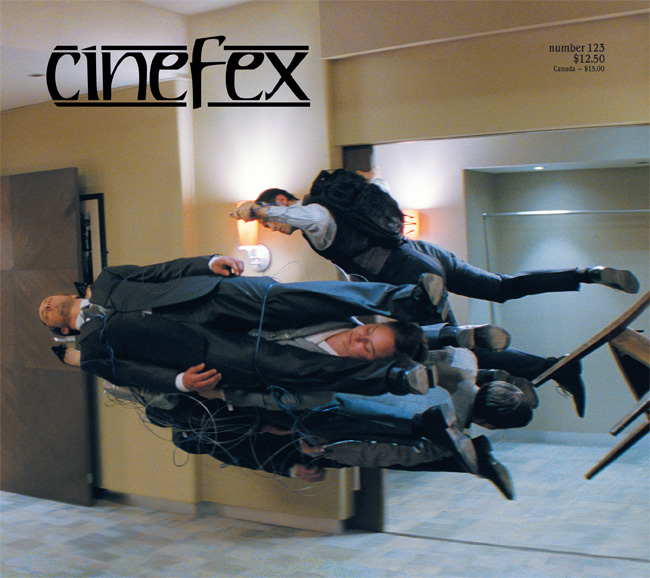
Inception<br>
In Dreams<br>
Article by Joe Fordham<br>
In this sophisticated science fiction thriller, written and directed by Christopher Nolan, a group of covert operatives infiltrates the dreams of unsuspecting victims for the purposes of corporate espionage. The film's extensive use of mind-bending dreamscapes and enhanced realities was achieved through a combination of practical effects by special effects supervisor Chris Corbould, miniatures by New Deal Studio, and digital work by Double Negative, under the guidance of visual effects supervisor Paul Franklin.<br>
Prince of Persia: Sands of Time<br>
Arabian Fantasy<br>
Article by Joe Fordham<br>
Producer Jerry Bruckheimer and director Mike Newell teamed to create Prince of Persia: Sands of Time, a lavish adventure-fantasy set in 6th-century Persia, and based on the popular 1980s Ubisoft videogame. To achieve the film's magical time-bending effects and exotic fantasy realms, Newell turned to special effects supervisor Trevor Wood, who oversaw live-action set pieces, and to visual effects supervisor Tom Wood, who oversaw the work of multiple vendors, including Double Negative, The Moving Picture Company, Cinesite and Framestore.<br>
The A-Team<br>
Plan "A"<br>
Article by Jody Duncan<br>
Adapted from a popular '80s-era television show, and filled with explosive, over-the-top action, The A-Team follows the exploits of a quartet of dishonorably discharged Army Rangers who become a crack covert fighting unit. Director Joe Carnahan relied on visual effects supervisor Jamie Price and an array of vendors that included Rhythm & Hues, Digital Domain, Weta Digital and Hydraulx to ramp up the action in the air and on the ground, in concert with special effects supervisor Mike Vezina's practical gags.<br>
The Last Airbender<br>
Braving the Elements<br>
Article by Jody Duncan<br>
In The Last Airbender, M. Night Shyamalan's live-action feature adaptation of an animated television series, a young boy, equipped with the power to manipulate the elemental forces of air, water, earth and fire, attempts to restore order and balance to a war-ravaged world. Visual effects supervisor Pablo Helman and his team at Industrial Light & Magic served up a vast and wide-ranging menu of digital effects for the mystical fantasy, with an assis
2011
Issue 124
January/February/March 2011
Main Cover

TRON: Legacy<br>
Legacy System<br>
Article by Jody Duncan<br>
For TRON: Legacy, the long-overdue sequel to the 1982 cult favorite, TRON, about a computer programmer who becomes trapped within a videogame's virtual realms, director Joseph Kosinski and visual effects supervisor Eric Barba took advantage of sophisticated digital and stereoscopic imaging techniques to give the film its modern spin. Teams at Digital Domain, Mr. X, Ollin Studio, Prime Focus and Whiskytree generated the spectacular visuals of the sequel's computer gaming world, while Quantum Creation built specialty costumes featuring cutting-edge lighting technology.<br>
Harry Potter and the Deathly Hallows: Part 1<br>
The Last Enemy<br>
Article by Joe Fordham<br>
In this first of a two-part climax, adapted from the seventh and final volume of J.K. Rowling's hugely popular children's book series, wizard Harry Potter and his two best friends roam beyond the walls of Hogwarts in search of the scattered fragments of the evil Lord Voldemort's soul. Returning director David Yates reunited with visual effects supervisor Tim Burke, special effects supervisor John Richardson and makeup effects supervisor Nick Dudman to bring the newest and darkest film in the franchise to fruition. Lending a hand were series veterans Double Negative, The Moving Picture Company, Framestore, Cinesite, Rising Sun Pictures and Baseblack.<br>
The Chronicles of Narnia: The Voyage of the Dawn Treader<br>
Sea Quest<br>
Article by Joe Fordham<br>
Director Michael Apted took the helm of the third film based on the C.S. Lewis' fantasy novels, as the narrative picks up with the Pevensie children joining King Caspian and a band of mythological creatures on a sea voyage to save Narnia. Makeup effects artists at KNB EFX Group and special effects supervisor Brian Cox collaborated with visual effects supervisor Angus Bickerton and teams at The Moving Picture Company, Framestore, Cinesite, The Mill and The Senate to create an array of all-new creatures, fantasy environments and nautical settings.<br>
Hereafter<br>
Visions of the Hereafter<br>
Article by Jody Duncan<br>
To realize an intense and breathtaking simulation of a massive tsunami that destroys an ocean-front resort town in the opening of Hereafter, director Clint Eastwood relied on the expertise of visual effects supervisor Michael Owens, and the work of artists at Scanline, led by visual effects supervisors Stephan Trojansky and Bryan Grill. The effects teams also provided artful glimpses into the afterlife, the exploration of which is the unifying theme of the film's interwoven storylines.
Issue 125
April/May/June 2011
Main Cover
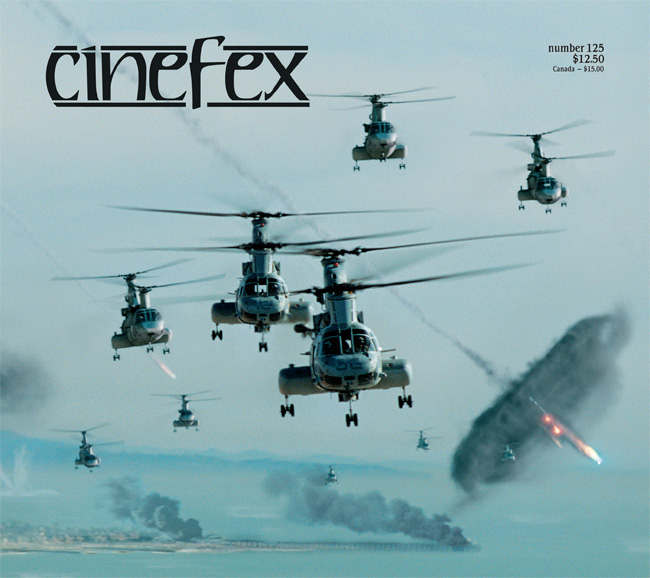
Battle: Los Angeles<br>
Aliens in the City of Angels<br>
Article by Jody Duncan<br>
In Battle: Los Angeles, a documentary-style action film that follows a squad of Marines defending the city of Los Angeles from invading hordes of extraterrestrials, director Jonathan Liebesman presents a gritty view of modern warfare, aided by visual effects supervisor Everett Burrell and an international complement of vendors that included Cinesite, Hydraulx, Luma Pictures, The Embassy, Matte World Digital, Spin VFX and Soho VFX. Makeup effects supervisor Joel Harlow and his crew contributed practical aliens.<br>
Rango<br>
The Good, the Bad and the Dusty<br>
Article by Jody Duncan<br>
Industrial Light & Magic and director Gore Verbinski, joined forces to make their computer-animated feature debut with Rango, a comical tale about a hapless chameleon-turned-hero stranded in a harsh desert environment, who ends up taking a stand against bandits to save a small western town. Verbinski called upon veteran visual effects supervisors John Knoll and Tim Alexander to head the ambitious project, and engaged celebrated concept artist Mark 'Crash' McCreery - in his first credit as production designer - to oversee the film's distinctly un-animated look.<br>
Black Swan<br>
Metamorphosis<br>
Article by Joe Fordham<br>
Director Darren Aronofsky charts the descent into madness of a young prima ballerina, who succumbs to backstage pressures and rivalries during a production of Swan Lake in Black Swan. Using surreal and disturbing imagery to create the manifestations of Nina's hallucinatory decline, Aronofsky called upon frequent collaborator Dan Schrecker to oversee visual effects, and Mike Marino at Prosthetic Renaissance to handle makeup effects. LOOK Effects provided visual effects for the film.<br>
Sucker Punch<br>
Nightmares and Dreamscapes<br>
Article by Jody Duncan<br>
To realize filmmaker Zack Snyder's exotic fantasy Sucker Punch, about a young woman wrongfully incarcerated in a mental asylum who escapes into a succession of alternate realities, production designer Rick Carter and visual effects supervisor John DesJardin brought to life settings both real and imagined, with the help of key vendors Animal Logic, The Moving Picture Company, Pixomondo and Prime Focus. Also assisting in the creation of creatures and effects were special effects supervisor Joel Whist and prosthetic artists at Quantum Creation.
Issue 126
July/August/September 2011
Main Cover
X-Men: First Class<br>
First Class Effects<br>
Article by Jody Duncan<br>
In this franchise 'reboot,' exploring the genesis of X-Men's warring mutant factions, director Matthew Vaughn and visual effects designer John Dykstra devised shots illustrating the super-powers of both new and returning characters, aided by a visual effects contingent comprised of MPC, Cinesite, Weta Digital, Rhythm & Hues, Luma Pictures, Digital Domain and The Senate. Complementing the visual effects were mutant makeups provided by Amalgamated Dynamics Incorporated, makeup artist David Elsey and Spectral Motion.<br>
Thor<br>
God of Thunder<br>
Article by Joe Fordham<br>
Director Kenneth Branagh brings the hammer-wielding Norse deity to life in this action-packed tale based on the popular Marvel Comics series. Under supervisor Wesley Sewell, seven vendors handled the visual effects work, including Whiskytree, BUF Compagnie and Digital Domain, which devised the film's mythic realms, and Luma Pictures, which focused on earthbound effects. Special effects were overseen by Daniel Sudick, while Legacy Effects handled special makeup effects.<br>
Priest<br>
Holy Warriors<br>
Article by Jody Duncan<br>
To depict the stark, alternate-reality world of Priest - the setting for this post-apocalyptic tale about a centuries-long war between man and vampires - director Scott Charles Stewart called upon visual effects supervisor Jonathan Rothbart to oversee the creation of vampires and environments in some 800 shots, divided among an array of effect facilities including Svengali FX, Tippett Studio, The Senate, Spin VFX and Zoic Studios. KNB EFX Group contributed vampire creature suits, makeup effects and dummies.<br>
Source Code<br>
Reality Deconstructed<br>
Article by Joe Fordham<br>
Following his directorial debut with Moon, filmmaker Duncan Jones returns with Source Code, a techno-thriller about a covert operation's use of immersive virtual reality to investigate a terrorist explosion onboard a Chicago commuter train. Special effects supervisor Ryal Cosgrove, makeup effects supervisor Adrien Morot and visual effects supervisor Louis Morin furnished reality-bending effects, with the help of Modus FX, Rodeo FX, MPC, Oblique FX, Fly Studio and Mr. X.
Issue 127
October/November/December 2011
Main Cover

Captain America: The First Avenger<br>
Soldier Blue<br>
Article by Joe Fordham<br>
In this spirited adaptation of Marvel Comics' World-War-II-era comic book, chronicling the transformation of a puny, but patriotic, army reject into a turbo-charged warrior tasked with thwarting the Nazis, director Joe Johnston brings to life period settings and retro high-tech gadgetry with the help of visual effects supervisor Christopher Townsend and more than a dozen vendors led by Double Negative, including Lola VFX, Matte World Digital, Luma Pictures, Framestore, Cinesite, Fuel VFX, Method Studios and The Senate VFX. Paul Corbould supervised special effects and David White guided makeup effects.<br>
Cowboys & Aliens<br>
Invasion of the Body Snatchers<br>
Article by Jody Duncan<br>
Director Jon Favreau blends two classic genres to create this clever sci-fi/western hybrid in which Old West gunslingers, ranchers and Indians join forces to battle aliens from another galaxy that have invaded their small town. Favreau teamed with Industrial Light & Magic and Legacy Effects - with an assist from The Embassy, Shade VFX, New Deal Studios, Fuel VFX and Kerner Optical - to create the film's terrifying aliens, alien ships and hardware, while Daniel Sudick oversaw on-set special effects.<br>
Harry Potter and the Deathly Hallows: Part 2<br>
Wizard War<br>
Article by Joe Fordham<br>
For the eighth and final film in the series, based on the best-selling childrens' books by J. K. Rowling, boy wizard Harry Potter makes a final stand against his lifelong nemesis, Lord Voldemort, with the help of his many friends at Hogwarts School of Witchcraft and Wizardry. To depict the epic battle, returning director David Yates re-teamed with special effects supervisor John Richardson, makeup effects supervisor Nick Dudman and visual effects supervisor Tim Burke, assisted by an army of effects artisans that encompassed thirteen visual effects vendors and seven facilities involved in stereoscopic conversion.<br>
Anonymous<br>
This Realm, This England<br>
Article by Jody Duncan<br>
Best known for his sci-fi/disaster films, director Roland Emmerich shuns cinematic pyrotechnics in favor of Elizabethan-era political intrigue and character-driven drama in Anonymous. To capture the film's Shakespearean-era settings, Emmerich relied on extensive use of greenscreens and cutting-edge digital technology, calling upon visual effects supervisors Marc Weigert and Volker Engel of Uncharted Territory - his filmmaking collaborators for more than two decades - to provide the photorealistic computer generated environments.
2012
Issue 128
January/February/March 2012
Main Cover

Real Steel<br>
Steel Works<br>
Article by Jody Duncan Jesser<br>
To create the robotic stars of Real Steel, set in a near-future world where professional boxing has been relegated to mechanical pugilists, director Shawn Levy relied on a seamless blend of practical and digital effects, with John Rosengrant and his team at Legacy Effects providing full-size animatronic puppets, while visual effects supervisor Erik Nash and a crew at Digital Domain devised their CG counterparts. Also lending a hand were Giant Studios, which motion-captured live performers in choreographed fights to provide critical data for the animators, and Glenn Derry's Video Hawks, which supplied virtual cameras and Simulcam setups for the complex fight action.<br>
Rise of the Planet of the Apes<br>
Render Unto Ceasar<br>
Article by Joe Fordham<br>
In this prequel to the popular franchise inspired by Pierre Boulle's science fiction novel about intelligent apes that rise up against their human captors, director Rupert Wyatt broke with tradition, abandoning the practical simian makeups of the previous ape films in favor of an all-digital approach. Weta Digital, under the supervision of Joe Letteri and Dan Lemmon, rose to the challenge, generating super-chimp Caesar and armies of photorealistic apes with the help of on-set motion capture of ape actors led by veteran mocap performer Andy Serkis and motion choreographer Terry Notary.<br>
Hugo<br>
Man in the Moon<br>
Article by Joe Fordham<br>
For his latest film, based on Brian Selznick's illustrated children's novel about a young boy who befriends once-great cinema pioneer Georges Meliθs, now living a reclusive life as a toymaker in 1920s Paris, director Martin Scorcese reunited with frequent collaborator Robert Legato who oversaw the visual effects needed to create lush period environments in stereoscopic 3D. Pixomondo served as primary visual effects vendor, aided by Uncharted Territory, ILM, Matte World Digital, and miniature effects provider New Deal Studios. Joss Williams handled special effects.<br>
The Tree of Life<br>
Creationisms<br>
Article by Jody Duncan Jesser<br>
To achieve a 22-minute long sequence featuring the creation of the universe through a series of stunning and scientifically sound images in The Tree of Life, director Terrence Malick melded old-school techniques by filmmaking pioneer Douglas Trumbull with digital effects orchestrated by visual effects supervisor Dan Glass and crews at Prime Focus, Double Negative, One of Us and Method Studios.
Issue 129
April/May/June 2012
Main Cover

John Carter<br>
Under the Moons of Mars<br>
Article by Joe Fordham<br>
Walt Disney Studios and director Andrew Stanton join forces for an adaptation of Edgar Rice Burroughs' pulp fiction adventure series about a Civil War veteran mysteriously whisked to Mars who becomes deeply entrenched in the affairs of its bizarre inhabitants. Legacy Effects provided creature designs and maquettes, while special effects supervisor Chris Corbould handled in-camera work. Visual effects supervisors Peter Chiang and Sue Rowe oversaw creature animation and environmental enhancements from principal vendors Double Negative, Cinesite and MPC.<br>
Red Tails<br>
The Long, Long War<br>
Article by Jody Duncan Jesser<br>
A pet project of producer George Lucas for 20 years, Red Tails is based on the real-life experiences of the Tuskegee airmen, a segregated squadron of African-American fighter pilots that distinguished itself during World War II. Industrial Light & Magic set the standard for the film's dynamic and authentic-looking aerial combat scenes, producing its own slate of shots, and coordinating the work of an international effects contingent that included Universal Production Partners, Pixomondo, Rodeo FX, Rising Sun Pictures and Ollin Studio.<br>
Mission: Impossible - Ghost Protocol<br>
Ingenious<br>
Article by Jody Duncan Jesser<br>
In this fourth, and most ambitious of the 'Mission: Impossible' films, the Impossible Missions Force executes a bold plan to clear its name after being blamed for a massive explosion at the Kremlin. Director Brad Bird ramps up the action with spectacular sequences calling for state-of-the-art work from Industrial Light & Magic, Fuel VFX, Rodeo FX, AFX Studio and other vendors around the world, led by visual effects supervisor John Knoll. Adding to the thrill quotient were daring stunts by Tom Cruise, and practical effects supervised by Mike Meinardus.<br>
The Adventures of Tintin<br>
A Thirst for Adventure<br>
Article by Joe Fordham<br>
Steven Spielberg and Peter Jackson join forces to present an animated take on the illustrated adventures of boy reporter Tintin and his wire-haired terrier, Snowy - iconic characters in the French-language comic strip series by Georges Remi, aka Herge. Directed by Spielberg, this first in a planned trilogy combines several Tintin tales into an origin story, realized by performers on motion capture stages and brought to life in stereographic computer animation by Weta Digital and Giant Studios.
Issue 130
July/August/September 2012
Main Cover

<table border='1' align='left'><tr><td align=center>
<a id='thumb1' href='../pics/c/cinefex130b.jpg' class='highslide' onclick='return hs.expand(this)'>
<img src='../pics/c/cinefex130b.jpg' height='200' alt='highslide js'='click to enlarge' /></a>
<div class='highslide-caption'>
</div><br>
2nd cover
</td></tr></table>
The Avengers: The Avengers Initiative<br>
Article by Jody Duncan Jesser<br>
Six of Marvel Comics' iconic superheroes - Captain America, Iron Man, Hulk, Hawkeye, Thor and Black Widow - come together in a clash of egos and machismo to thwart Thor's power-hungry brother Loki, who plots to enslave Earth's inhabitants with an invading alien army. Director Joss Whedon called upon visual effects supervisor Janek Sirrs and industry powerhouses Industrial Light & Magic and Weta Digital, aided by a dozen supporting vendors around the globe, to deliver the film's delightful blend of mayhem and humor.<br>
Prometheus: Alien Genesis<br>
Article by Joe Fordham<br>
Filmmaker Ridley Scott returns to the science fiction genre with Prometheus, picking up the threads of his Alien mythology with yet another nightmarish tale in which a deep-space exploration team is sent to probe the origins of life on a distant planetoid. Visual effects supervisor Richard Stammers and creature and makeup effects designers Neal Scanlan and Conor O'Sullivan joined forces with MPC, Weta Digital, Fuel VFX, Luma Pictures and other vendors to bring the alien world, its futuristic technology and terrifying inhabitants to life.<br>
Battleship: War Games<br>
Article by Joe Fordham<br>
Peter Berg directs this ocean-going sci-fi war film, in which Navy seamen battle malevolent extraterrestrial spacecraft that rise from the ocean floor to wreak widespread havoc. Industrial Light & Magic visual effects supervisors Pablo Helman and Grady Cofer led the effort to create naval hardware, alien vessels and creature effects with an eye toward a gritty realism. Contributing vendors included Image Engine, Scanline VFX, New Deal Studios and The Embassy Visual Effects, while Burt Dalton handled special effects.<br>
Snow White and the Huntsman: Grim Fairy Tale<br>
Article by Jody Duncan Jesser<br>
Veteran commercial director Rupert Sanders makes his feature film debut with this lush, artistic adventure based on the classic Snow White fairy tale. Relying on old-school practical techniques in combination with visual effects to realize many of the film's fantasy elements, Sanders brings his vision to the screen with the help of visual effects supervisors Cedric Nicolas-Troyan and Phil Brennan, and more than a half-dozen vendors, including Legacy Effects, Digital Domain, Double Negative, Pixomondo, Lola Visual Effects, Baseblack, The Mill and Rhythm & Hues.
Issue 131
October/November/December 2012
Main Cover

The Dark Knight Rises: A Farewell to Arms<br>
Article by Jody Duncan<br>
For the final dazzling installment of his epic 'Dark Knight Trilogy,' director Christopher Nolan pulls out all the stops as Batman faces a ruthless mercenary and his most formidable opponent in an existential battle for Gotham. Relying heavily on in-camera effects, Nolan called upon special effects veteran Chris Corbould to orchestrate a range of spectacular effects sequences for the film, while Double Negative, under the guidance of visual effects supervisor Paul Franklin, contributed equally stunning imagery to realize Batman’s complex world.<br>
The Amazing Spider-Man: Return of the Webslinger<br>
Article by Joe Fordham<br>
In this reboot of the popular franchise featuring Marvel Comics’ web-slinging superhero, director Marc Webb steps in with an all-new cast to explore Spider-Man's origins as Peter Parker, and his entanglements with a reptilian shape-shifter known as The Lizard. Sony Pictures Imageworks reprised its role as lead visual effects house on the film, with oversight from senior visual effects supervisor Jerome Chen and animation supervisor Randall William Cook, and a host of supporting visual effects vendors. In-camera illusions were the work of special effects supervisor John Frazier, stunt coordinator Vic Armstrong and Legacy Effects.<br>
Total Recall: Recall Redux<br>
Article by Jody Duncan<br>
Colin Farrell assumes Arnold Schwarzenegger’s role as Douglas Quaid in a remake of the 1990 blockbuster, based on a futuristic tale by Philip K. Dick about a man who discovers that his memories are not his own, but have been implanted by sinister forces. Director Len Wiseman updated the original film's optical effects with a startling digital re-imagining of a futuristic, post-Apocalyptic world, delivered by lead effects house Double Negative and a supporting array of boutique vendors that included The Senate, Baseblack, Prime Focus, Lipsync VFX and MPC. Legacy Effects provided suits for an army of robotic police.<br>
Abraham Lincoln: Vampire Hunter: Slayer in Chief<br>
Article by Joe Fordham<br>
Director Timur Bekmambetov brings novelist Seth Grahame-Smith’s satirical take on the life and times of America's 16th president to the big screen in this tongue-in-cheek horror film depicting Lincoln as fearless slayer of an insidious vampire sect responsible for enslaving the South. Special effects supervisor Matthew Kutcher and makeup effects supervisor Greg Cannom created Civil War battles and vampire effects, while visual effects supervisors Craig Lyn and Michael Owens oversaw period enhancements and stylized monster mayhem by more than a dozen vendors worldwide, including Weta Digital, Rodeo FX, Soho VFX, Method Studios, CGF and Spin VFX.
2013
Issue 132
January/February/March 2013
Main Cover

The Hobbit: An Unexpected Journey<br>
There and Back Again<br>
Article by Jody Duncan<br>
In this first installment in a planned three-part prequel, director Peter Jackson takes us back to J.R.R. Tolkien's Middle-earth and a young Bilbo Baggins, who joins up with 13 dwarves in a quest to reclaim stolen treasure from the dragon Smaug. As he did in Lord of the Rings, Jackson collaborated closely with his effects teams at Weta Digital and Weta Workshop, with the latter providing dwarf designs and prosthetics, while the former offered up extensive digital environments for the film’s many fantasy settings, as well as dwarf scale effects and a state-of-the-art Gollum that benefitted from improvements in on-set performance capture and other technological advances in animation.<br>
Cloud Atlas<br>
Causes and Consequences<br>
Article by Barbara Robertson<br>
Adapted by filmmakers Lana and Andy Wachowski and Tom Tykwer from a from a sprawling novel by David Mitchell, Cloud Atlas covers six intersecting stories, and spans continents and time periods as it follows the transformation of a single soul through many lifetimes. The film's sweeping storyline relied on prosthetic makeup effects by Jeremy Woodhead and Daniel Parker, as well as countless visual effects divided among fifteen vendors worldwide, led by visual effects supervisors Dan Glass and Stephane Ceretti, who provided everything from set extensions and enhancements to full CG environments for a futuristic metropolis.<br>
Life of Pi<br>
The Calculus of Pi<br>
Article by Jody Duncan<br>
Ang Lee directs the film adaptation of Yann Martel’s award-winning novel about an Indian boy, Pi Patel, who, as sole survivor of a shipwreck that takes the life of his entire family, finds himself adrift at sea for many months in a small lifeboat shared with a Bengal tiger. Visual effects supervisors Bill Westenhofer worked with animation experts at Rhythm & Hues to achieve an utterly convincing computer generated tiger, who progresses from healthy to emaciated, while Legacy Effects provided animatronics support. Other contributing vendors included MPC, Crazy Horse Effects, LOOK Effects, Christov Effects, Buf, Lola VFX and Halon Entertainment.<br>
Beasts of the Southern Wild<br>
Q&A: Ray Tintori<br>
Interview by Janine Pourroy<br>
In this in-depth Q&A, special effects unit director Ray Tintori sheds light on how the makers of this Cannes and Sundance Film Festival favorite, about a young child who fights to survive poverty and Mother Nature on a storm-threatened atoll, realized the film's principal effect — the mythical ‘aurochs’ beasts — on a shoestring budget, through the use of creative and quirky practical solutions.
Issue 133
April/May/June 2013
Main Cover

Oz: The Great and Powerful: Tempests and Teapots<br>
Article by Jody Duncan<br>
In this prequel to The Wizard of Oz, a conman's illusionist powers are put to the test when he is magically transported to the enchanted Emerald City, and runs afoul of three witches. Director Sam Raimi shot the film entirely on sound stages with help from special effects supervisor John Frazier, while visual effects supervisor Scott Stokdyk brought magical realms to life with the aid of Sony Pictures Imageworks, Luma Pictures, Evil Eye and Digiscope.<br>
Jack the Giant Slayer: Giant Steps<br>
Article by Joe Fordham<br>
Director Bryan Singer rejuvenates an ancient English folktale in this film about a medieval farmboy who unwittingly causes a gargantuan beanstalk to grow up into the clouds, unleashing a fearsome race of giants who inhabit a vast floating island in the sky. Visual effects supervisor Hoyt Yeatman worked with Digital Domain to realize the giants with state-of-the-art performance capture, and with MPC, Rodeo FX, Soho VFX and Hatch to create fantasy environments and other effects.<br>
Skyfall: Old Dog, New Tricks<br>
Article by Joe Fordham<br>
James Bond returns for his 23rd screen adventure in this high-octane caper involving a sinister cyber-terrorist with a grudge against the international spy community. Director Sam Mendes energized the film with a bold blend of full-scale practical effects engineered by special effects supervisor Chris Corbould, along with miniature and digital effects provided by visual effects supervisor Steven Begg and a host of vendors that included MPC, Cinesite, Double Negative, Framestore, Peerless Camera Company and others.<br>
Les Misérables: At the Barricade<br>
Article by Jody Duncan<br>
A beloved stage musical is given new life on the big screen in this film adaptation of Victor Hugo’s classic novel Les Misérables. Director Tom Hooper imbued the film with a gritty realism rarely exhibited in the musical genre, calling upon artists at Double Negative, The Mill and Utopia VFX to expand the scope of the production by digitally extending stage sets to authentically replicate 18th-century Parisian street scenes and other period settings.
Issue 134
July/August/September 2013
Main Cover

Issue 135
October/November/December 2013
Main Cover
2014
Issue 136
January/February/March 2014
Main Cover
Issue 137
April/May/June 2014
Main Cover
The Hobbit: The Desolation of Smaug<br>
Pete's Dragon<br>
Article by Joe Fordham<br>
Filmmaker Peter Jackson continues his epic trilogy, following plucky hobbit Bilbo Baggins to his fateful encounter with Smaug the Terrible, an ancient dragon that resides in the dwarf kingdom of Erebor. Special effects supervisor Steve Ingram, Weta Workshop creature designer Richard Taylor, senior visual effects supervisor Joe Letteri and crews at Weta Digital return to the Middle-earth of J.R.R. Tolkien, creating skin-shifter Beorn, giant arachnid denizens of Mirkwood, elven woodland realms, the Lake-town of Esgaroth and the subterranean terrors of the Lonely Mountain.<br>
Game of Thrones<br>
Songs of Ice and Fire<br>
Article by Jody Duncan<br>
Based on the bestselling books by George R.R. Martin, the award-winning HBO series has won legions of fans with its multi-faceted tale of power won and lost in the fictional land of Westeros. The show's epic environments and mythical creatures required visual effects of a scope and level of excellence rarely seen in episodic television. Interviews with visual effects supervisor Joe Bauer and artists from Pixomondo, BlueBolt, Screen Scene, Spin VFX, Gradient VFX, Entity VFX, Look Effects and Peanut FX take you behind the scenes of the Game of Thrones phenomenon.<br>
RoboCop<br>
RoboCop Retooled<br>
Article by Jody Duncan<br>
Twenty-seven years after director Paul Verhoeven introduced the futuristic cyborg crime-fighter, Robocop, director José Padilha tackles a retelling of the story. Whereas the original featured only old-school optical and practical effects, the updated Robocop relies on an artful combination of masterful practical suits and makeup effects by Legacy Effects, and visually stunning digital effects shots executed by Framestore, Method Studios, Soho VFX, Mr. X, Modus FX yU+Co and Cinesite.<br>
The Secret Life of Walter Mitty<br>
Beautiful Dreamer<br>
Article by Joe Fordham<br>
Humorist James Thurbe's slender tale of daydreaming underachiever Walter Mitty, previously filmed in 1947 as a zany romp starring Danny Kaye, is updated as a wry and charming modern-day romantic fantasy starring and directed by Ben Stiller. Visual effects supervisor Guillaume Rocheron and special effects supervisor Mark Hawker bring Mitty's whimsies to life with a wealth of vendors, including Framestore, MPC, LOOK Effects, Hydraulx, Soho VFX, Hatch, Lola Visual Effects, Mr. X, Method Studios, Rhythm & Hues, Phosphene, Company 3 and Blind Squirrel. Mike Marino's Prosthetic Renaissance provided special makeup effects.
Issue 138
July/August/September 2014
Main Cover
Issue 139
October/November/December 2014
Main Cover

2015
Issue 140
January/February/March 2015
Main Cover
Interstellar: That Our Feet May Leave<br>
Article by Jody Duncan<br>
Christopher Nolan directs Matthew McConaughey, Anne Hathaway and Jessica Chastain in an adventure story about interstellar space travel. Co-written by Nolan and brother Jonathan, the film is a journey of discovery, realized in part through stunning visual effects images created by Double Negative. As he had with the Dark Knight Trilogy and other films, however, Nolan sought to capture as much action as possible in-camera, with on-set special effects orchestrated by Scott Fisher, and other practical effects by New Deal Studios.<br>
Exodus: Gods and Kings: Gods and Kings<br>
Article by Jody Duncan<br>
Christian Bale, Sigourney Weaver and Aaron Paul star in director Ridley Scott's retelling of the biblical account of Moses leading the Israelites out of bondage in Egypt. Spain and Mexico stood in for Egypt throughout filming. Double Negative provided visual effects to imbue the film with a grandeur and epic scale befitting its source material, with additional effects support from MPC, The Senate, Method Studios and The Third Floor.<br>
The Zero Theorem: Nowhere Man<br>
Article by Joe Fordham<br>
A neurotic computer genius (Christoph Waltz), employed by a vast futuristic company named Mancrom, attempts to find a mathematical formula that may lead to the meaning of life, but instead falls in love with a beautiful avatar (Mélanie Thierry) and slowly loses his mind. Filmmaker Terry Gilliam brings his idiosyncratic visual flair to create a nightmarish technological world and phantasmagoric landscapes working with production designer David Warren, special effects supervisor Nick Allder, and visual effects supervisors Felix Lepadatu, Jonah Loop and Fredrik Nord at LenscareFX, Haymaker, The Chimney Pot Group and Bold Turtle Productions.<br>
Q&A: Tom Woodruff Jr. and Alec Gillis<br>
Article by Joe Fordham<br>
An in-depth look into the history and more recent adventures of special makeup effects designers and creature creators Tom Woodruff Jr. and Alec Gillis, co-founders of Amalgamated Dynamics, Incorporated. Woodruff and Gillis discuss their backgrounds in the burgeoning 1980s creature effects industry, early assignments at Stan Winston Studio, and their creative partnership that has spanned 25 years, encompassing Death Becomes Her, Starship Troopers, Tremors, multiple Alien films, and more recently Fire City: The Interpreter of Signs and Harbinger Down — a pair of independent monster movies, wrought with passion and 'crowdfunded' resources, that mark Woodruff's and Gillis' feature directing debuts.
Issue 141
April/May/June 2015
Main Cover

Issue 142
July/August/September 2015
Main Cover

Issue 143
Fall 2015
Main Cover
Ant-Man<br>
Microcosmos<br>
Article by Joe Fordham<br>
Disney and Marvel Studios introduce the latest character to the Marvel Comics Universe with biochemist Dr. Hank Pym (Michael Douglas), a former crimefighter who recruits cat burglar Scott Lang (Paul Rudd) to battle a rival weapons manufacturer in the development of a serum that can shrink a protagonist to ant size, imbuing microscopic combatants with super powers. Visual effects supervisor Jake Morrison and visual effects producer Diana Giorgiutti explored Lang's action-packed adventures in the microcosm along with artists at Double Negative, Method Studios, Luma Pictures, Industrial Light & Magic, Cinesite, Lola VFX and The Third Floor.<p>
Terminator Genisys<br>
Wrinkles in Time<br>
Article by Jody Duncan<br>
Alan Taylor directs the fifth entry in the Terminator franchise launched by James Cameron in 1984. In the new film, an alternate timeline reunites characters Sarah Connor (Emilia Clarke), her son John Conner (Jason Clarke) and Kyle Reese (Jai Courtney). At the heart of the action/adventure are dueling Terminators, including the aging T-800 (Arnold Schwarzenegger) from the first two Terminator films. Visual effects supervisor Janek Sirrs oversaw approximately 1,200 visual effects shots generated at Double Negative, MPC, Lola VFX, One of Us, and Method Studios. Special effects supervisor Mark Hawker provided on-set effects, while Legacy Effects continued its long history with the franchise, building practical endoskeletons.<p>
Mission: Impossible — Rogue Nation<br>
Keeping it Real<br>
Article by Jody Duncan<br>
Tom Cruise returns as IMF agent Ethan Hunt in this fifth entry in the phenomenally successful run of Mission Impossible films, based on the '60s-era television series. In the film, written and directed by Christopher McQuarrie, the IMF team is targeted for destruction by an equally ingenious and well-trained 'Syndicate,' requiring its most audacious feats of espionage and daring to date — matched by stunts and effects orchestrated by stunt coordinator Wade Eastwood and special effects supervisor Dominic Tuohy. Double Negative generated visual effects, under the guidance and direction of visual effects supervisor David Vickery.<p>
The Walk<br>
Skywalker<br>
Article by Joe Fordham<br>
Sony Pictures and Columbia Tristar present filmmaker Robert Zemeckis' gripping dramatization of the true story of Philippe Petit (Joseph Gordon-Levitt), a French high-wire artist who in 1974 attempted to walk a steel cable strung between the Twin Towers of the World Trade Center. Visual effects supervisor Kevin Baillie and special effects supervisor Ryal Cosgrove provided enhancements to wire-walking environments, which Zemeckis and his production team conjured in IMAX 3D, assisted by visual effects artists at Atomic Fiction, Rodeo FX and UPP, and vertiginous stereographic conversions handled at Legend 3D.
Issue 144
December 2015
Main Cover
The Martian
An Abundant Solitude
Article by Jody Duncan,<br>
Director Ridley Scott helms 20th Century Fox's screen adaptation of The Martian, the bestselling novel by Andy Weir. In the story, astronaut Mark Watney (Matt Damon) is presumed dead by his crew and left stranded alone on the surface of Mars. Exhibiting extraordinary courage and ingenuity, Watney manages to stay alive on the hostile planet and, eventually, to resume contact with NASA, which — working with agencies around the world — launches an ambitious and high-risk mission to bring Watney home. Visual effects supervisor Richard Stammers oversaw the film's 1,100-shot visual effects assignment, which called upon the concerted efforts of MPC, Framestore, The Senate and others to create alien Red Planet environments, large-scale dust storms, various earthbound locations, and suspenseful, dynamic space shots. Special effects supervisor Neil Corbould orchestrated the film's practical, in-camera effects.<br>
In the Heart of the Sea
High Seas Drifter
Article by Jody Duncan<br>
Ron Howard directs this film, starring Chris Hemsworth, about the attack of the whaling ship Essex by a monstrously large and aggressive sperm whale that results in the loss of the ship and most of her crew. The true and tragic tale was the inspiration for Herman Melville's 19th century classic, Moby-Dick. The film's big whale and seafaring action were realized, in part, through visual effects supervised by Jody Johnson and delivered by Double Negative, while Rodeo FX extended art department sets representing 19th century Nantucket, Massachusetts. Special effects supervisor Mark Holt engineered gimbals to simulate a full-scale Essex set at sea, and also created in-camera storm effects, augmented to a raging squall by Scanline.<br>
Crimson Peak
A Monstrous Love
Article by Joe Fordham<br>
Filmmaker Guillermo del Toro brings his stylish take to a Gothic horror story, set in a crumbling mansion in Victorian northern England, where a young newlywed (Mia Wasikowska) discovers that her charming, sophisticated husband (Tom Hiddleston) and his cold-hearted sister (Jessica Chastain) are harboring supernatural secrets. Special effects supervisor Laird McMurray provided practical on-set effects, along with makeup effects supervisor David Marti and DDT Efectos Especiales. Visual effects supervisor Dennis Berardi and visual effects producer Jo Hughes supplied apparitions and otherworldly phenomena at Toronto visual effects studio, Mr. X.<br>
Everest
The Death Zone
Article by Joe Fordham<br>
Universal Pictures presents a gripping account of a mountain-climbing expedition that, in 1996, attempted to scale the world's tallest peak and instead met with tragedy and terror. Director Baltasar Kormákur retraced the ill-fated journey on locations in the Himalayas and the Dolomites, and studios in Rome and London. Makeup and hair designer Jan Sewell and special effects supervisor Richard Van Den Bergh assisted the production with visual effects supervisor Daði Einarsson, visual effects producer Roma O'Connor and artists at Reykjavík Visual Effects, Framestore, Important Looking Pirates, One of Us, Union Visual Effects, Milk VFX and Stereo D.
2016
Issue 145
February/March 2016
Main Cover

Issue 146
April/May 2016
Main Cover

Batman v Superman: Dawn of Justice: When Gods Collide<br>
Director Zack Snyder sets the stage for combat with production designer Patrick Tatopoulos, visual effects supervisor John DesJardin and special effects supervisor Joel Whist, with other practical effects supplied by Ironhead Studio, Film Illusions and Vehicle Effects, along with visual effects pugilists at Scanline VFX, MPC, Weta Digital, Double Negative, Shade VFX, Teamworks Digital, The Resistance VFX and Gentle Giant Studios.<br>
Deadpool: Smart-Mouthed Glory<br>
In his feature directing debut, Tim Miller helms Deadpool, starring Ryan Reynolds as Marvel's outrageous anti-hero, who gains accelerated healing powers following an unauthorized military experiment. Deadpool's unique blend of violent action and dark humor is brought to the screen with the help of artists at Luma Pictures, Image Engine, Digital Domain, Rodeo FX, Ollin VFX, Atomic Fiction and Digiscope, under the supervision of visual effects supervisor Jonathan Rothbart, with practical duties performed on set by special effects supervisor Alex Burdett and makeup effects supervisor Bill Corso.<br>
Hail, Caesar! :History in the Making<br>
Directors Joel and Ethan Coen transport audiences to the Technicolor world of the 1950s with the quirky Hail, Caesar!, in which Hollywood fixer Eddie Mannix tries everything in his power to keep a movie studio's wayward stars in line. With an all-star cast including George Clooney, Josh Brolin, Scarlett Johansson and Channing Tatum, Hail, Caesar! sees visual effects supervisor Dan Schrecker and artists at Psyop, together with special effects supervisor Steve Cremin, using effects techniques both old and new to re-create the cinematic magic of a bygone era.<br>
The 5th Wave: Cassie's World<br>
Sony Pictures Entertainment and director J Blakeson bring author Rick Yancey's popular novel series to the screen. Starring Chloë Grace Moretz and Liev Schreiber, the film follows Cassie Sullivan, a young woman struggling to survive the latest in the waves of alien invasion as she searches for her lost brother. The production required interesting special makeup effects by Mark James Ross, as well as a variety of high-end visual effects by Shade VFX, Scanline VFX, Spin VFX, Clearcut FX, Method Studios, The Embassy and Mammal Studios.<br>
Gods of Egypt: Q&A: Eric Durst<br>
Visionary director Alex Proyas conjures a magical world inspired by the mythology of Ancient Egypt. In this special Q&A, visual effects supervisor Eric Durst talks gods, monsters and the truly monumental 2,550-shot workload shared between Iloura, Rising Sun Pictures, Cinesite, Tippett Studio, Rodeo FX, Fin VFX, Raynault VFX, UPP, Makeshift VFX, Comen VFX and Crafty Apes, working from extensive previs by Proof, Inc.
Issue 147
June/July 2016
Main Cover

Issue 148
August/September 2016
Main Cover
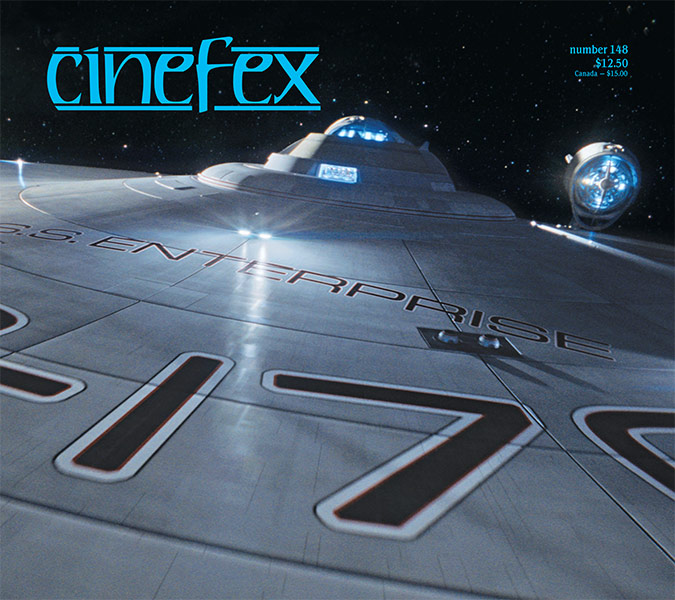
Issue 149
October/November 2016
Main Cover

Issue 150
December 2016
Main Cover